คำค้นหา : ด้านสุขภาพ

คำค้นหา : ด้านสุขภาพ

คำนี้ค้นหามาแล้ว : 435 ครั้ง
เงินภาษี 2% คุ้มค่าแค่ไหน? สสส. กับผลลัพธ์ 25 ปีของการควบคุมเครื่องดื่มแอลกอฮอล์ในประเทศไทย
https://cas.or.th/content?id=1149
Tags : -

เงินภาษี 2% คุ้มค่าแค่ไหน? สสส. กับผลลัพธ์ 25 ปีของการควบคุมเครื่องดื่มแอลกอฮอล์ในประเทศไทย

เงินภาษี 2% ที่จัดสรรให้สำนักงานกองทุนสนับสนุนการสร้างเสริมสุขภาพ (สสส.) ไม่ได้เป็นเพียงงบประมาณสำหรับการรณรงค์ แต่เป็นการลงทุนเพื่อพัฒนาระบบสุขภาพ สร้างองค์ความรู้ สนับสนุนมาตรการทางกฎหมายและนโยบาย ตลอดจนขับเคลื่อนความร่วมมือจากทุกภาคส่วน เพื่อป้องกันและลดผลกระทบจากการบริโภคเครื่องดื่มแอลกอฮอล์ในประเทศไทย

ตลอด 25 ปีที่ผ่านมา การดำเนินงานด้านการควบคุมเครื่องดื่มแอลกอฮอล์ครอบคลุมตั้งแต่การสร้างความตระหนักรู้ในสังคม การรณรงค์ลด ละ เลิกดื่ม การพัฒนาระบบดูแลผู้มีปัญหาการดื่ม การผลักดันกฎหมาย ไปจนถึงการสร้างหลักฐานเชิงประจักษ์เพื่อสนับสนุนการตัดสินใจเชิงนโยบายและความร่วมมือระดับนานาชาติ


1. ผลประเมินแผนควบคุมแอลกอฮอล์ พ.ศ. 2561–2565

ผลการประเมินแผนควบคุมเครื่องดื่มแอลกอฮอล์ พ.ศ. 2561–2565 สะท้อนผลประโยชน์ทางเศรษฐศาสตร์และความก้าวหน้าของตัวชี้วัดที่เกี่ยวข้องกับการดำเนินงาน

  • ผลประโยชน์ทางเศรษฐศาสตร์: เงินลงทุน สสส. 1,540 ล้านบาท ได้รับผลประโยชน์ทางเศรษฐศาสตร์ 9,444 ล้านบาท

  • อัตราผลประโยชน์ต่อเงินลงทุน: เงินลงทุน 1 บาท สร้างผลประโยชน์ที่ประเมินได้ 6.13 บาท

  • ตัวชี้วัดที่มีผลการดำเนินงานดีขึ้น: 32 จาก 41 ตัว หรือร้อยละ 78

ผลประโยชน์ที่ประเมินได้จำแนกตามประเภท

  • การลดการดื่มเครื่องดื่มแอลกอฮอล์: 6,133 ล้านบาท หรือร้อยละ 64.9

  • การลดอุบัติเหตุ: 2,519 ล้านบาท

  • การลดโรคและความรุนแรง: 651 ล้านบาท

  • งานประเพณีและพื้นที่ปลอดเหล้า: 141 ล้านบาท

หมายเหตุ: ตัวเลขผลประโยชน์เป็นการประเมินทางเศรษฐศาสตร์ ไม่ใช่เงินสดที่รัฐได้รับคืนโดยตรง


2. สสส. นำเงิน 2% ไปทำอะไรบ้าง? 5 กลยุทธ์หลักตลอด 25 ปี

2.1 รณรงค์ให้คนลด ละ เลิกดื่ม

การรณรงค์งดเหล้าเข้าพรรษาเป็นหนึ่งในกลไกสำคัญที่ส่งเสริมการปรับเปลี่ยนพฤติกรรมการบริโภคเครื่องดื่มแอลกอฮอล์ในระดับประชากร

ผลการศึกษาพบว่า ปริมาณการบริโภคแอลกอฮอล์ลดลงประมาณร้อยละ 10 ในช่วงรณรงค์ เมื่อเปรียบเทียบกับแนวโน้มตามปกติ ขณะที่ข้อมูลปี พ.ศ. 2568 ระบุว่ามีผู้ร่วมงดตลอดช่วงเข้าพรรษา 8.6 ล้านคน โดยมีผู้ที่งดตลอดช่วงเข้าพรรษา 4.5 ล้านคน และครัวเรือนประหยัดค่าใช้จ่ายได้ประมาณ 14,949 ล้านบาทในช่วง 3 เดือน

นอกจากนี้ ค่านิยมการให้เครื่องดื่มแอลกอฮอล์เป็นของขวัญลดลงจากร้อยละ 30.2 เหลือร้อยละ 9 ภายหลังการรณรงค์ “ให้เหล้าเท่ากับแช่ง” ในช่วง พ.ศ. 2551–2560

2.2 สร้างระบบช่วยเหลือผู้มีปัญหาการดื่ม

การควบคุมเครื่องดื่มแอลกอฮอล์ไม่ได้จำกัดอยู่ที่การป้องกันและการรณรงค์เท่านั้น แต่ยังครอบคลุมการพัฒนาระบบบริการสุขภาพเพื่อช่วยเหลือผู้มีปัญหาการดื่มอย่างต่อเนื่อง

การดำเนินงานประกอบด้วยการสนับสนุนแผนงานพัฒนาระบบการดูแลผู้มีปัญหาการดื่มสุรา (ผรส.) การพัฒนาระบบบริการตั้งแต่โรงพยาบาลส่งเสริมสุขภาพตำบลจนถึงโรงพยาบาลระดับตติยภูมิ การสนับสนุนการคัดกรองปัญหาการดื่ม ตลอดจนการพัฒนาศักยภาพบุคลากรสาธารณสุขและแนวปฏิบัติที่เกี่ยวข้อง

จำนวนผู้ได้รับการคัดกรอง 262,355 คน และการคัดกรองในกลุ่มต่าง ๆ จำนวน 10.3 ล้านคนในปี พ.ศ. 2562

2.3 ผลักดันกฎหมายและนโยบาย

สสส. มีบทบาทสนับสนุนการขับเคลื่อนนโยบายควบคุมเครื่องดื่มแอลกอฮอล์ผ่านความร่วมมือของภาครัฐ ภาควิชาการ ภาคประชาสังคม และเครือข่ายที่เกี่ยวข้อง โดยใช้แนวคิด “สามเหลี่ยมเขยื้อนภูเขา” เป็นกรอบหนึ่งในการเชื่อมโยงพลังจากหลายภาคส่วน

การดำเนินงานครอบคลุมการสนับสนุนการพัฒนากฎหมาย การเสริมศักยภาพหน่วยงานที่เกี่ยวข้อง และการสร้างหลักฐานเชิงประจักษ์เพื่อประเมินมาตรการควบคุม เช่น มาตรการภาษีและการกำหนดเวลาจำหน่ายเครื่องดื่มแอลกอฮอล์ ข้อมูลเหล่านี้มีความสำคัญต่อการพิจารณาทางเลือกเชิงนโยบายที่คำนึงถึงผลกระทบต่อสุขภาพและสังคม

2.4 สร้างหลักฐานและองค์ความรู้

การวิจัยและข้อมูลที่มีคุณภาพเป็นรากฐานสำคัญของการกำหนดนโยบายควบคุมเครื่องดื่มแอลกอฮอล์ สสส. สนับสนุนการพัฒนาองค์ความรู้ผ่านหน่วยงานวิจัยและเครือข่ายวิชาการ รวมถึงศูนย์วิจัยปัญหาสุรา (ศวส.)

การดำเนินงานครอบคลุมการศึกษาสถานการณ์การบริโภคเครื่องดื่มแอลกอฮอล์ การสำรวจสุขภาพประชาชน การประเมินผลมาตรการ และการเผยแพร่ผลงานวิจัยในวารสารวิชาการระดับนานาชาติ เพื่อให้การกำหนดนโยบายมีหลักฐานรองรับและสามารถประเมินผลได้อย่างเป็นระบบ

2.5 สร้างเครือข่ายและขับเคลื่อนความร่วมมือระดับโลก

การควบคุมเครื่องดื่มแอลกอฮอล์จำเป็นต้องอาศัยความร่วมมือจากหลายภาคส่วน ทั้งด้านสุขภาพ กฎหมาย การศึกษา การวิจัย และภาคประชาสังคม การสร้างเครือข่ายและพัฒนาศักยภาพบุคลากรจึงเป็นส่วนสำคัญของการดำเนินงานในระยะยาว

ประเทศไทยยังมีบทบาทในการแลกเปลี่ยนประสบการณ์ด้านนโยบายกับนานาชาติ โดยองค์ความรู้และประสบการณ์จากประเทศไทยมีส่วนเชื่อมโยงกับการพัฒนากรอบการดำเนินงานควบคุมแอลกอฮอล์ระดับโลกขององค์การอนามัยโลก (WHO) พ.ศ. 2565–2573


3. เงินภาษี 2% สร้างความคุ้มค่าอย่างไร?

เงินลงทุนที่เชื่อมโยงกับผลลัพธ์ทางสังคม

ตัวอย่างที่นำเสนอในเอกสารประกอบคือ เบียร์ 1 กระป๋อง ราคาขาย 38.52 บาท รวมภาษีมูลค่าเพิ่ม โดยมีเงินจัดสรรเข้ากองทุน สสส. 29 สตางค์ต่อกระป๋อง ตัวเลขดังกล่าวสะท้อนให้เห็นว่าเงินจัดสรรเพียงส่วนหนึ่งสามารถสนับสนุนการทำงานที่ครอบคลุมทั้งการรณรงค์ การวิจัย การพัฒนาระบบบริการ และการผลักดันนโยบาย

ความคุ้มค่าใน 4 มิติ

  • เศรษฐศาสตร์: ผลประเมินระบุว่าเงินลงทุน 1 บาทก่อให้เกิดผลประโยชน์ทางเศรษฐศาสตร์ที่ประเมินได้ 6.13 บาท

  • สุขภาพ: สนับสนุนการลดการดื่ม ลดความเสี่ยงจากอุบัติเหตุและผลกระทบต่อสุขภาพ ตลอดจนพัฒนาการเข้าถึงบริการช่วยเหลือ

  • ระบบนโยบาย: สนับสนุนงานวิจัย การพัฒนาบุคลากร และการสร้างหลักฐานประกอบการตัดสินใจ

  • ความยั่งยืน: ลงทุนในระบบ กลไก และเครือข่ายความร่วมมือที่สามารถดำเนินงานต่อเนื่อง ไม่จำกัดอยู่เพียงกิจกรรมรณรงค์ระยะสั้น


4. ย้อนรอย 2 ทศวรรษ สสส. กับบทบาทการควบคุมสุราในประเทศไทย

ย้อนฟังเส้นทางและหมุดหมายสำคัญของ สำนักงานกองทุนสนับสนุนการสร้างเสริมสุขภาพ (สสส.) ตลอดระยะเวลา 2 ทศวรรษ ในการขับเคลื่อน มาตรการ นโยบาย และแคมเปญสังคม เพื่อลดการดื่มสุราและสร้างสุขภาวะที่ดีให้กับคนไทย

ทศวรรษแรก: บทบาท สสส. ในการควบคุมสุรา

พ.ศ. 2544–2556

เริ่มต้นจากการก่อตั้งกองทุน และการวางรากฐานนโยบายควบคุมเครื่องดื่มแอลกอฮอล์ผ่านแคมเปญสังคมที่สร้างการรับรู้ในวงกว้าง

  • พ.ศ. 2544: ก่อตั้ง สสส. อย่างเป็นทางการ โดยจัดตั้งจากเงินภาษีจัดเก็บเพิ่ม 2%

  • พ.ศ. 2546: ริเริ่มแคมเปญ "งดเหล้าเข้าพรรษา" เป็นปีแรก และก่อตั้งสำนักงานเครือข่ายองค์กรรอบรู้เรื่องเหล้า (สคล.)

  • พ.ศ. 2547: จัดตั้งศูนย์วิจัยปัญหาการดื่มสุรา (ศวส.)

  • พ.ศ. 2548: เคลื่อนไหวคัดค้านการนำ "เบียร์ช้าง" เข้าเข้าสู่ตลาดหลักทรัพย์แห่งประเทศไทย

  • พ.ศ. 2549: รณรงค์สร้างค่านิยมใหม่ "กฐินปลอดเหล้า" สู่ "งานศพปลอดเหล้า" ในปี 2550

  • พ.ศ. 2550: มาตรการขึ้นภาษีสุรา ส่งผลให้ปริมาณการดื่มต่อหัวลดลง -6.7% (Zayar และคณะ 2026)

  • พ.ศ. 2551: ประกาศใช้ พ.ร.บ. ควบคุมเครื่องดื่มแอลกอฮอล์ พร้อมสโลแกนรณรงค์ติดหู "ให้เหล้าเท่ากับแช่ง"

  • พ.ศ. 2552: จัดทำโครงการโซนนิ่งและแผนที่ร้านเหล้ารอบสถานศึกษา/มหาวิทยาลัย

  • พ.ศ. 2556: ปรับโครงสร้างภาษีเครื่องดื่มแอลกอฮอล์ ส่งผลให้อัตราการดื่มต่อหัวลดลง -9.3% (Zayar และคณะ 2026)

ทศวรรษที่สอง: ขึ้นเวทีโลก และยันต้านกระแสผ่อนกฎ

พ.ศ. 2557–2569

ก้าวสู่การยกระดับการทำงานบนเวทีระดับสากล พร้อมกับการรับมือและคัดค้านนโยบายผ่อนคลายการควบคุมสุราในประเทศ

  • พ.ศ. 2557: แนวโน้มพฤติกรรมการดื่มหนักของผู้บริโภคเริ่มลดลงอย่างเห็นได้ชัด (Talek และคณะ 2024)

  • พ.ศ. 2560: ผลจากการปฏิรูปภาษี ส่งผลให้อัตราการดื่มต่อหัวลดลงมากถึง -23% (Zayar และคณะ 2026)

  • พ.ศ. 2561: ก้าวสู่ระดับนานาชาติ นำเสนอการดำเนินงานบนเวที UN NCDs (สหประชาชาติว่าด้วยโรคไม่ติดต่อเรื้อรัง)

  • พ.ศ. 2562: ประชุมสมัชชาอนามัยโลก WHA72 เผยอัตราการเสียชีวิตจากเหล้าลดลง -25% (สุปรีดา 2563)

  • พ.ศ. 2565: WHA75 ให้การรับรองแผนปฏิบัติการลดอันตรายจากแอลกอฮอล์ระดับโลก (Global Alcohol Action Plan 2022–2030)

  • พ.ศ. 2567: ผลกระทบจากมาตรการนำร่องเปิดสถานบริการถึงตี 4 พบสถิติ เมาแล้วขับเพิ่มขึ้นสูงถึง +117% (ศวส. 2568)

  • พ.ศ. 2568: จับตาการเสนอ พ.ร.บ. ฉบับที่ 2 ที่มีทิศทางปลดล็อกการขายเครื่องดื่มแอลกอฮอล์ช่วงบ่าย

  • พ.ศ. 2569: การรับมือกับ ร่างกฎหมายยุติเงิน 2% ที่อาจส่งผลกระทบต่อกองทุนสร้างเสริมสุขภาพ

สรุปภาพรวม: การควบคุมเครื่องดื่มแอลกอฮอล์ตลอด 20 ปีที่ผ่านมา ถือเป็นบทเรียนสำคัญที่แสดงให้เห็นถึงการทำงานร่วมกันระหว่างมาตรการทางกฎหมาย ภาษี และกระแสสังคมในการลดผลกระทบทางสุขภาพของประชาชน


5. เอกสารอ้างอิง

ผลประเมินแผนควบคุมแอลกอฮอล์ 2561–2565

  • สุรศักดิ์ ไชยสงค์, กมลพัฒน์ มากแจ้ง, กฤษณี สระมุณี, ร่มตะวัน กาลพัฒน์, โศภิต นาสืบ, สุรัชดา ชนโสภณ, และคณะ. รายงานฉบับสมบูรณ์ โครงการประเมินผลลัพธ์และผลกระทบเชิงเศรษฐศาสตร์ของแผนควบคุมเครื่องดื่มแอลกอฮอล์และสิ่งเสพติด ปี 2561–2565. มหาสารคาม: A-HPRU มหาวิทยาลัยมหาสารคาม; 2568.

รณรงค์ให้คนลด ละ เลิกดื่ม

  • Saengow U, Patanavanich R, Suriyawongpaisul P, et al. The effect of an annual temporary abstinence campaign on population-level alcohol consumption in Thailand: a time-series analysis of 23 years. BMJ Glob Health. 2024;9(7).

  • สุริยัน บุญแท้. ประเมินผลการรณรงค์งดเหล้าเข้าพรรษา ปี 2568. สงขลา: ศูนย์วิจัยปัญหาสุรา; 2568.

ผลักดันกฎหมายและนโยบาย

  • Thamarangsi T. The “triangle that moves the mountain” and Thai alcohol policy development: four case studies. Contemp Drug Probl. 2009;36(1-2):245-81.

  • Sornpaisarn B, Rehm J. Strategies used to initiate the first alcohol control law in Thailand: lessons learned for other low- and middle-income countries. Int J Drug Policy. 2020;86:102975.

  • Zayar NN, Vichitkunakorn P, Aekplakorn W, et al. Impact of alcohol excise taxation and structural reforms on per capita consumption in Thailand, 1995-2021. Int J Drug Policy. 2026;150:105191.

  • มติชนออนไลน์. สสส.-เครือข่ายงดเหล้า ดันกิจกรรมใหม่ "วิ่งพักตับ" เสริมแคมเปญงดเหล้าเข้าพรรษา [อินเทอร์เน็ต]. 4 ก.ค. 2562.

  • ผู้จัดการออนไลน์. ปชช.75% เมินเหล้าเป็นของขวัญปีใหม่ ร่วมรณรงค์ "ให้เหล้าเท่ากับแช่ง" [อินเทอร์เน็ต]. 22 ธ.ค. 2552. https://mgronline.com/qol/detail/9520000156778

  • Hfocus. สสส.องค์กรต้นแบบ สร้างกลยุทธ์ใหม่ 'เลิกเหล้า' [อินเทอร์เน็ต]. 7 มิ.ย. 2556. https://www.hfocus.org/content/2013/06/3330

  • ช่อง 8. สสส.เผย คนให้เหล้าเป็นของขวัญปีใหม่ ลดลงเหลือร้อยละ 9 [อินเทอร์เน็ต]. 27 ธ.ค. 2560. https://www.thaich8.com/news_detail/56446

สร้างระบบช่วยเหลือผู้มีปัญหาการดื่ม

  • แผนงานการพัฒนาระบบการดูแลผู้มีปัญหาการดื่มสุรา (ผรส.). ทศวรรษแห่งการเรียนรู้และการขับเคลื่อนกึ่งทศวรรษแผนงานการพัฒนาระบบการดูแลผู้มีปัญหาการดื่มสุรา. นนทบุรี: กรมสุขภาพจิต; 2557.

  • Waleewong O, Khampang R, Wichaidit W, Tangjit A, editors. Progress in implementation of alcohol policy in Thailand during 2008-2019. Nonthaburi: IHPP; 2020.

  • สำนักงานคณะกรรมการควบคุมเครื่องดื่มแอลกอฮอล์ กรมควบคุมโรค. แนวปฏิบัติการคัดกรองและบำบัดรักษาฟื้นฟูสภาพผู้มีปัญหาการดื่มสุรา. นนทบุรี: กรมควบคุมโรค; 2561 (ฉบับปรับปรุง 2568).

  • Sornpaisarn B, Shield KD, Rehm J. Alcohol taxation policy in Thailand: implications for other low- to middle-income countries. Addiction. 2012;107(8):1372-84.

  • ศูนย์วิจัยปัญหาสุรา. ประชาชน 82.8% หนุนคงมาตรการจำกัดเวลาขายเหล้า–เบียร์ [ข่าวเผยแพร่]. สงขลา: ศวส.; 12 พ.ย. 2568.

  • เกษมศักดิ์ จันดี. ถอดรหัสผลกระทบเชิงลึก: การปลดล็อกเวลาขายแอลกอฮอล์กับวิกฤตอุบัติเหตุทางถนนช่วงปีใหม่ 2569 [อินเทอร์เน็ต]. สงขลา: ศวส.; 2569.

ลงทุนในงานวิจัยและข้อมูล

  • อุดมศักดิ์ แซ่โง้ว, อภิญญา เลาหประภานนท์, รัตติยา อักษรทอง. บทบาทศูนย์วิจัยปัญหาสุรากับนโยบายแอลกอฮอล์ในประเทศไทย. วารสารการสร้างเสริมสุขภาพไทย. 2565;1(1).

  • เริงฤดี ปธานวนิช, วิชัย เอกพลากร, และคณะ. การสำรวจสุขภาพประชาชนไทยโดยการตรวจร่างกาย ครั้งที่ 7 พ.ศ. 2567–2568. นนทบุรี: สถาบันวิจัยระบบสาธารณสุข; 2568.

  • สสส. สสส. สานพลัง สวรส.-รามาฯ เปิดผลสำรวจสุขภาพคนไทยครั้งที่ 7 [อินเทอร์เน็ต]. กรุงเทพฯ: สสส.; 2568.

  • ศูนย์วิจัยปัญหาสุรา. สถานการณ์การดื่มเครื่องดื่มแอลกอฮอล์ในประเทศไทย 2564 VS 2567 [อินเทอร์เน็ต]. สงขลา: ศวส.; 2568.

ขับเคลื่อนความร่วมมือระดับโลก

  • สุปรีดา อดุลยานนท์. กลไก สสส. กับการขับเคลื่อนงานควบคุมเครื่องดื่มแอลกอฮอล์. ใน: ประชุมวิชาการสุราระดับชาติ ครั้งที่ 11. สงขลา: ศวส.; 2563.

  • World Health Organization. Global alcohol action plan 2022–2030. Geneva: WHO; 2024.

  • Pongutta S, Suphanchaimat R, Patcharanarumol W, Tangcharoensathien V. Lessons from the Thai Health Promotion Foundation. Bull World Health Organ. 2019;97(3):213-20.

สัดส่วนเงินกองทุน สสส. ในเบียร์ 1 กระป๋อง

  • Wichaidit W. Taxes in action: the use of taxes for harmful products for mental health in Thailand [presentation]. 2nd International Forum “¿Quién paga los daños?”; 2026 Sep 22.

เส้นเวลา 25 ปี (เฉพาะรายการที่ไม่ได้อยู่ในกลุ่มข้างบน)

  • Talek M, Vichitkunakorn P, Assanangkornchai S, Wichaidit W. Global alcohol policy implementation in Thailand: a narrative review. Int J Alcohol Drug Res. 2024;12(S1).


Is the 2% Health Promotion Levy Worth It? The ThaiHealth Promotion Foundation and 25 Years of Alcohol Control in Thailand

The 2% earmarked tax revenue allocated to the Thai Health Promotion Foundation (ThaiHealth) is more than a budget for public awareness campaigns. It represents an investment in strengthening health systems, generating knowledge, supporting legislation and public policy, and fostering multisectoral collaboration to prevent and reduce the harms associated with alcohol consumption in Thailand.

Over the past 25 years, alcohol control efforts have spanned a broad range of activities, from raising public awareness and encouraging people to reduce or abstain from drinking to developing support services for people experiencing alcohol-related problems, advancing alcohol control legislation, and generating evidence to inform policy decisions and international collaboration.


1. Evaluation of the Alcohol Control Plan, 2018–2022

The evaluation of Thailand’s Alcohol Control Plan for 2018–2022 demonstrated measurable economic benefits and progress across key performance indicators.

  • Estimated economic benefits: An investment of THB 1.54 billion by ThaiHealth generated an estimated THB 9.444 billion in economic benefits.

  • Benefit-to-investment ratio: Every THB 1 invested generated an estimated THB 6.13 in economic benefits.

  • Improved performance indicators: 32 of 41 indicators, or 78%, showed improvement.

Estimated Economic Benefits by Category

  • Reduced alcohol consumption: THB 6.133 billion, or 64.9% of the total.

  • Reduced road traffic accidents: THB 2.519 billion.

  • Reduced disease burden and violence: THB 651 million.

  • Alcohol-free traditional events and spaces: THB 141 million.

Note: These figures represent estimated economic benefits, not cash revenue directly returned to the government.


2. How Does ThaiHealth Use the 2% Levy? Five Key Strategies Over 25 Years

2.1 Encouraging People to Reduce or Stop Drinking

The annual Buddhist Lent abstinence campaign is one of Thailand’s key initiatives for encouraging changes in alcohol consumption at the population level.

Research found that alcohol consumption declined by approximately 10% during the campaign period compared with the expected trend under normal conditions. In 2025, campaign data indicated that 8.6 million people participated in abstinence during Buddhist Lent, including 4.5 million who abstained throughout the entire period. Participating households saved an estimated THB 14.949 billion over three months.

Social norms have also shifted. Between 2008 and 2017, following the “Giving Alcohol as a Gift Is Like Wishing Someone Harm” campaign, the proportion of people who gave alcoholic beverages as gifts declined from 30.2% to 9%.

2.2 Developing Support Systems for People Experiencing Alcohol-Related Problems

Alcohol control extends beyond prevention and public awareness campaigns. It also involves developing accessible and continuous health services for people experiencing problems related to alcohol use.

ThaiHealth has supported initiatives to strengthen care systems for people with alcohol-related problems, including the development of services ranging from subdistrict health-promoting hospitals to tertiary-care hospitals. These efforts include alcohol screening, health workforce development, and the implementation of relevant clinical guidelines.

Reported figures include 262,355 people screened and 10.3 million screening instances across various groups in 2019.

2.3 Advancing Alcohol Control Legislation and Public Policy

ThaiHealth has supported alcohol control policy development through collaboration among government agencies, academic institutions, civil society organizations, and relevant networks. One framework informing this approach is the “Triangle That Moves the Mountain,” which emphasizes bringing together knowledge, social engagement, and political action to address complex social problems.

Activities include supporting legislative development, strengthening the capacity of relevant organizations, and generating empirical evidence to evaluate control measures, such as alcohol taxation and restrictions on sales hours. This evidence helps inform policy choices that take health and social consequences into account.

2.4 Generating Research and Evidence

High-quality research and reliable data are essential foundations for effective alcohol control policy. ThaiHealth has supported knowledge generation through research institutions and academic networks, including the Centre for Alcohol Studies (CAS).

Activities include monitoring alcohol consumption patterns, supporting population health surveys, evaluating policy measures, and disseminating research through international academic journals. These efforts help ensure that policy decisions are evidence-informed and that interventions can be systematically evaluated.

2.5 Building Networks and Advancing Global Collaboration

Effective alcohol control requires cooperation across multiple sectors, including health, law, education, research, and civil society. Building networks and strengthening professional capacity are therefore essential to sustaining long-term progress.

Thailand has also contributed to international policy dialogue. Its experience and accumulated knowledge have helped inform discussions on global alcohol control, including the World Health Organization’s Global Alcohol Action Plan 2022–2030.


3. How Does the 2% Levy Deliver Value?

An Investment That Generates Social Benefits

One illustrative example presented in the supporting materials is a can of beer priced at THB 38.52, inclusive of value-added tax. Of this amount, THB 0.29 is allocated to ThaiHealth.

This example illustrates how a relatively small allocation can support a broad range of activities, including public awareness campaigns, research, health service development, and policy advocacy.

Four Dimensions of Value

  • Economic value: The evaluation estimated that every THB 1 invested generated THB 6.13 in economic benefits.

  • Health benefits: Initiatives support reduced alcohol consumption, lower risks of traffic accidents and other health harms, and improved access to assistance and treatment.

  • Policy and system development: Funding supports research, workforce development, and the generation of evidence for informed decision-making.

  • Long-term sustainability: Investment strengthens systems, mechanisms, and collaborative networks that can continue operating beyond short-term campaigns.


4. A Two-Decade Journey: ThaiHealth and Alcohol Control in Thailand

Explore the key milestones in the work of the Thai Health Promotion Foundation (ThaiHealth) over two decades, advancing alcohol control through policy measures, legislation, and public campaigns to reduce alcohol consumption and improve the health and well-being of the Thai population.

The First Decade: Laying the Foundations for Alcohol Control

2001–2013

This period marked the establishment of ThaiHealth and the foundations of Thailand’s alcohol control policies, supported by public campaigns that raised awareness and encouraged social change.

  • 2001: The Thai Health Promotion Foundation (ThaiHealth) was officially established, funded through an additional 2% earmarked tax on specified sources of excise tax revenue.

  • 2003: Thailand’s annual Buddhist Lent Alcohol Abstinence Campaign was launched, and the StopDrink Network (SDN) was established.

  • 2004: The Centre for Alcohol Studies (CAS) was established.

  • 2005: Civil society groups mobilized against the proposed listing of Chang Beer on the Stock Exchange of Thailand.

  • 2006: The Alcohol-Free Kathin campaign promoted alcohol-free Buddhist robe-offering ceremonies, followed by the Alcohol-Free Funerals campaign in 2007.

  • 2007: An increase in alcohol taxation was associated with a 6.7% reduction in per capita alcohol consumption (Zayar et al., 2026).

  • 2008: Thailand enacted the Alcoholic Beverage Control Act, alongside the memorable public campaign slogan “Giving Alcohol as a Gift Is Like Wishing Someone Harm.”

  • 2009: Initiatives were developed to promote alcohol outlet zoning and map alcohol retailers around schools and universities.

  • 2013: Alcohol taxation was restructured, with a reported 9.3% reduction in per capita alcohol consumption (Zayar et al., 2026).

The Second Decade: Global Engagement and Responses to Regulatory Relaxation

2014–2026

Thailand expanded its engagement in international policy forums while responding to domestic proposals to relax alcohol control regulations.

  • 2014: Trends in heavy drinking began to show a notable decline (Talek et al., 2024).

  • 2017: The effects of tax reform were associated with a reduction in per capita alcohol consumption of up to 23% (Zayar et al., 2026).

  • 2018: Thailand presented its alcohol control experience at the United Nations High-Level Meeting on Noncommunicable Diseases (UN NCDs).

  • 2019: At the 72nd World Health Assembly (WHA72), Thailand highlighted progress in reducing alcohol-related harm, including a reported 25% decline in alcohol-attributable mortality (Supreeda, 2020).

  • 2022: The 75th World Health Assembly (WHA75) endorsed the Global Alcohol Action Plan 2022–2030.

  • 2024: Following a pilot policy extending entertainment venue operating hours until 4 a.m., reported data indicated an increase of up to 117% in drink-driving incidents (CAS, 2025).

  • 2025: Proposed amendments to the Alcoholic Beverage Control Act raised concerns about potential relaxation of restrictions on afternoon alcohol sales.

  • 2026: Proposals to terminate the 2% earmarked funding mechanism raised concerns about potential implications for sustainable health promotion financing.

Key takeaway: Thailand’s experience in alcohol control over the past two decades highlights the role of legislation, taxation, and public engagement in working together to reduce alcohol-related harm and protect population health.


5. References

Evaluation of the Alcohol Control Plan, 2018–2022

  • Chaisong S, Makjang K, Sramunee K, Kalaphan R, Nasueb S, Chonsophon S, et al. Final report: Evaluation of the outcomes and economic impacts of the Alcohol and Substance Control Plan, 2018–2022. Mahasarakham: Alcohol and Health Policy Research Unit (A-HPRU), Mahasarakham University; 2025.

Public Campaigns to Reduce or Stop Drinking

  • Saengow U, Patanavanich R, Suriyawongpaisul P, et al. The effect of an annual temporary abstinence campaign on population-level alcohol consumption in Thailand: a time-series analysis of 23 years. BMJ Global Health. 2024;9(7).

  • Boonthae S. Evaluation of the 2025 Buddhist Lent alcohol abstinence campaign. Songkhla: Centre for Alcohol Studies; 2025.

Alcohol Control Legislation and Public Policy

  • Thamarangsi T. The “triangle that moves the mountain” and Thai alcohol policy development: four case studies. Contemporary Drug Problems. 2009;36(1–2):245–281.

  • Sornpaisarn B, Rehm J. Strategies used to initiate the first alcohol control law in Thailand: lessons learned for other low- and middle-income countries. International Journal of Drug Policy. 2020;86:102975.

  • Zayar NN, Vichitkunakorn P, Aekplakorn W, et al. Impact of alcohol excise taxation and structural reforms on per capita consumption in Thailand, 1995–2021. International Journal of Drug Policy. 2026;150:105191.

  • Matichon Online. ThaiHealth and alcohol abstinence networks promote the “Liver Rest Run” initiative to strengthen the Buddhist Lent abstinence campaign [Internet]. 4 July 2019.

  • Manager Online. 75% of the public reject alcohol as a New Year gift and join the “Giving Alcohol as a Gift Is Like Wishing Someone Harm” campaign [Internet]. 22 December 2009. Available from: https://mgronline.com/qol/detail/9520000156778

  • Hfocus. ThaiHealth as a model organization: developing new strategies to help people quit drinking [Internet]. 7 June 2013. Available from: https://www.hfocus.org/content/2013/06/3330

  • Channel 8. ThaiHealth reports that the proportion of people giving alcohol as a New Year gift has fallen to 9% [Internet]. 27 December 2017. Available from: https://www.thaich8.com/news_detail/56446

Support Systems for People Experiencing Alcohol-Related Problems

  • Alcohol-Related Problem Care System Development Programme. A decade of learning and progress in developing care systems for people experiencing alcohol-related problems. Nonthaburi: Department of Mental Health; 2014.

  • Waleewong O, Khampang R, Wichaidit W, Tangjit A, editors. Progress in implementation of alcohol policy in Thailand during 2008–2019. Nonthaburi: International Health Policy Program (IHPP); 2020.

  • Office of the Alcoholic Beverage Control Committee, Department of Disease Control. Guidelines for screening, treatment, and rehabilitation of people experiencing alcohol-related problems. Nonthaburi: Department of Disease Control; 2018. Revised edition, 2025.

  • Sornpaisarn B, Shield KD, Rehm J. Alcohol taxation policy in Thailand: implications for other low- to middle-income countries. Addiction. 2012;107(8):1372–1384.

  • Centre for Alcohol Studies. 82.8% of the public support maintaining restrictions on alcohol sales hours [press release]. Songkhla: CAS; 12 November 2025.

  • Chandi K. Examining the wider impacts: Relaxing alcohol sales hours and the road traffic accident crisis during New Year 2026 [Internet]. Songkhla: Centre for Alcohol Studies; 2026.

Research and Data Generation

  • Saengow U, Laohaprapanon A, Aksornthong R. The role of the Centre for Alcohol Studies in alcohol policy in Thailand. Thai Health Promotion Journal. 2022;1(1).

  • Patanavanich R, Aekplakorn W, et al. The 7th Thai National Health Examination Survey, 2024–2025. Nonthaburi: Health Systems Research Institute; 2025.

  • Thai Health Promotion Foundation. ThaiHealth joins forces with the Health Systems Research Institute and Ramathibodi Hospital to release findings from the 7th Thai National Health Examination Survey [Internet]. Bangkok: ThaiHealth; 2025.

  • Centre for Alcohol Studies. Alcohol consumption in Thailand: 2021 vs. 2024 [Internet]. Songkhla: CAS; 2025.

Global Collaboration

  • Adulyanon S. The ThaiHealth mechanism and the advancement of alcohol control in Thailand. In: Proceedings of the 11th National Alcohol Conference. Songkhla: Centre for Alcohol Studies; 2020.

  • World Health Organization. Global alcohol action plan 2022–2030. Geneva: World Health Organization; 2024.

  • Pongutta S, Suphanchaimat R, Patcharanarumol W, Tangcharoensathien V. Lessons from the Thai Health Promotion Foundation. Bulletin of the World Health Organization. 2019;97(3):213–220.

ThaiHealth’s Share of the Price of a Can of Beer

  • Wichaidit W. Taxes in action: the use of taxes for harmful products for mental health in Thailand [presentation]. 2nd International Forum “¿Quién paga los daños?”; 22 September 2026.

Additional Reference for the Timeline

  • Talek M, Vichitkunakorn P, Assanangkornchai S, Wichaidit W. Global alcohol policy implementation in Thailand: a narrative review. International Journal of Alcohol and Drug Research. 2024;12(S1)–27.
ปัจจัยเชิงพาณิชย์ที่กำหนดสุขภาพ: กรณีศึกษา อุตสาหกรรมเครื่องดื่มแอลกอฮอล์
https://cas.or.th/content?id=1147
Tags : -

ปัจจัยเชิงพาณิชย์ที่กำหนดสุขภาพ: กรณีศึกษา อุตสาหกรรมเครื่องดื่มแอลกอฮอล์
Commercial Determinants of Health: Alcohol Industry


ผู้เขียน: ศาสตราจารย์ ดร.นิทัศน์ ศิริโชติรัตน์
สถาบันส่งเสริมสุขภาพไทย มูลนิธิสาธารณสุขแห่งชาติ

องค์กรธุรกิจปกป้องผลประโยชน์และ ‘กำไร’ ด้วยกลยุทธ์ที่หลากหลาย

  • โน้มน้าว/ล้อบบี้ ผู้กำหนดนโยบาย
  • จัดตั้งองค์กรบังหน้า (front group)
  • การตลาด ‘ล่าเหยื่อ’
  • การให้ข้อมูลที่บิดเบือนเพื่อให้สังคมเข้าใจผิด

นิยามปัจจัยเชิงพาณิชย์ที่กำหนดสุขภาพ

ปัจจัยเชิงพาณิชย์ที่กำหนดสุขภาพ (Commercial Determinants of Health) หมายถึง ปัจจัยที่มีอิทธิพลทางลบต่อสุขภาพด้วยแรงจูงใจจาก “กำไร” ซึ่งหมายถึง พลังอำนาจเชิงธุรกิจที่มีอิทธิพลต่อการเมือง การเงิน เศรษฐกิจ สังคม และวัฒนธรรม ตลอดจนการค้าระหว่างประเทศ [1, 2] เหล่านี้เป็นปัจจัยคุกคามมหาศาล หากองค์กรธุรกิจนั้นผลิตสินค้าและผลิตภัณฑ์ที่ทำลายสุขภาพของผู้บริโภค

องค์กรธุรกิจปกป้องผลประโยชน์และ ‘กำไร’ ด้วยกลยุทธ์ที่หลากหลาย เช่น โน้มน้าว/ล้อบบี้ผู้กำหนดนโยบาย จัดตั้งองค์กรบังหน้า (front group) ใช้กลยุทธ์การตลาด ‘ล่าเหยื่อ’ เพื่อขับเคลื่อนอุปสงค์และอุปทานของสินค้าให้เพิ่มขึ้น [4]

กลยุทธ์ ‘ความรับผิดชอบต่อสังคม’ เป็นการสร้างภาพและรักษาภาพลักษณ์ที่ดีของอุตสาหกรรม ในขณะเดียวกัน เมื่อมีโอกาสอุตสาหกรรมจะใช้กลยุทธิ์นี้ในการ ‘เซาะกร่อน บ่อนทำลาย’ นโยบายสาธารณะเพื่อสุขภาพที่ ‘คุกคาม’ ผลประโยชน์เชิงพาณิชย์ [11]


กลยุทธ์อุตสาหกรรมเครื่องดื่มแอลกอฮอล์

อุตสาหกรรมเครื่องดื่มแอลกอฮอล์ เช่น บริษัทผู้ผลิต ใช้กลยุทธ์และวิธีการดังกล่าวข้างต้น ไม่แตกต่างกับกลยุทธ์ที่อุตสาหกรรมยาสูบใช้ [3] มีการให้ข้อมูลที่บิดเบือน เซาะกร่อนความจริง เพื่อให้สังคมเข้าใจผิดและบ่อนทำลายความน่าเชื่อถือทางวิชาการทางสาธารณสุข แม้ว่าข้อมูลเหล่านั้นดำเนินการโดยสถาบันวิจัยของมหาวิทยาลัยต่าง ๆ ทางด้านการสาธารณสุขและการแพทย์ชั้นนำก็ตาม

ที่ผ่านมา มีหลักฐานเชิงประจักษ์บ่งชี้ว่า อุตสาหกรรมแอลกอฮอล์ใช้วิธีการหลากหลายเพื่อบิดเบือนข้อเท็จจริงผลงานวิจัยเกี่ยวกับผลกระทบเชิงลบต่อสุขภาพของการดื่มแอลกอฮอล์ โดยปิดบัง ซ่อนเร้น บิดเบือน สร้างความสงสัยต่องานวิจัย และปฏิเสธข้อมูล

ข้อเท็จจริงทางสุขภาพที่ถูกอุตสาหกรรมบั่นทอน ได้แก่ ความเสี่ยงของการเกิดมะเร็งจากการดื่มเครื่องดื่มแอลกอฮอล์ [6]ความเสี่ยงของการดื่มของแม่ที่ตั้งครรภ์ต่อการเกิดกลุ่มความผิดปกติที่เกิดขึ้นกับทารกในครรภ์และอันตรายต่อทารก [7] ความสัมพันธ์ของการดื่มเครื่องดื่มแอลกอฮอล์ต่อการเกิดโรคระบบหลอดเลือดและหัวใจ [8, 9, 10]

ข้อมูลสถิติและการวิจัยทางวิทยาศาสตร์การแพทย์ บ่งชี้ชัดเจนว่า “เครื่องดื่มแอลกอฮอล์คือสารก่อมะเร็ง” แต่บริษัทเครื่องดื่มแอลกอฮอล์ข้ามชาติและรัฐบาลของประเทศที่เป็นผู้ส่งออกผลิตภัณฑ์เครื่องดื่มแอลกอฮอล์ ต่างพยายามปิดบัง อำพราง ซ่อนเร้น ไม่ให้สาธารณะและผู้บริโภคได้รับทราบถึงความสัมพันธ์ของการดื่มเครื่องดื่มแอลกอฮอล์และการเกิดโรคมะเร็ง [12, 13] รวมทั้ง การขัดขวางการออกมาตรการฉลากคำเตือนโรคมะเร็งบนบรรจุภัณฑ์เครื่องดื่มแอลกอฮอล์ ผ่านกลไกองค์การการค้าโลก (World Trade Organization) และระเบียบว่าด้วยอุปสรรคเชิงเทคนิคทางการค้า [14] นอกจากนี้ ยังมีการข่มขู่ว่าจะดำเนินคดีเพื่อขัดขวางงานวิจัยเกี่ยวกับประสิทธิผลของฉลากคำเตือนโรคมะเร็งบนบรรจุภัณฑ์เครื่องดื่มแอลกอฮอล์ของประเทศแคนาดา [15]

นอกจากนี้ อุตสาหกรรมเครื่องดื่มแอลกอฮอล์ยังพยายาม ‘สร้างภาพลักษณ์’ ด้วยกิจกรรมเพื่อสังคม อาทิ การบริจาคเงินเพื่อสาธารณประโยชน์ และสร้าง ‘วาทกรรม’ เพื่อโยนความรับผิดชอบไปยัง ปัจเจกบุคคล หรือโยนความผิดไปให้ผู้บริโภคว่าต้อง ‘ดื่มแบบรับผิดชอบ’ อีกด้วย [5]
 

กรณีศึกษาจากบทความวิชาการ วารสาร British Medical Journal (BMJ)

จากงานวิจัยการศึกษาอิทธิพลของอุตสาหกรรมแอลกอฮอล์ต่อนโยบายด้านสุขภาพ ที่ตีพิมพ์ในวารสาร British Medical Journal (BMJ) โดย Jim McCambridge และทีมวิจัยจาก London School of Hygiene and Tropical Medicine ที่เก็บข้อมูลโดยการสัมภาษณ์สมาชิกอาวุโสของอุตสาหกรรมเครื่องดื่มแอลกอฮอล์ พบว่า “อิทธิพลของอุตสาหกรรมเป็นไปอย่างแนบเนียนผ่านการล้อบบี้ และการสร้างสายสัมพันธ์ระยะยาวกับผู้กำหนดนโยบายคนสำคัญ” [16, 17]

อิทธิพลของอุตสาหกรรมเครื่องดื่มแอลกอฮอล์มีมหาศาล โดยผู้แทนจากอุตสาหกรรมเครื่องดื่มแอลกอฮอล์มักเข้าพบผู้บริหารในรัฐบาลหรือข้าราชการระดับสูงเป็นประจำ รวมถึงการร่วมประชุมกับรัฐมนตรี และที่ปรึกษาต่าง ๆ เป็นประจำ อาทิ กระทรวงการคลัง กระทรวงมหาดไทย สำนักนายกรัฐมนตรี กระทรวงสิ่งแวดล้อม กระทรวงการต่างประเทศ กระทรวงสาธารณสุข เป็นต้น

จากการศึกษา รายงานการประชุมพิจารณามาตรการราคาขายปลีกขั้นต่ำในประเทศสก็อตแลนด์ ในรายงานมีการชี้แจง หลักฐานเชิงประจักษ์จากกลุ่มแพทย์ผู้เชี่ยวชาญด้านโรคตับ ซึ่งมีน้ำหนักมากพอที่จะสนับสนุนการออกมาตรการราคาขายปลีกขั้นต่ำ แต่รองปลัดกระทรวงสาธารณสุข กลับสรุปว่า ความรับผิดชอบหลักในการลดปริมาณการดื่มเครื่องดื่มแอลกอฮอล์ อยู่ที่ตัวบุคคล” [16]

บทสรุป

พลังอำนาจทางธุรกิจของอุตสาหกรรมเครื่องดื่มแอลกอฮอล์มีอิทธิพลมหาศาล ทั้งด้านการเมือง การเงิน และการค้าระหว่างประเทศมีกรณีศึกษาอิทธิพลของอุตสาหกรรมเครื่องดื่มแอลกฮอล์ต่อการคัดค้านกฎหมายควบคุมเครื่องดื่มแอลกฮอล์ในหลายประเทศ เช่น การฟ้องร้องการออกกฎหมายราคาขายปลีกเครื่องดื่มแอลกอฮอล์ขั้นต่ำในสก็อตแลนด์ ในปี พ.ศ. 2555 ต่อศาลทั้งในสก็อตแลนด์ สหราชอาณาจักร และสหภาพยุโรป โดยอุตสาหกรรมเครื่องดื่มแอลกอฮอล์ นำโดยสมาคมสก็อตวิสกี้ ที่ทำให้มีการชะลอการออกฎหมายไปถึง 6 ปี

การปกป้องสุขภาพประชาชนจากปัจจัยเชิงพาณิชย์ที่กำหนดสุขภาพของอุตสาหกรรมเครื่องดื่มแอลกฮอล์ ต้องอาศัยความร่วมมือและบูรณาการระหว่างภาคประชาสังคม ภาควิชาการ และเครือข่ายระดับภูมิภาค/โลก จึงจะสามารถยืนหยัดเพื่อตอบโต้กับอิทธิพลเหล่านั้นได้ สถาบันวิชาการทางการแพทย์และการสาธารณสุข และภาคประชาสังคม ควรจะต้องสื่อสารเชิงรุกกับผู้กำหนดนโยบายทุกระดับ เกี่ยวกับปัจจัยเชิงพาณิชย์ที่กำหนดสุขภาพและผลกระทบต่อสุขภาพจากเครื่องดื่มแอลกอฮอล์ที่นำไปสู่อุปสรรคสำคัญสำหรับเป้าหมายของการพัฒนาอย่างยั่งยืน โดยเฉพาะสมาชิกสภาผู้แทนราษฎรและวุฒิสภาซึ่งมีอำนาจหน้าที่ในการพิจารณากฎหมายของประเทศ

เอกสารอ้างอิง:

  1. Kickbusch I, Allen L, Franz C, 2016. The Commercial Determinants of Health. Comment. Lancet Global Health 2016; 4 (12): e895-6. Available at: https://www.thelancet.com/action/showPdf?pii=S2214-109X%2816%2930217-0, https://doi.org/10.1016/S2214-109X(16)30217-0
  2. Maani N, Petticrew M, and Galea S, 2022. The Commercial Determinants of Health. Oxford University Press. ISBN-13: 978-0197578759
  3. Doyle A, 2025. Commercial determinants of health: the case of the alcohol industry. Drugnet Ireland, Issue 91, Spring 2025, pp.23-25. Available at: https://www.drugsandalcohol.ie/43352/
  4. Mialon M, 2020. An overview of the commercial determinants of health. Global Health 2020; 16: 74.
  5. Marten R, Amul GGH, Casswell S., 2020. Alcohol: global health’s blind spot. Lancet Glob Health 2020; 8: e329–30.
  6. Petticrew M, Maani N, Knai C, Weiderpass E, 2018. How alcohol industry organisations mislead the public about alcohol and cancer. Drug Alcohol Rev, 2018 Mar; 37(3): 293-303. doi: 10.1111/dar.12596. Epub 2017 Sep 7.
  7. Lim AWY, van Schalkwyk MCI, Maani N, Petticrew M, 2019.Pregnancy, fertility, breastfeeding, and alcohol consumption: an analysis of framing and completeness of information disseminated by alcohol industry-funded organizations. J Stud Alcohol Drugs, 2019 Sep; 80(5): 524-533. doi: 10.15288/jsad.2019.80.524.
  8. Peake L, van Schalkwyk MCI, Maani N, et al., 2021. Analysis of the accuracy and completeness of cardiovascular health information on alcohol industry-funded websites. Eur J Public Health, 2021 Dec 1; 31(6): 1197-1204. doi: 10.1093/eurpub/ckab135.
  9. Mitchell G, Lesch M, and McCambridge J, 2020. Alcohol industry involvement in the moderate alcohol and cardiovascular health trial. Am J Public Health, 2020 Apr; 110(4): 485-488. doi: 10.2105/AJPH.2019.305508. Epub 2020 Feb 20.
  10. Krittanawong C, Isath A, Rosenson RS, Khawaja M, Wang Z, Fogg SE, Virani SS, Qi L, Cao Y, Long MT, Tangney CC, Lavie CJ, 2022. Alcohol Consumption and Cardiovascular Health. Am J Med, 2022 Oct; 135(10): 1213-1230.e3. doi: 10.1016/j.amjmed.2022.04.021. Epub 2022 May 14.
  11. Marks JH 2019. The perils of partnership: industry influence, institutional integrity, and public health.Oxford: Oxford University Press.doi: 10.1093/oso/9780190907082.001.0001ISBN: 9780190907082; 9780190907112
  12. Madden M, McCambridge J, 2021. Alcohol marketing versus public health: David and Goliath? Global Health. 2021; 17(1): 45.
  13. Bates S, Holmes J, Gavens L, de Matos EG, Li J, Ward B, Hooper L, Dixon S, Buykx P, 2018. Awareness of alcohol as a risk factor for cancer is associated with public support for alcohol policies. BMC Public Health. 2018; 18(1): 688.
  14. O’Brien P, Stockwell T, Vallance K, Room R, 2021. WHO should not support alcohol Industry co-regulation of public health labelling.Addiction. 2021; 116(7): 1619-1621.
  15. Stockwell, T, Solomon R, O’Brien P, Vallance K, Hobin E, 2020. Cancer warning labels on alcohol containers: A consumer’s right to know, a government’s responsibility to inform, and industry’s power to thwart. J Stud Alcohol Drugs. 2020; 81(2): 284-292.
  16. Gornall J, 2014. Under the influence. BMJ 2014; 348: f7646 doi: https://doi.org/10.1136/bmj.f7646 (Published 08 January 2014)
  17. Hawkins B, Holden C, 2012. “Water dripping on Stone?” Industry lobbying and UK alcohol policy. Policy Press.


Commercial Determinants of Health: Alcohol Industry

Author: Professor Dr. Nithat Sirichotiratana 
Institute for Thai Health Promotion, National Health Foundation

Business Organizations Protect Their Interests and “Profits” Through Various Strategies

  • Influencing/lobbying policymakers
  • Establishing front groups
  • Predatory marketing
  • Providing distorted information to mislead the public

Definition of Commercial Determinants of Health

Commercial Determinants of Health (CDOH) refer to factors that negatively influence health, driven by the motivation to generate “profit.” These include the power of businesses to influence politics, finance, the economy, society, and culture, as well as international trade [1, 2]. These factors pose a significant threat when businesses produce goods and products that are harmful to consumers’ health.

Business organizations protect their interests and “profits” through various strategies, such as influencing or lobbying policymakers, establishing front groups, and employing “predatory” marketing strategies to drive demand for and supply of their products [4].

Corporate “social responsibility” strategies are used to create and maintain a positive image of the industry. At the same time, when opportunities arise, industries may use such strategies to “erode and undermine” public health policies that threaten their commercial interests [11].

Strategies of the Alcohol Industry

The alcohol industry, including manufacturers and producers, employs strategies and practices similar to those used by the tobacco industry [3]. These include providing misleading information, undermining scientific evidence, and eroding public understanding in ways that undermine the credibility of public health research, even when such research is conducted by leading university research institutions in the fields of public health and medicine.

There is substantial empirical evidence indicating that the alcohol industry has used various tactics to distort scientific evidence concerning the negative health effects of alcohol consumption. These tactics include concealing, suppressing, distorting, creating doubt about, and denying research findings.

Health-related facts that have been undermined by the industry include the risk of cancer associated with alcohol consumption [6], the risks of maternal alcohol consumption during pregnancy and its association with fetal abnormalities and harm to infants [7], and the relationship between alcohol consumption and cardiovascular disease [8, 9, 10].

Statistical data and medical scientific research clearly indicate that “alcohol is a carcinogen.” However, multinational alcohol companies and governments of countries that export alcoholic beverages have attempted to conceal, obscure, and withhold information from the public and consumers regarding the relationship between alcohol consumption and cancer [12, 13]. They have also opposed the introduction of cancer warning labels on alcoholic beverage packaging through mechanisms of the World Trade Organization (WTO) and the Agreement on Technical Barriers to Trade (TBT Agreement) [14]. In addition, there have been threats of legal action aimed at obstructing research on the effectiveness of cancer warning labels on alcoholic beverage packaging in Canada [15].

Furthermore, the alcohol industry seeks to build a positive public image through social activities, such as charitable donations and other philanthropic initiatives. It also constructs narratives that shift responsibility onto individuals, blaming consumers by promoting the notion that they should “drink responsibly” [5].

Case Study from an Academic Article Published in the British Medical Journal (BMJ)

A study examining the influence of the alcohol industry on health policy, published in the British Medical Journal (BMJ) by Jim McCambridge and a research team from the London School of Hygiene & Tropical Medicine, collected data through interviews with senior members of the alcohol industry. The study found that “industry influence operates subtly through lobbying and the development of long-term relationships with key policymakers” [16, 17].

The influence of the alcohol industry is substantial. Representatives of the alcohol industry frequently meet with senior government officials and high-ranking civil servants, as well as ministers and their advisers. Such interactions involve various ministries and government agencies, including the Ministry of Finance, Ministry of Interior, Office of the Prime Minister, Ministry of Environment, Ministry of Foreign Affairs, and Ministry of Public Health.

A review of the meeting records concerning the consideration of minimum retail pricing measures in Scotland found that the records included evidence presented by specialist physicians in liver disease. This evidence was sufficiently strong to support the introduction of minimum retail pricing. However, the Deputy Director-General of the Ministry of Public Health concluded that the primary responsibility for reducing alcohol consumption rested with individuals [16].

Conclusion

The business power of the alcohol industry has substantial influence over politics, finance, and international trade. There are numerous documented cases of the alcohol industry influencing and opposing alcohol control legislation in various countries. One example is the legal challenge to minimum unit pricing legislation for alcoholic beverages in Scotland in 2012, brought by the Scotch Whisky Association before courts in Scotland, the United Kingdom, and the European Union. The actions of the alcohol industry contributed to delaying the implementation of the legislation for as long as six years.

Protecting public health from the commercial determinants of health created by the alcohol industry requires collaboration and integration among civil society, academia, and regional and global networks in order to effectively counter such influence. Academic institutions in medicine and public health, together with civil society organizations, should proactively communicate with policymakers at all levels about the commercial determinants of health and the health impacts of alcohol. These factors represent significant barriers to achieving the Sustainable Development Goals (SDGs), particularly for members of the House of Representatives and the Senate, who have the authority and responsibility to consider and enact national legislation.

References:

  1. Kickbusch I, Allen L, Franz C, 2016. The Commercial Determinants of Health. Comment. Lancet Global Health 2016; 4 (12): e895-6. Available at: https://www.thelancet.com/action/showPdf?pii=S2214-109X%2816%2930217-0, https://doi.org/10.1016/S2214-109X(16)30217-0
  2. Maani N, Petticrew M, and Galea S, 2022. The Commercial Determinants of Health. Oxford University Press. ISBN-13: 978-0197578759
  3. Doyle A, 2025. Commercial determinants of health: the case of the alcohol industry. Drugnet Ireland, Issue 91, Spring 2025, pp.23-25. Available at: https://www.drugsandalcohol.ie/43352/
  4. Mialon M, 2020. An overview of the commercial determinants of health. Global Health 2020; 16: 74.
  5. Marten R, Amul GGH, Casswell S., 2020. Alcohol: global health’s blind spot. Lancet Glob Health 2020; 8: e329–30.
  6. Petticrew M, Maani N, Knai C, Weiderpass E, 2018. How alcohol industry organisations mislead the public about alcohol and cancer. Drug Alcohol Rev, 2018 Mar; 37(3): 293-303. doi: 10.1111/dar.12596. Epub 2017 Sep 7.
  7. Lim AWY, van Schalkwyk MCI, Maani N, Petticrew M, 2019.Pregnancy, fertility, breastfeeding, and alcohol consumption: an analysis of framing and completeness of information disseminated by alcohol industry-funded organizations. J Stud Alcohol Drugs, 2019 Sep; 80(5): 524-533. doi: 10.15288/jsad.2019.80.524.
  8. Peake L, van Schalkwyk MCI, Maani N, et al., 2021. Analysis of the accuracy and completeness of cardiovascular health information on alcohol industry-funded websites. Eur J Public Health, 2021 Dec 1; 31(6): 1197-1204. doi: 10.1093/eurpub/ckab135.
  9. Mitchell G, Lesch M, and McCambridge J, 2020. Alcohol industry involvement in the moderate alcohol and cardiovascular health trial. Am J Public Health, 2020 Apr; 110(4): 485-488. doi: 10.2105/AJPH.2019.305508. Epub 2020 Feb 20.
  10. Krittanawong C, Isath A, Rosenson RS, Khawaja M, Wang Z, Fogg SE, Virani SS, Qi L, Cao Y, Long MT, Tangney CC, Lavie CJ, 2022. Alcohol Consumption and Cardiovascular Health. Am J Med, 2022 Oct; 135(10): 1213-1230.e3. doi: 10.1016/j.amjmed.2022.04.021. Epub 2022 May 14.
  11. Marks JH 2019. The perils of partnership: industry influence, institutional integrity, and public health.Oxford: Oxford University Press.doi: 10.1093/oso/9780190907082.001.0001ISBN: 9780190907082; 9780190907112
  12. Madden M, McCambridge J, 2021. Alcohol marketing versus public health: David and Goliath? Global Health. 2021; 17(1): 45.
  13. Bates S, Holmes J, Gavens L, de Matos EG, Li J, Ward B, Hooper L, Dixon S, Buykx P, 2018. Awareness of alcohol as a risk factor for cancer is associated with public support for alcohol policies. BMC Public Health. 2018; 18(1): 688.
  14. O’Brien P, Stockwell T, Vallance K, Room R, 2021. WHO should not support alcohol Industry co-regulation of public health labelling.Addiction. 2021; 116(7): 1619-1621.
  15. Stockwell, T, Solomon R, O’Brien P, Vallance K, Hobin E, 2020. Cancer warning labels on alcohol containers: A consumer’s right to know, a government’s responsibility to inform, and industry’s power to thwart. J Stud Alcohol Drugs. 2020; 81(2): 284-292.
  16. Gornall J, 2014. Under the influence. BMJ 2014; 348: f7646 doi: https://doi.org/10.1136/bmj.f7646 (Published 08 January 2014)
  17. Hawkins B, Holden C, 2012. “Water dripping on Stone?” Industry lobbying and UK alcohol policy. Policy Press.
รายงานวิจัย โครงการประเมินผลการรณรงค์ “งดเหล้าเข้าพรรษาปี 2568” : กรณีศึกษาประชาชนอายุ 15 ปีขึ้นไปใน 12 จังหวัดทั่วทุกภูมิภาคของประเทศ
https://cas.or.th/content?id=1143
Tags : -

โครงการประเมินผลการรณรงค์ “งดเหล้าเข้าพรรษา ปี 2568” : กรณีศึกษาประชาชนอายุ 15 ปีขึ้นไปใน 12 จังหวัดทั่วทุกภูมิภาคของประเทศ
ผู้วิจัย: ดร.สุริยัน บุญแท้
งานวิจัยนี้ประเมินผลการรณรงค์งดเหล้าเข้าพรรษา โดยศึกษาการรับรู้สื่อประชาสัมพันธ์ การมีส่วนร่วมในกิจกรรมรณรงค์ ความคิดเห็นของประชาชน พฤติกรรมการดื่มเครื่องดื่มแอลกอฮอล์ การเปลี่ยนแปลงพฤติกรรมในช่วงเข้าพรรษา ตลอดจนผลลัพธ์ด้านสุขภาพ เศรษฐกิจ และความตั้งใจในการลดหรือเลิกดื่มในอนาคต จากประชาชนอายุ 15 ปีขึ้นไปใน 12 จังหวัด ครอบคลุมทุกภูมิภาคของประเทศไทย

รายงานวิจัย การศึกษาความรอบรู้ด้านสุขภาพในประเด็นเกี่ยวกับเครื่องดื่มแอลกอฮอล์ และนโยบายควบคุมเครื่องดื่มแอลกอฮอล์ของประชาชนไทย : กรณีศึกษาประชาชนอายุ 15 ปีขึ้นไปใน 12 จังหวัดทั่วทุกภูมิภาคของประเทศ
https://cas.or.th/content?id=1128
Tags : -

การศึกษาความรอบรู้ด้านสุขภาพในประเด็นเกี่ยวกับเครื่องดื่มแอลกอฮอล์และนโยบายควบคุมเครื่องดื่มแอลกอฮอล์ของประชาชนไทย: กรณีศึกษาประชาชนอายุ 15 ปีขึ้นไปใน 12 จังหวัดทั่วทุกภูมิภาคของประเทศ

งานวิจัยนี้สำรวจความรอบรู้ด้านสุขภาพเกี่ยวกับเครื่องดื่มแอลกอฮอล์ พฤติกรรมการบริโภค ความคิดเห็นต่อนโยบายควบคุมเครื่องดื่มแอลกอฮอล์ และประสบการณ์จากการบังคับใช้กฎหมายของประชาชนไทยอายุ 15 ปีขึ้นไป โดยเก็บข้อมูลจากกลุ่มตัวอย่าง 3,924 คน ใน 12 จังหวัดทั่วประเทศ นอกจากนี้ยังศึกษาการบริโภคเครื่องดื่มแอลกอฮอล์นอกระบบภาษี เพื่อสะท้อนระดับความรู้ ความเข้าใจ และทัศนคติของประชาชนต่อผลกระทบจากการดื่มและมาตรการควบคุมเครื่องดื่มแอลกอฮอล์ อันเป็นข้อมูลสำคัญสำหรับการพัฒนานโยบาย การสื่อสารสาธารณะ และการส่งเสริมสุขภาพของประชาชนไทย


Health Literacy on Alcohol-Related Issues and Alcohol Control Policies among Thai People: A Case Study of Individuals Aged 15 Years and Older in 12 Provinces Across Thailand

This research examines health literacy related to alcoholic beverages, drinking behaviors, public attitudes toward alcohol control policies, and experiences with law enforcement among Thai people aged 15 years and older. The survey collected data from 3,924 respondents across 12 provinces representing all regions of Thailand. The study also investigates the consumption of untaxed and informal alcohol products to better understand public knowledge, perceptions, and attitudes regarding alcohol-related harms and regulatory measures. The findings provide valuable evidence for strengthening alcohol control policies, public communication strategies, and health promotion efforts in Thailand.

รายงานวิจัย LIVED EXPERIENCE OF LATE ADOLESCENT FEMALES WITH BINGE DRINKING
https://cas.or.th/content?id=1103

งานวิจัยเรื่อง “ประสบการณ์ของวัยรุ่นหญิงตอนปลายที่ดื่มสุราแบบหนักเป็นครั้งคราว” ศึกษาประสบการณ์ มุมมอง และความหมายของการดื่มสุราแบบหนักเป็นครั้งคราวในกลุ่มวัยรุ่นหญิงอายุ 18–24 ปี เพื่อทำความเข้าใจปัจจัยที่นำไปสู่การดื่ม ผลกระทบที่เกิดขึ้น และบทบาทของบรรทัดฐานทางเพศในสังคมไทย ผลการศึกษาสะท้อนว่าการดื่มมีความเชื่อมโยงกับการแสดงตัวตน ความเท่าเทียมทางเพศ การจัดการอารมณ์ และการสร้างความสัมพันธ์ทางสังคม ขณะเดียวกันก็นำไปสู่ผลกระทบด้านสุขภาพและความเสี่ยงต่อการถูกคุกคามทางเพศ ซึ่งเป็นข้อมูลสำคัญสำหรับการพัฒนาแนวทางป้องกันและช่วยเหลือที่เหมาะสมกับบริบทของวัยรุ่นหญิงไทย


The study “Lived Experience of Late Adolescent Females with Binge Drinking” explores the experiences, perceptions, and meanings of binge drinking among females aged 18–24 years. It examines the factors influencing binge drinking, its consequences, and the role of gender norms within the Thai social context. The findings reveal that binge drinking is associated with self-expression, gender equality, emotional coping, and social relationships, while also contributing to health problems and vulnerability to sexual harassment. The study provides valuable insights for developing culturally appropriate prevention and intervention strategies for young women in Thailand.

ข้อเท็จจริงและตัวเลขเครื่องดื่มแอลกอฮอล์ในประเทศไทย พ.ศ. 2565–2568: ภายใต้การเปลี่ยนแปลงนโยบายควบคุมเครื่องดื่มแอลกอฮอล์
https://cas.or.th/content?id=1099

ข้อเท็จจริงและตัวเลขเครื่องดื่มแอลกอฮอล์ในประเทศไทย พ.ศ. 2565–2568: ภายใต้การเปลี่ยนแปลงนโยบายควบคุมเครื่องดื่มแอลกอฮอล์ เป็นหนังสือที่รวบรวม วิเคราะห์ และนำเสนอข้อมูลสถานการณ์ล่าสุดเกี่ยวกับเครื่องดื่มแอลกอฮอล์ในประเทศไทย ในช่วงปี พ.ศ. 2565–2568 ซึ่งเป็นช่วงเวลาที่เกิดการเปลี่ยนแปลงสำคัญทั้งด้านนโยบาย กฎหมาย เศรษฐกิจ และสังคมที่เกี่ยวข้องกับเครื่องดื่มแอลกอฮอล์

บรรณาธิการ

  • ศ.ดร.พญ.สาวิตรี อัษณางค์กรชัย
  • รศ.ดร.นพ.พลเทพ วิจิตรคุณากร
  • ชฎาบุญ เจียรธนกฤติ

วัตถุประสงค์ของหนังสือ

หนังสือเล่มนี้จัดทำขึ้นเพื่อรวบรวม วิเคราะห์ และนำเสนอข้อมูลสถานการณ์เครื่องดื่มแอลกอฮอล์ของประเทศไทยในช่วงที่มีการเปลี่ยนแปลงเชิงนโยบายและบริบททางสังคมอย่างสำคัญ โดยครอบคลุมทั้งพฤติกรรมการบริโภค ผลกระทบด้านสุขภาพและเศรษฐกิจ การตลาดและวาทกรรมทางสังคม ตลอดจนการเปลี่ยนแปลงด้านกฎหมายและมาตรการควบคุมเครื่องดื่มแอลกอฮอล์ เพื่อเป็นแหล่งข้อมูลอ้างอิงสำหรับนักวิชาการ ผู้กำหนดนโยบาย หน่วยงานภาครัฐ ภาคเอกชน และภาคประชาสังคม รวมถึงสนับสนุนการกำหนดนโยบายและมาตรการที่มีประสิทธิภาพในการลดผลกระทบจากแอลกอฮอล์อย่างยั่งยืน

เนื้อหาภายในหนังสือ

หนังสือประกอบด้วย 6 บทหลัก ได้แก่

  1. พฤติกรรมการบริโภคเครื่องดื่มแอลกอฮอล์: สถานการณ์ปัจจุบันและแนวโน้มการเปลี่ยนแปลง
    • ปริมาณการบริโภคต่อหัว
    • ความชุกของนักดื่ม
    • พฤติกรรมการดื่มในวัยรุ่น
    • การบริโภคเครื่องดื่มแอลกอฮอล์นอกระบบภาษี
  2. ผลกระทบของการบริโภคเครื่องดื่มแอลกอฮอล์
    • ภาวะผิดปกติจากการดื่มสุรา
    • การเข้ารับการรักษาในโรงพยาบาล
    • ภาระโรคและการเสียชีวิต
    • ผลกระทบจากการดื่มของผู้อื่น (ภัยเหล้ามือสอง)
  3. อุตสาหกรรมและตลาดเครื่องดื่มแอลกอฮอล์: สถานการณ์ระดับโลกและในประเทศไทย
    • สถานการณ์ตลาดโลกและประเทศไทย
    • แนวโน้มอุตสาหกรรม
    • การตลาดออนไลน์
    • การปรับตัวของผู้ผลิตรายใหญ่และรายย่อย
  4. พลวัตของนโยบายแอลกอฮอล์ในประเทศไทย
    • ความเคลื่อนไหวด้านนโยบาย พ.ศ. 2565–2568
    • กฎหมายและระเบียบใหม่ที่เกี่ยวข้องกับการควบคุมเครื่องดื่มแอลกอฮอล์
  5. ผลของนโยบายควบคุมเครื่องดื่มแอลกอฮอล์ในประเทศไทย
    • ประสิทธิผลของมาตรการควบคุม
    • ผลกระทบทางเศรษฐกิจ สุขภาพ และสังคม
    • การเปลี่ยนแปลงโครงสร้างภาษี
    • การผ่อนปรนข้อจำกัดด้านการขายและการผลิตสุรา
  6. ความคิดเห็นและความรอบรู้ของประชาชนไทยต่อสถานการณ์และนโยบายเครื่องดื่มแอลกอฮอล์
    • ความคิดเห็นต่อนโยบายภาครัฐ
    • ความรู้ความเข้าใจเกี่ยวกับผลกระทบของแอลกอฮอล์
    • วาทกรรมทางสังคมเกี่ยวกับนโยบายแอลกอฮอล์


Facts and Figures on Alcohol in Thailand 2022–2025: Amidst the Evolution of Alcohol Control Policies provides a comprehensive overview of alcohol-related situations in Thailand during 2022–2025, a period marked by significant changes in alcohol policies, legislation, economic conditions, and social contexts. The book compiles and analyzes the latest evidence to support informed policy discussions and public health decision-making.

Editors

  • Prof. Dr. Sawitri Assanangkornchai
  • Assoc. Dr. Prof. Polathep Vichitkunakorn
  • Chadaboon Jiaratanakrit

Objectives

The book was developed to compile, analyze, and present up-to-date information on alcohol consumption, alcohol-related harms, market dynamics, social discourse, and policy developments in Thailand. It aims to serve as a key reference for researchers, policymakers, government agencies, civil society organizations, and other stakeholders working to prevent and reduce alcohol-related harm through evidence-based policies and interventions.

Contents

The publication is organized into six main chapters:

  1. Alcohol Consumption Patterns: Current Situation and Trends
    • Per capita alcohol consumption
    • Prevalence of alcohol use
    • Youth drinking behaviors
    • Unrecorded alcohol consumption
  2. Impacts of Alcohol Consumption
    • Alcohol use disorders
    • Hospital admissions
    • Alcohol-attributable diseases and deaths
    • Harm to others from drinking
  3. Alcohol Industry and Market Trends
    • Global and Thai alcohol markets
    • Industry developments
    • Online alcohol marketing
    • Adaptation strategies of major and small-scale producers
  4. Dynamics of Alcohol Policy in Thailand
    • Policy developments during 2022–2025
    • New alcohol-related laws and regulations
  5. Effects of Alcohol Control Policies
    • Policy effectiveness
    • Economic, health, and social impacts
    • Excise tax reforms
    • Regulatory changes related to alcohol sales and production
  6. Public Opinions and Alcohol Literacy in Thailand
    • Public attitudes toward alcohol policies
    • Knowledge and awareness of alcohol-related harms
    • Social discourse surrounding alcohol control policies

This book serves as an important evidence-based resource for understanding the evolving alcohol landscape in Thailand and the challenges of balancing economic interests with public health priorities.

ระบาดวิทยาแอลกอฮอล์: ระเบียบวิธีวิจัยและการประเมินนโยบาย
https://cas.or.th/content?id=1084
Tags : -

ระบาดวิทยาแอลกอฮอล์: ระเบียบวิธีวิจัยและการประเมินนโยบาย
Alcohol Epidemiology: Research Methods and Policy Evaluation


หนังสือ “ระบาดวิทยาแอลกอฮอล์: ระเบียบวิธีวิจัยและการประเมินนโยบาย” เป็นคู่มือเชิงวิชาการที่อธิบายแนวคิด วิธีการวิจัย และการใช้ข้อมูลเพื่อทำความเข้าใจปัญหาการบริโภคแอลกอฮอล์ในระดับประชากร รวมถึงการประเมินผลกระทบด้านสุขภาพ สังคม และเศรษฐกิจ ตลอดจนการพัฒนานโยบายควบคุมอย่างมีหลักฐานรองรับ

เนื้อหาครอบคลุมตั้งแต่พื้นฐานระบาดวิทยา การออกแบบการศึกษา การวัดพฤติกรรมการดื่ม ปัจจัยกำหนด ไปจนถึงการประเมินนโยบายและการสื่อสารหลักฐานเชิงนโยบาย เหมาะสำหรับนักวิจัย นักวิชาการสาธารณสุข ผู้กำหนดนโยบาย และผู้ที่สนใจการลดผลกระทบจากแอลกอฮอล์

“Alcohol Epidemiology: Research Methods and Policy Evaluation” is an academic guide that explains concepts, research methodologies, and the use of evidence to understand alcohol consumption at the population level, including its health, social, and economic impacts, as well as evidence-based policy evaluation

The book covers fundamental epidemiology, study design, measurement of drinking behaviors, determinants, and policy evaluation, along with knowledge translation into practice. It is suitable for researchers, public health professionals, policymakers, and anyone interested in reducing alcohol-related harms.


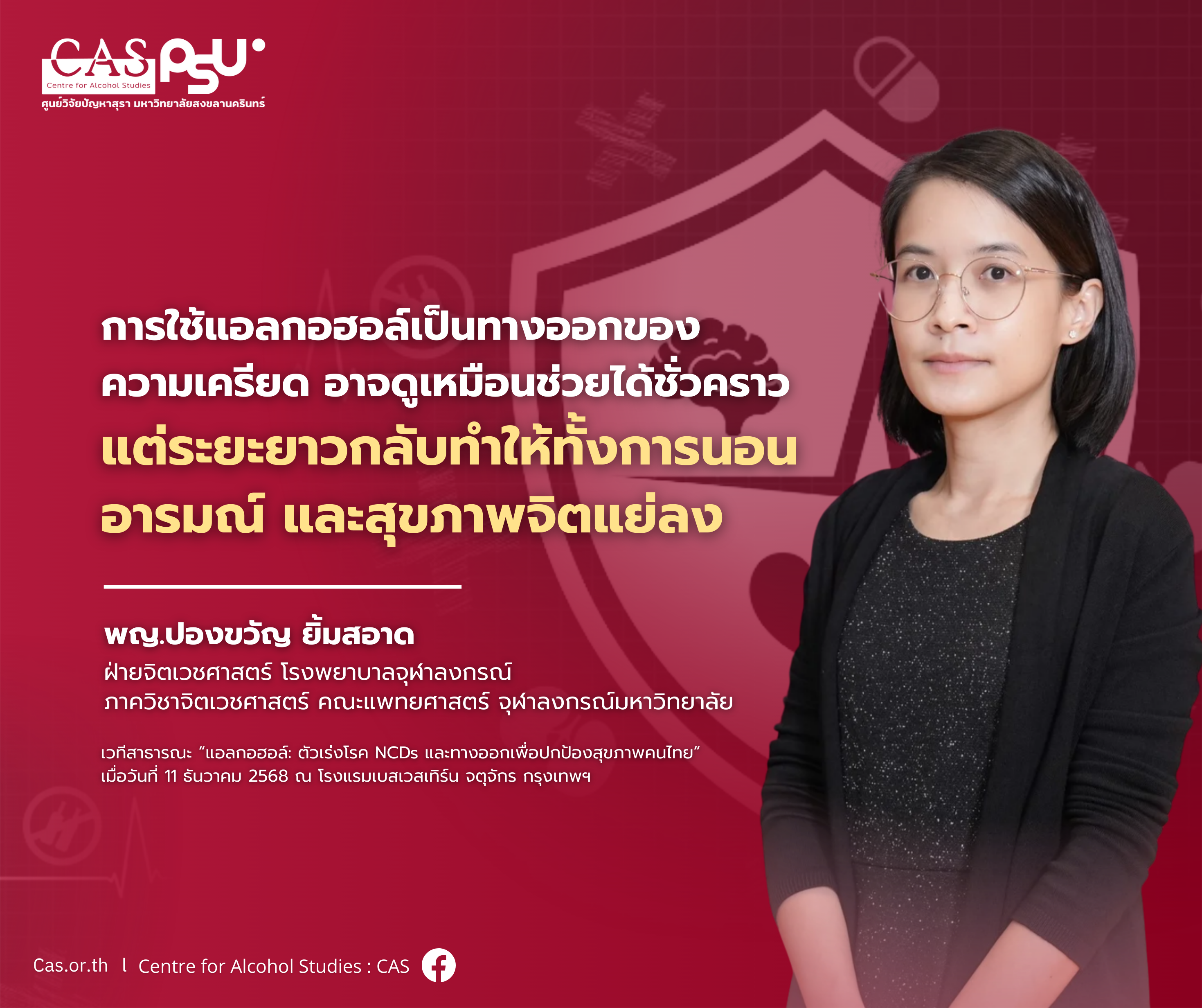
“การใช้แอลกอฮอล์เป็นทางออกของความเครียด อาจดูเหมือนช่วยได้ชั่วคราว แต่ระยะยาวกลับทำให้ทั้งการนอน อารมณ์ และสุขภาพจิตแย่ลง”
https://cas.or.th/content?id=1037
Tags : -

“การใช้แอลกอฮอล์เป็นทางออกของความเครียด อาจดูเหมือนช่วยได้ชั่วคราว แต่ระยะยาวกลับทำให้ทั้งการนอน อารมณ์ และสุขภาพจิตแย่ลง”
------------

อ.พญ.ปองขวัญ ยิ้มสอาด
อาจารย์ภาควิชาจิตเวชศาสตร์ คณะแพทยศาสตร์ จุฬาลงกรณ์มหาวิทยาลัย
ร่วมให้ข้อมูลในเวทีเสวนา “แอลกอฮอล์: ตัวเร่งโรค NCDs และทางออกเพื่อปกป้องสุขภาพคนไทย” เมื่อวันที่ 11 ธันวาคม 2568 ณ โรงแรมเบสเวสเทิร์น จตุจักร กรุงเทพฯ

อ.พญ.ปองขวัญ กล่าวว่า ถ้าพูดถึงเรื่องสุขภาพจิต หลายคนอาจเคยได้ยิน หรืออาจเคยรู้สึกด้วยตัวเองว่า เวลาเครียด เหนื่อย หรือมีปัญหาเรื่องการนอน แอลกอฮอล์ดูเหมือนจะเป็นตัวช่วยที่เข้าถึงง่าย ดื่มแล้วรู้สึกผ่อนคลาย หลับง่ายขึ้น แต่ในมุมมองทางการแพทย์ เราพบว่า แอลกอฮอล์ไม่ได้ช่วยแก้ปัญหาสุขภาพจิตอย่างที่หลายคนเข้าใจ ตรงกันข้าม มันกลับเป็นตัวที่รบกวนระบบการทำงานของสมอง โดยเฉพาะวงจรการนอนและการควบคุมอารมณ์

ในระยะสั้น อาจรู้สึกง่วง หลับเร็วขึ้น แต่การนอนที่เกิดจากแอลกอฮอล์ไม่ใช่การนอนที่มีคุณภาพ สมองไม่ได้พักจริง วงจรการนอนถูกรบกวน ทำให้ตื่นมาไม่สดชื่น และเมื่อสะสมไปเรื่อย ๆ จะส่งผลต่ออารมณ์ ความเครียด ความหงุดหงิด และภาวะซึมเศร้าในระยะยาว

สิ่งที่น่ากังวล คือ คนจำนวนไม่น้อยเริ่มใช้แอลกอฮอล์เป็นเครื่องมือจัดการอารมณ์ โดยไม่รู้ตัว จากดื่มเพื่อผ่อนคลาย กลายเป็นดื่มเพื่อรับมือกับความเครียด ความเศร้า หรือความกดดันในชีวิตประจำวัน และเมื่อดื่มมากขึ้นเรื่อย ๆ ก็อาจพัฒนาไปสู่ภาวะติดแอลกอฮอล์ โดยข้อมูลทางการแพทย์และงานวิจัย เราพบความเชื่อมโยงอย่างชัดเจนระหว่างปัญหาการดื่มแอลกอฮอล์ กับความเสี่ยงด้านสุขภาพจิตที่รุนแรงขึ้น โดยเฉพาะความเสี่ยงในการทำร้ายตนเอง ซึ่งไม่ใช่เรื่องไกลตัว และไม่ใช่เรื่องของคนกลุ่มเล็ก ๆ ดังนั้น สิ่งสำคัญ คือ เราต้องเปลี่ยนมุมมองต่อแอลกอฮอล์ ไม่มองว่าเป็นทางออกของความเครียดหรือการนอนหลับ แต่ต้องมองว่าเป็นปัจจัยเสี่ยงที่อาจทำให้ปัญหาสุขภาพจิตรุนแรงขึ้น หากปล่อยไว้โดยไม่ได้รับการดูแลที่เหมาะสม

สุดท้ายนี้ อยากย้ำว่า หากใครเริ่มรู้สึกว่าการดื่มเริ่มควบคุมยาก หรือส่งผลต่ออารมณ์ การนอน หรือการใช้ชีวิตประจำวัน การขอความช่วยเหลือไม่ใช่ความล้มเหลว แต่เป็นก้าวสำคัญของการดูแลสุขภาพ สามารถขอคำปรึกษาได้ที่สายด่วน 1413 หรือที่สถานพยาบาลใกล้บ้าน

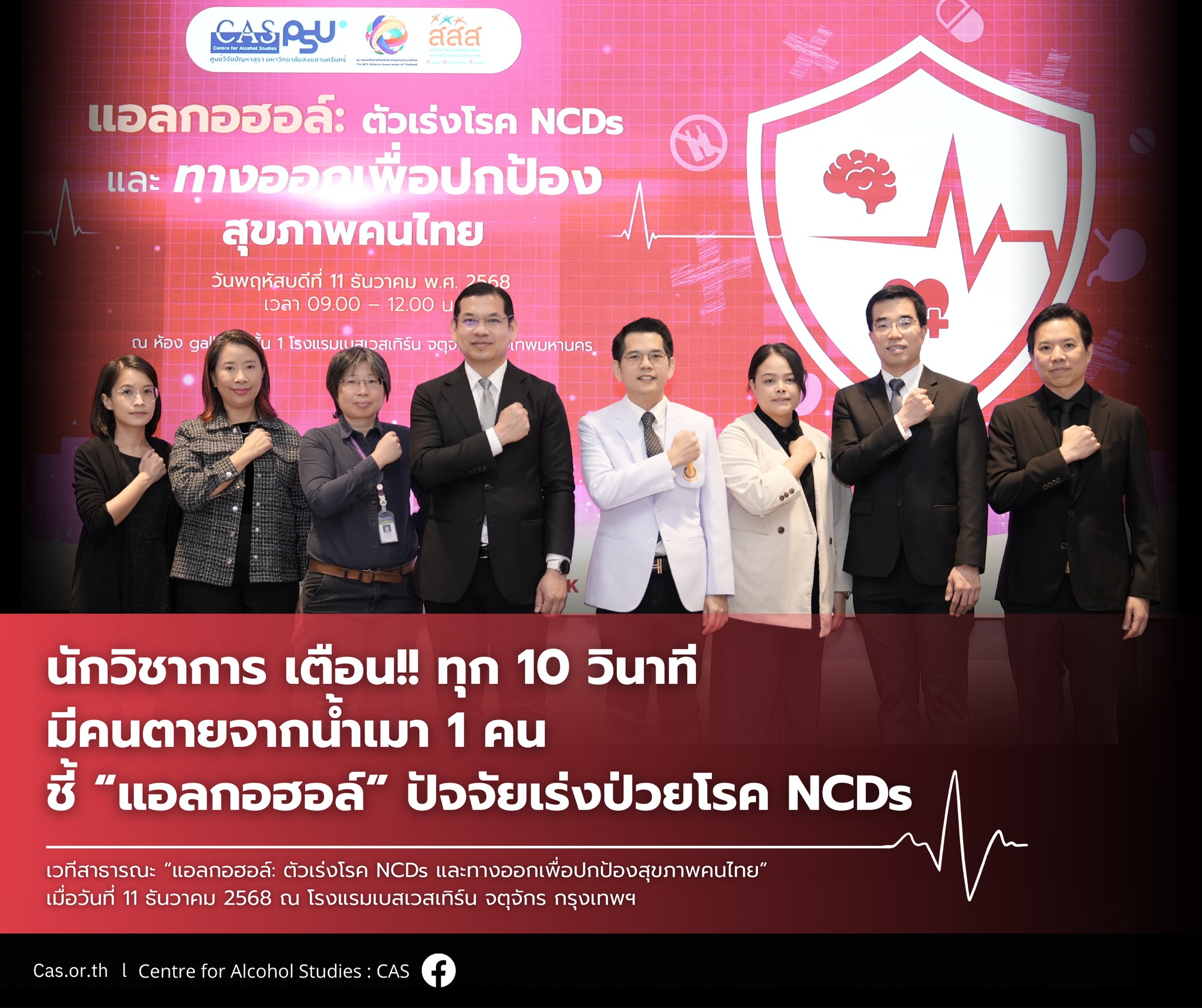
นักวิชาการ เตือนทุก 10 วินาที มีคนตายจากน้ำเมา 1 คน ชี้ “แอลกอฮอล์” ปัจจัยเร่งป่วยโรค NCDs เกินครึ่งป่วยไม่รู้ตัว
https://cas.or.th/content?id=1035

นักวิชาการ เตือนทุก 10 วินาที มีคนตายจากน้ำเมา 1 คน ชี้ “แอลกอฮอล์” ปัจจัยเร่งป่วยโรค NCDs เกินครึ่งป่วยไม่รู้ตัว สร้างความเสี่ยหายทางเศรษฐกิจ 1.65 แสนล้านบาท สสส.-ศวส. หนุนมาตรการป้องกันที่เหมาะสมกับบริบทพื้นที่-บูรณาการทุกภาคส่วน หวังลดผลกระทบจากน้ำเมา

เมื่อเวลา 09.00 น. วันที่ 11 ธ.ค. 2568 ที่โรงแรมเบสเวสเทิร์น กรุงเทพฯ ศูนย์วิจัยปัญหาสุรา (ศวส.) ร่วมกับ สมาคมเครือข่ายโรคไม่ติดต่อแห่งประเทศไทย และสำนักงานกองทุนสนับสนุนการสร้างเสริมสุขภาพ (สสส.) จัดเวทีสาธารณะ “แอลกอฮอล์ : ตัวเร่งโรค NCDs และทางออกเพื่อปกป้องสุขภาพคนไทย”

โดย ดร.นพ.ไพโรจน์ เสาน่วม รองผู้จัดการกองทุน สสส. เปิดเผยว่า ประเทศไทยกำลังก้าวสู่ “ภาวะวิกฤต NCDs” จากโรคอ้วน ความดันโลหิตสูง เบาหวาน และพฤติกรรมเสี่ยง โดยเฉพาะการดื่มแอลกอฮอล์ ซึ่งสร้างภาระทั้งด้านสุขภาพและเศรษฐกิจอย่างกว้างขวาง เฉพาะปี 2564 ไทยสูญเสียทางเศรษฐกิจกว่า 165,450 ล้านบาท และเกือบ 80% ของคนไทย เคยได้รับผลกระทบจากการดื่มของผู้อื่น ทั้งด้านร่างกาย จิตใจ และครอบครัว แอลกอฮอล์ได้ถูกจัดให้เป็นสารก่อมะเร็งกลุ่มที่ 1 เชื่อมโยงกับมะเร็งอย่างน้อย 8 ชนิด ได้แก่ มะเร็งช่องปาก กล่องเสียง คอหอย เต้านม (ในผู้หญิง) หลอดอาหาร ลำไส้ใหญ่/ทวารหนัก ตับ และตับอ่อน

“แต่ที่น่ากังวลจากงานวิจัยของศวส. สำรวจประชาชนไทย 3,924 คน จาก 12 จังหวัดทั่วประเทศ ในปี 2568 พบคนไทยกว่า 90% ไม่รู้ว่าเครื่องดื่มแอลกอฮอล์ก่อมะเร็งได้ สะท้อนความจำเป็นของการสื่อสารความเสี่ยงที่ถูกต้องและทันต่อสถานการณ์ เพราะปัญหานี้ไม่ใช่ของใครคนใดคนหนึ่ง แต่เป็นภารกิจร่วมของทั้งสังคม ทุกคนจึงควรช่วยกันสร้างสภาพแวดล้อมที่ปลอดภัย ภาระโรคจะลดลง และคุณภาพชีวิตของคนไทยจะดีขึ้นอย่างยั่งยืน” ดร.นพ.ไพโรจน์ กล่าว

รศ.พญ.เริงฤดี ปธานวนิช อาจารย์ภาควิชาเวชศาสตร์ชุมชน คณะแพทยศาสตร์โรงพยาบาลรามาธิบดี กล่าวว่า จากการสำรวจสุขภาพประชาชนไทย โดยการตรวจร่างกายครั้งที่ 7 ปี2567-2568 พบว่า คนไทยอายุ 15 ปีขึ้นไป ดื่มเครื่องดื่มแอลกอฮอล์ในช่วง 30 วันที่ผ่านมา จำนวน 17.1 ล้านคน ซึ่งในจำนวนนี้ ดื่มอย่างหนัก 7.7 ล้านคน หรือ 45% ส่วนอัตราการดื่มเครื่องดื่มแอลกอฮอล์ มีแนวโน้มลดลงเล็กน้อยในทุกกลุ่มอายุ แต่เป็นที่น่าสังเกตคือ แนวโน้มการดื่มในกลุ่มวัยรุ่นมีสัดส่วนที่ใกล้เคียงกันระหว่างวัยรุ่นชายและหญิง ซึ่งแตกต่างจากกลุ่มวัยผู้ใหญ่หรือสูงอายุที่พบว่า เพศชายมักจะมีอัตราการดื่มสูงกว่าเพศหญิง ความแตกต่างของความชุกของการดื่มระหว่างชายและหญิงมีแนวโน้มแคบลงเรื่อย ๆ โดยเฉพาะในกลุ่มวัยรุ่น ซึ่งใกล้เคียงกับสถานการณ์ในประเทศแถบยุโรป และสหรัฐอเมริกา ซึ่งเป็นผลมาจากสภาพเศรษฐกิจและสังคมที่เปลี่ยนแปลงไป รวมทั้งความเชื่อ หรือการมองว่าการดื่มเครื่องดื่มแอลกอฮอล์เป็นสิ่งช่วยในการเข้าสังคม หรือความเท่าเทียม

“ในกลุ่มผู้ป่วยโรคเรื้อรัง ยังมีการดื่มเครื่องดื่มแอลกอฮอล์ในสัดส่วนที่สูง และคนที่ยังดื่มส่วนมากไม่รู้ตัวว่าป่วยเป็นโรคเรื้อรังแล้ว เช่น ผู้ป่วยเบาหวานที่ยังดื่มแอลกอฮอล์1.4 ล้านคน ในจำนวนนี้ ยังไม่รู้ตัวเองว่าป่วยเป็นเบาหวาน 5.9 แสนคน และผู้ป่วยความดันโลหิตสูงที่ยังดื่มแอลกอฮอล์ 4.8 ล้านคน ในจำนวนนี้ ยังไม่รู้ตัวเองว่าป่วยเป็นโรคความดันโลหิตสูง 3.1 ล้านคน ซึ่งการดื่มแอลกอฮอล์จะส่งผลเสียต่อการควบคุมโรคเบาหวานและความดันโลหิตสูง นอกจากนี้ยังพบว่าคนที่ดื่มแอลกอฮอล์มีระดับค่าเอนไซม์ตับที่ผิดปกติสูงกว่าคนที่ไม่ดื่มโดยเฉลี่ย 3-5 เท่า และมีระดับไขมันไตรกลีเซอไรด์ที่สูงขึ้นโดยเฉลี่ย 1-2 เท่า ซึ่งเป็นปัจจัยเสี่ยงต่อการเกิดโรคตับ โรคมะเร็ง โรคหัวใจและหลอดเลือด” รศ.พญ.เริงฤดี กล่าว

ด้าน รศ.ดร.นพ.พลเทพ วิจิตรคุณากร ผู้อำนวยการ ศวส. มหาวิทยาลัยสงขลานครินทร์ กล่าวว่า คนไทยดื่มแอลกอฮอล์สูงเป็นอันดับ 3 ของอาเซียน และเป็นอันดับ 1 ของประเทศรายได้ปานกลางระดับบน ข้อมูลจากสำนักงานสถิติแห่งชาติ ปี 2567 ร่วมกับการสำรวจสุขภาพประชาชนไทย โดยการตรวจร่างกาย ครั้งที่ 7 ชี้ตรงกันว่า ปัญหาการดื่มแอลกอฮอล์ของคนไทยยังคงสูงมาก ปัจจุบันคนไทยเริ่มดื่มเร็วขึ้น มีอายุเฉลี่ยที่ดื่มครั้งแรกอยู่ที่ 19.9 ปี สะท้อนว่า “ผู้หญิงและเยาวชน” กลายเป็นกลุ่มเปราะบาง และเป้าหมายทางการตลาดของอุตสาหกรรมเครื่องดื่มแอลกอฮอล์ โดยภาคเหนือและภาคตะวันออกเฉียงเหนือ เป็นพื้นที่ที่มีอัตราการดื่มสูงที่สุดเมื่อเทียบกับภาคอื่น ความแตกต่างนี้ชี้ให้เห็นว่ามาตรการควบคุมต้องตอบโจทย์บริบทแต่ละพื้นที่ควบคู่ไปกับนโยบายระดับชาติ

“ทุก 10 วินาที มีคนตายจากแอลกอฮอล์ 1 คน หากยังปล่อยให้การดื่มเป็นเรื่องปกติ ความสูญเสียจะทวีขึ้นอย่างหลีกเลี่ยงไม่ได้ ภาระโรคที่เกี่ยวข้องกับแอลกอฮอล์ในไทยเพิ่มสูงขึ้นอย่างมีนัยสำคัญ มากกว่า 1 ใน 10 ของการตาย หรือปีสุขภาวะที่สูญเสีย (DALYs) เกิดจากแอลกอฮอล์ ทั้งก่อให้เกิดการบาดเจ็บ และป่วยจากโรค NCDs เช่น โรคหัวใจ-หลอดเลือด โรคตับ และมะเร็งหลายชนิด โดยเฉพาะผู้ชายที่มีอัตราเสียชีวิตสูงกว่าผู้หญิงอย่างชัดเจน ดังนั้น ไทยจำเป็นต้องมีมาตรการควบคุมแอลกอฮอล์ที่เข้มแข็งขึ้น พร้อมบูรณาการการทำงานทุกภาคส่วน ทั้งภาครัฐ นักวิชาการ แพทย์ ภาคประชาชน และชุมชน เพื่อปกป้องสุขภาพของประชาชนในระยะยาว และลดภาระ NCDs ที่กำลังทวีความรุนแรง” ผู้อำนวยการ ศวส. กล่าว

------------------------------
เวทีสาธารณะ “แอลกอฮอล์: ตัวเร่งโรค NCDs และทางออกเพื่อปกป้องสุขภาพคนไทย”
เมื่อวันที่ 11 ธันวาคม 2568 ณ โรงแรมเบสเวสเทิร์น จตุจักร กรุงเทพฯ


การขยายเวลาขายเครื่องดื่มแอลกอฮอล์ ความเสี่ยงเพิ่มขึ้น และขัดกับความเห็นประชาชนส่วนใหญ่
https://cas.or.th/content?id=1030

การขยายเวลาขายเครื่องดื่มแอลกอฮอล์ ความเสี่ยงเพิ่มขึ้น และขัดกับความเห็นประชาชนส่วนใหญ่

ในช่วงที่มีการแลกเปลี่ยนความคิดเห็นเกี่ยวกับการปรับเวลาในการจำหน่ายเครื่องดื่มแอลกอฮอล์ ข้อมูลจากหลายแหล่งชี้ให้เห็นภาพที่เป็นประโยชน์ต่อการพิจารณานโยบายอย่างรอบคอบ โดยเฉพาะข้อมูลที่สะท้อน “ความเห็นของประชาชน” และ “ผลกระทบด้านสุขภาพ–ความปลอดภัย” ซึ่งเป็นฐานสำคัญของการกำหนดมาตรการสาธารณสุข

ผลสำรวจประชาชนจาก 12 จังหวัดทั่วประเทศ พบว่า 82.8% ไม่เห็นด้วยกับการขยายเวลาขายเครื่องดื่มแอลกอฮอล์ เหตุผลหลักเกี่ยวข้องกับความกังวลด้านความปลอดภัยบนท้องถนน การเข้าถึงของเยาวชน และผลกระทบทางสังคมที่อาจเพิ่มขึ้น หากมีการขยายชั่วโมงการจำหน่าย

ข้อมูลด้านการท่องเที่ยวก็มีประเด็นที่น่าสนใจเช่นกัน งานศึกษาหลายฉบับระบุว่า นักท่องเที่ยวไม่ได้เลือกประเทศไทยจากเวลาเปิด–ปิดของการจำหน่ายแอลกอฮอล์ แต่ให้ความสำคัญกับอาหาร วัฒนธรรม วิถีชีวิต และประสบการณ์ในท้องถิ่นเป็นหลัก ข้อมูลนี้ช่วยยืนยันว่า “เวลาเปิดขาย” อาจไม่ได้เป็นปัจจัยชี้ขาดด้านเศรษฐกิจการท่องเที่ยวตามที่เข้าใจกัน

ด้านความปลอดภัย ข้อมูลจากพื้นที่ที่เคยมีการผ่อนปรนเวลาอย่างน้อยช่วงหนึ่ง พบว่า การเสียชีวิตจากอุบัติเหตุช่วงกลางคืนเพิ่มขึ้น 13.4% คดีเมาแล้วขับเพิ่มขึ้นกว่า 117% ซึ่งเป็นตัวชี้วัดที่สะท้อนถึงความจำเป็นของมาตรการกำกับดูแล

ในขณะเดียวกัน กระทรวงสาธารณสุขได้ประกาศว่าจะมี การติดตามและประเมินผลอย่างต่อเนื่องในช่วง 6 เดือนข้างหน้า เพื่อประเมินผลกระทบจากการปรับนโยบาย และนำไปใช้ประกอบการพิจารณาเชิงนโยบายอย่างรอบด้าน

แนวทางนี้ถือเป็นกลไกสำคัญของ “การกำกับนโยบายแบบอิงหลักฐาน (evidence-informed policy)” ที่ช่วยให้ประเทศสามารถประเมินผลกระทบจริงได้อย่างเป็นระบบ

แม้ในสังคมจะมีมุมมองที่แตกต่างกัน แต่ข้อมูลเชิงประจักษ์เหล่านี้ช่วยให้เรามองภาพรวมของผลกระทบได้ชัดเจนยิ่งขึ้น และช่วยย้ำว่า "การตัดสินใจเชิงนโยบายควรตั้งอยู่บนฐานข้อมูลและความปลอดภัยของประชาชนเป็นสำคัญ"

ด้วยข้อมูลที่กำลังถูกรวบรวมอย่างต่อเนื่องในช่วง 6 เดือนข้างหน้า เราทุกฝ่ายจะมีโอกาสประเมินร่วมกันว่า แนวทางใดสามารถรักษาสมดุลระหว่างเศรษฐกิจ สังคม และสุขภาพของประชาชนได้ดีที่สุด

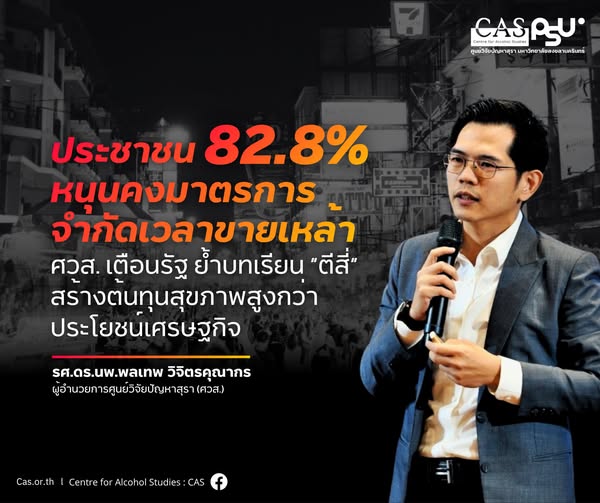
ประชาชน 82.8% หนุนคงมาตรการจำกัดเวลาขายเหล้า–เบียร์ ศวส. เตือนรัฐฟังเสียงส่วนใหญ่ ก่อนขยายเวลาและย้ำบทเรียน “ตีสี่” สร้างต้นทุนสุขภาพสูงกว่าประโยชน์เศรษฐกิจ
https://cas.or.th/content?id=1063
Tags : -

ประชาชน 82.8% หนุนคงมาตรการจำกัดเวลาขายเหล้า–เบียร์ ศวส. เตือนรัฐฟังเสียงส่วนใหญ่ ก่อนขยายเวลาและย้ำบทเรียน “ตีสี่” สร้างต้นทุนสุขภาพสูงกว่าประโยชน์เศรษฐกิจ

ท่ามกลางกระแสวิพากษ์วิจารณ์อย่างกว้างขวางต่อร่าง พระราชบัญญัติควบคุมเครื่องดื่มแอลกอฮอล์ (ฉบับที่ 2) พ.ศ. 2568 ซึ่งอยู่ระหว่างการพิจารณาของภาครัฐ โดยเฉพาะ ประเด็นการกำหนดเวลาในการขายและดื่มเครื่องดื่มแอลกอฮอล์ ที่ภาคธุรกิจบางส่วนเสนอให้ “ขยายเวลาจำหน่าย” จากเดิมที่กฎหมายกำหนดช่วงห้ามขายระหว่าง 14.00–17.00 น. เพื่อส่งเสริมการท่องเที่ยวและเศรษฐกิจ ขณะเดียวกัน กรมควบคุมโรคกำลังเตรียมจัดประชุมคณะกรรมการนโยบายเครื่องดื่มแอลกอฮอล์แห่งชาติ และคณะกรรมการควบคุมเครื่องดื่มแอลกอฮอล์แห่งชาติในไม่กี่วันนี้ เพื่อพิจารณาทิศทางนโยบายดังกล่าว ทำให้ประเด็นนี้กลายเป็นจุดสนใจของสังคมอีกครั้ง

เพื่อตอบต่อสถานการณ์ ศูนย์วิจัยปัญหาสุรา (ศวส.) มหาวิทยาลัยสงขลานครินทร์ ได้เปิดเผย ผลการศึกษาความรอบรู้ด้านสุขภาพเกี่ยวกับนโยบายควบคุมเครื่องดื่มแอลกอฮอล์ของประชาชนไทย ปี 2568 เพื่อสะท้อนเสียงประชาชนและเตือนให้รัฐใช้ “ข้อมูลวิจัยเชิงประจักษ์” เป็นฐานในการตัดสินใจ มากกว่าการตอบสนองต่อแรงผลักจากกลุ่มผลประโยชน์เฉพาะ ซึ่งผลจากการศึกษาความรอบรู้ด้านสุขภาพเกี่ยวกับนโยบายควบคุมเครื่องดื่มแอลกอฮอล์ของประชาชนไทย จากกลุ่มตัวอย่าง 3,924 คน ครอบคลุม 12 จังหวัดทั่วประเทศ ปี 2568 พบว่า ร้อยละ 82.8 เห็นด้วยกับการคงมาตรการจำกัดเวลาขายเครื่องดื่มแอลกอฮอล์ ตามที่กฎหมายกำหนดให้ขายได้เฉพาะเวลา 11.00–14.00 น. และ 17.00–24.00 น.

รศ.ดร.นพ.พลเทพ วิจิตรคุณากร ผู้อำนวยการศูนย์วิจัยปัญหาสุรา กล่าวย้ำว่า “เสียงประชาชนส่วนใหญ่ชัดเจนว่าต้องการให้คงเวลาห้ามขายไว้ตามเดิม เพราะมองว่าเป็นมาตรการสำคัญในการลดอุบัติเหตุและปัญหาความรุนแรง แต่ภาครัฐกลับกำลังพิจารณาขยายเวลาขายในช่วง 14.00–17.00 น. ซึ่งตรงกับช่วงเวลาที่สถิติอุบัติเหตุสูงสุดของวัน” โดยข้อมูลจาก สำนักงานตำรวจแห่งชาติ ชี้ว่า ช่วงเวลา 14.00–17.00 น. เป็นช่วงที่มีอัตราอุบัติเหตุบนท้องถนนสูงสุดของวัน และเป็นช่วงที่ นักเรียน นักศึกษา และพนักงานกำลังเดินทางกลับบ้าน หากยกเลิกช่วงห้ามขายในเวลานี้ จะเพิ่มโอกาสการดื่มก่อนขับขี่ และทำให้อุบัติเหตุในช่วงเย็นเพิ่มขึ้น ในด้านเศรษฐกิจและสุขภาพ ผลการประเมินของโครงการศึกษาผลกระทบทางเศรษฐกิจ สุขภาพ และสังคมจากการผ่อนคลายมาตรการแอลกอฮอล์ ปี 2566 พบว่า การขยายเวลาขายอาจเพิ่มความสูญเสียทางเศรษฐกิจจากอุบัติเหตุและความรุนแรงในครอบครัว เพิ่มต้นทุนทางสังคมและค่าใช้จ่ายด้านสาธารณสุข และในมิติทางสังคม ยังเพิ่มความเสี่ยงต่อการเข้าถึงเครื่องดื่มแอลกอฮอล์ของเยาวชนและผู้มีรายได้น้อย ขณะเดียวกัน หากรัฐเปิดทางให้ผู้ผลิตรายย่อยเพิ่มจำนวนหรืออนุญาตพื้นที่พิเศษเพื่อขายเครื่องดื่มแอลกอฮอล์สำหรับการท่องเที่ยวยามค่ำคืน โดยไม่มีมาตรการควบคุมที่เข้มงวด จะสร้าง “เขตยกเว้นกฎหมาย” และขัดต่อเจตนารมณ์ของ พ.ร.บ. ควบคุมเครื่องดื่มแอลกอฮอล์ที่มุ่งคุ้มครองสุขภาพประชาชน

จากบทเรียนนโยบายขยายเวลา “ตีสี่” ผลจากการศึกษาโดยคณะผู้ทรงคุณวุฒิที่กระทรวงสาธารณสุขแต่งตั้ง เพื่อติดตามผลกระทบการขยายเวลาเปิดสถานบริการถึงตี 4 ใน 5 พื้นที่นำร่อง ได้แก่ กรุงเทพมหานคร ชลบุรี ภูเก็ต เชียงใหม่ และเกาะสมุย พบว่า อัตราการเสียชีวิตช่วงตีสองถึงหกโมงเช้าเพิ่มขึ้น 13.4% จากปีก่อนหน้า โดยเฉพาะในพื้นที่ท่องเที่ยวหลัก คดีเมาแล้วขับเพิ่มขึ้นกว่า 2 เท่า (117%) และมีเจ้าหน้าที่ตำรวจเสียชีวิต 3 รายจากเหตุคนเมาขับชน ผู้ประกอบการในเขตโซนนิ่งส่วนใหญ่ยังไม่ปฏิบัติตามเงื่อนไขการควบคุม เช่น ไม่ตรวจวัดแอลกอฮอล์ก่อนขับกลับ และขายให้ผู้มึนเมา

แม้ภาครัฐคาดหวังผลเชิงเศรษฐกิจจากนโยบายดังกล่าว แต่ข้อมูลจากการท่องเที่ยวแห่งประเทศไทย (ททท.) ปี 2023 ชี้ว่า การใช้จ่ายของนักท่องเที่ยวหรูเฉลี่ยต่อทริปอยู่ที่ 71,933 บาท และส่วนใหญ่ (81%) เดินทางมาเพื่อพักผ่อน ไม่ได้เน้นการท่องเที่ยวยามค่ำคืนเป็นหลัก โดยกิจกรรมยอดนิยม คือ การกินอาหารไทยสูงถึง 90% จึงสะท้อนว่าการกระตุ้นเศรษฐกิจผ่าน “การดื่มยามค่ำคืน” ไม่ใช่ปัจจัยหลักของการท่องเที่ยวคุณภาพ

ศวส. เสนอข้อพิจารณาต่อรัฐบาลและคณะกรรมการควบคุมเครื่องดื่มแอลกอฮอล์แห่งชาติ ดังนี้

  1. คงช่วงเวลาห้ามขายเครื่องดื่มแอลกอฮอล์ตามเดิม (14.00–17.00 น.) เพื่อสอดคล้องกับเสียงของประชาชนส่วนใหญ่ (82.8%) และลดความเสี่ยงต่ออุบัติเหตุและการเข้าถึงของกลุ่มเปราะบาง
  2. ยกระดับระบบการสื่อสารสาธารณะและการบังคับใช้กฎหมาย เพื่อสร้างความเข้าใจที่ถูกต้องและลดการละเมิดโดยไม่ตั้งใจ ทั้งในกลุ่มผู้ขายและผู้บริโภค
  3. ไม่ขยายเวลาขายหลังเที่ยงคืนเพิ่มเติม จากบทเรียน “ตีสี่” ที่ชี้ให้เห็นว่าผลกระทบทางสุขภาพและสังคมสูงกว่าผลประโยชน์ทางเศรษฐกิจ
  4. ให้คณะกรรมการควบคุมเครื่องดื่มแอลกอฮอล์แห่งชาติใช้ข้อมูลวิจัยเชิงประจักษ์เป็นฐานตัดสินใจ และเปิดรับฟังความคิดเห็นจากภาคประชาชนอย่างรอบด้าน เพื่อให้การออกกฎหมายสอดคล้องกับเจตนารมณ์การคุ้มครองสุขภาพของประชาชนไทย

หากรัฐบาลยืนยันจะขยายเวลาจำหน่ายเครื่องดื่มแอลกอฮอล์ การดำเนินงานจำเป็นต้องมีกลไก “ลดความเสียหายและเฝ้าระวังผลกระทบ” ที่เข้มแข็งกว่าปัจจุบันอย่างมาก เพื่อไม่ให้สังคมต้องแบกรับต้นทุนด้านสุขภาพ ความปลอดภัย และเศรษฐกิจสูงขึ้น ศูนย์วิจัยปัญหาสุราเสนอให้ใช้แนวทาง “ขยายอย่างมีเงื่อนไข–ควบคุมเข้มกว่าก่อน” โดยต้องมาพร้อมกับกลไกเฝ้าระวังผลกระทบรายเดือน, มาตรการรับผิดร่วมของผู้ขาย, โซนนิ่งจำกัดพื้นที่, และการสื่อสารสาธารณะเข้มข้น มาตรการเหล่านี้ไม่ใช่เพียง “ทางเลือกรอง” แต่เป็น “เส้นกันชนสุดท้าย” ที่จะช่วยป้องกันไม่ให้การเปลี่ยนแปลงเชิงนโยบายครั้งนี้นำไปสู่การสูญเสียชีวิต สุขภาพ และความปลอดภัยของประชาชนอย่างที่เคยเกิดขึ้นจากบทเรียน “ตีสี่” ในปีที่ผ่านมา “หากรัฐต้องการขยายเวลาเพื่อเศรษฐกิจ ก็ต้องขยายระบบป้องกันเพื่อชีวิตคนด้วย” รศ.ดร.นพ.พลเทพ กล่าว


ประชุมเชิงปฏิบัติการ การจัดกระบวนการสื่อสารนโยบายและเวทีสนทนาสาธารณะ (Policy Dialogue) เพื่อขับเคลื่อนนโยบายควบคุมเครื่องดื่มแอลกอฮอล์สู่การปฏิบัติจริง
https://cas.or.th/content?id=1039
Tags : -

ประชุมเชิงปฏิบัติการ การจัดกระบวนการสื่อสารนโยบายและเวทีสนทนาสาธารณะ (Policy Dialogue) เพื่อขับเคลื่อนนโยบายควบคุมเครื่องดื่มแอลกอฮอล์สู่การปฏิบัติจริง 


วันที่ 31 กรกฎาคม – 1 สิงหาคม พ.ศ. 2568
ณ ห้องประชุมฮิลล์เครส ชั้น 5 โรงแรมเดอะควอเตอร์ ลาดพร้าว กรุงเทพมหานคร

การประชุมครั้งนี้มีผู้เข้าร่วมจากหลากหลายภาคส่วน อาทิ หน่วยงานรัฐด้านสุขภาพและนโยบาย นักวิชาการ ภาคประชาสังคม และเครือข่ายที่ทำงานด้านการควบคุมเครื่องดื่มแอลกอฮอล์ ร่วมแลกเปลี่ยนเรียนรู้และฝึกปฏิบัติอย่างเข้มข้น

การประชุมเชิงปฏิบัติการครั้งนี้ช่วยเสริมสร้างความเข้าใจของผู้เข้าร่วมเกี่ยวกับกระบวนการนโยบาย การสื่อสารเชิงนโยบาย และบทบาทของเวทีสนทนาสาธารณะ (Policy Dialogue) ในการผลักดันนโยบายควบคุมเครื่องดื่มแอลกอฮอล์จากระดับแนวคิดไปสู่การปฏิบัติจริง โดยผู้เข้าร่วมได้เรียนรู้บทเรียนความสำเร็จจากการขับเคลื่อนนโยบายควบคุมยาสูบ ซึ่งสะท้อนให้เห็นความสำคัญของการใช้ข้อมูลและหลักฐานทางวิชาการควบคู่กับการสร้างกระแสและการยอมรับทางสังคม

นอกจากนี้ ยังได้ร่วมกันวิเคราะห์ช่องว่างและความท้าทายของการบังคับใช้กฎหมายควบคุมเครื่องดื่มแอลกอฮอล์ในบริบทปัจจุบัน ตลอดจนฝึกปฏิบัติการจัดทำเอกสารเชิงนโยบาย (Policy Brief) และการออกแบบกระบวนการ Policy Dialogue เพื่อใช้เป็นเครื่องมือสำคัญในการขับเคลื่อนนโยบายในระดับต่าง ๆ การประชุมยังมีส่วนช่วยเสริมสร้างเครือข่ายและแนวร่วมของผู้ทำงานด้านนโยบายและสุขภาพ เพื่อร่วมกันมุ่งลดผลกระทบจากแอลกอฮอล์ต่อสุขภาพและสังคมไทยอย่างยั่งยืน

ศวส. ขอขอบคุณวิทยากร ผู้ทรงคุณวุฒิ และผู้เข้าร่วมทุกท่าน ที่ร่วมกันแลกเปลี่ยนองค์ความรู้และประสบการณ์ เพื่อผลักดันนโยบายควบคุมเครื่องดื่มแอลกอฮอล์ให้เกิดผลในทางปฏิบัติอย่างเป็นรูปธรรม

ศูนย์วิจัยปัญหาสุรา (ศวส.)

Centre for Alcohol Studies (CAS)

สาขาวิชาเวชศาสตร์ครอบครัวและเวชศาสตร์ป้องกัน อาคารศรีเวชวัฒน์ ชั้น 11 มหาวิทยาลัยสงขลานครินทร์ เลขที่ 15 ถนนกาญจนวนิช ตำบลคอหงส์ อำเภอหาดใหญ่ จังหวัดสงขลา 90110

083-5775533

https://www.facebook.com/cas.org.th

เข้าชมแล้ว 0 ครั้ง
Copyright © 2026 CAS All rights reserved.