คำค้นหา : ราคา

คำค้นหา : ราคา

คำนี้ค้นหามาแล้ว : 712 ครั้ง
เงินภาษี 2% คุ้มค่าแค่ไหน? สสส. กับผลลัพธ์ 25 ปีของการควบคุมเครื่องดื่มแอลกอฮอล์ในประเทศไทย
https://cas.or.th/content?id=1149
Tags : -

เงินภาษี 2% คุ้มค่าแค่ไหน? สสส. กับผลลัพธ์ 25 ปีของการควบคุมเครื่องดื่มแอลกอฮอล์ในประเทศไทย

เงินภาษี 2% ที่จัดสรรให้สำนักงานกองทุนสนับสนุนการสร้างเสริมสุขภาพ (สสส.) ไม่ได้เป็นเพียงงบประมาณสำหรับการรณรงค์ แต่เป็นการลงทุนเพื่อพัฒนาระบบสุขภาพ สร้างองค์ความรู้ สนับสนุนมาตรการทางกฎหมายและนโยบาย ตลอดจนขับเคลื่อนความร่วมมือจากทุกภาคส่วน เพื่อป้องกันและลดผลกระทบจากการบริโภคเครื่องดื่มแอลกอฮอล์ในประเทศไทย

ตลอด 25 ปีที่ผ่านมา การดำเนินงานด้านการควบคุมเครื่องดื่มแอลกอฮอล์ครอบคลุมตั้งแต่การสร้างความตระหนักรู้ในสังคม การรณรงค์ลด ละ เลิกดื่ม การพัฒนาระบบดูแลผู้มีปัญหาการดื่ม การผลักดันกฎหมาย ไปจนถึงการสร้างหลักฐานเชิงประจักษ์เพื่อสนับสนุนการตัดสินใจเชิงนโยบายและความร่วมมือระดับนานาชาติ


1. ผลประเมินแผนควบคุมแอลกอฮอล์ พ.ศ. 2561–2565

ผลการประเมินแผนควบคุมเครื่องดื่มแอลกอฮอล์ พ.ศ. 2561–2565 สะท้อนผลประโยชน์ทางเศรษฐศาสตร์และความก้าวหน้าของตัวชี้วัดที่เกี่ยวข้องกับการดำเนินงาน

  • ผลประโยชน์ทางเศรษฐศาสตร์: เงินลงทุน สสส. 1,540 ล้านบาท ได้รับผลประโยชน์ทางเศรษฐศาสตร์ 9,444 ล้านบาท

  • อัตราผลประโยชน์ต่อเงินลงทุน: เงินลงทุน 1 บาท สร้างผลประโยชน์ที่ประเมินได้ 6.13 บาท

  • ตัวชี้วัดที่มีผลการดำเนินงานดีขึ้น: 32 จาก 41 ตัว หรือร้อยละ 78

ผลประโยชน์ที่ประเมินได้จำแนกตามประเภท

  • การลดการดื่มเครื่องดื่มแอลกอฮอล์: 6,133 ล้านบาท หรือร้อยละ 64.9

  • การลดอุบัติเหตุ: 2,519 ล้านบาท

  • การลดโรคและความรุนแรง: 651 ล้านบาท

  • งานประเพณีและพื้นที่ปลอดเหล้า: 141 ล้านบาท

หมายเหตุ: ตัวเลขผลประโยชน์เป็นการประเมินทางเศรษฐศาสตร์ ไม่ใช่เงินสดที่รัฐได้รับคืนโดยตรง


2. สสส. นำเงิน 2% ไปทำอะไรบ้าง? 5 กลยุทธ์หลักตลอด 25 ปี

2.1 รณรงค์ให้คนลด ละ เลิกดื่ม

การรณรงค์งดเหล้าเข้าพรรษาเป็นหนึ่งในกลไกสำคัญที่ส่งเสริมการปรับเปลี่ยนพฤติกรรมการบริโภคเครื่องดื่มแอลกอฮอล์ในระดับประชากร

ผลการศึกษาพบว่า ปริมาณการบริโภคแอลกอฮอล์ลดลงประมาณร้อยละ 10 ในช่วงรณรงค์ เมื่อเปรียบเทียบกับแนวโน้มตามปกติ ขณะที่ข้อมูลปี พ.ศ. 2568 ระบุว่ามีผู้ร่วมงดตลอดช่วงเข้าพรรษา 8.6 ล้านคน โดยมีผู้ที่งดตลอดช่วงเข้าพรรษา 4.5 ล้านคน และครัวเรือนประหยัดค่าใช้จ่ายได้ประมาณ 14,949 ล้านบาทในช่วง 3 เดือน

นอกจากนี้ ค่านิยมการให้เครื่องดื่มแอลกอฮอล์เป็นของขวัญลดลงจากร้อยละ 30.2 เหลือร้อยละ 9 ภายหลังการรณรงค์ “ให้เหล้าเท่ากับแช่ง” ในช่วง พ.ศ. 2551–2560

2.2 สร้างระบบช่วยเหลือผู้มีปัญหาการดื่ม

การควบคุมเครื่องดื่มแอลกอฮอล์ไม่ได้จำกัดอยู่ที่การป้องกันและการรณรงค์เท่านั้น แต่ยังครอบคลุมการพัฒนาระบบบริการสุขภาพเพื่อช่วยเหลือผู้มีปัญหาการดื่มอย่างต่อเนื่อง

การดำเนินงานประกอบด้วยการสนับสนุนแผนงานพัฒนาระบบการดูแลผู้มีปัญหาการดื่มสุรา (ผรส.) การพัฒนาระบบบริการตั้งแต่โรงพยาบาลส่งเสริมสุขภาพตำบลจนถึงโรงพยาบาลระดับตติยภูมิ การสนับสนุนการคัดกรองปัญหาการดื่ม ตลอดจนการพัฒนาศักยภาพบุคลากรสาธารณสุขและแนวปฏิบัติที่เกี่ยวข้อง

จำนวนผู้ได้รับการคัดกรอง 262,355 คน และการคัดกรองในกลุ่มต่าง ๆ จำนวน 10.3 ล้านคนในปี พ.ศ. 2562

2.3 ผลักดันกฎหมายและนโยบาย

สสส. มีบทบาทสนับสนุนการขับเคลื่อนนโยบายควบคุมเครื่องดื่มแอลกอฮอล์ผ่านความร่วมมือของภาครัฐ ภาควิชาการ ภาคประชาสังคม และเครือข่ายที่เกี่ยวข้อง โดยใช้แนวคิด “สามเหลี่ยมเขยื้อนภูเขา” เป็นกรอบหนึ่งในการเชื่อมโยงพลังจากหลายภาคส่วน

การดำเนินงานครอบคลุมการสนับสนุนการพัฒนากฎหมาย การเสริมศักยภาพหน่วยงานที่เกี่ยวข้อง และการสร้างหลักฐานเชิงประจักษ์เพื่อประเมินมาตรการควบคุม เช่น มาตรการภาษีและการกำหนดเวลาจำหน่ายเครื่องดื่มแอลกอฮอล์ ข้อมูลเหล่านี้มีความสำคัญต่อการพิจารณาทางเลือกเชิงนโยบายที่คำนึงถึงผลกระทบต่อสุขภาพและสังคม

2.4 สร้างหลักฐานและองค์ความรู้

การวิจัยและข้อมูลที่มีคุณภาพเป็นรากฐานสำคัญของการกำหนดนโยบายควบคุมเครื่องดื่มแอลกอฮอล์ สสส. สนับสนุนการพัฒนาองค์ความรู้ผ่านหน่วยงานวิจัยและเครือข่ายวิชาการ รวมถึงศูนย์วิจัยปัญหาสุรา (ศวส.)

การดำเนินงานครอบคลุมการศึกษาสถานการณ์การบริโภคเครื่องดื่มแอลกอฮอล์ การสำรวจสุขภาพประชาชน การประเมินผลมาตรการ และการเผยแพร่ผลงานวิจัยในวารสารวิชาการระดับนานาชาติ เพื่อให้การกำหนดนโยบายมีหลักฐานรองรับและสามารถประเมินผลได้อย่างเป็นระบบ

2.5 สร้างเครือข่ายและขับเคลื่อนความร่วมมือระดับโลก

การควบคุมเครื่องดื่มแอลกอฮอล์จำเป็นต้องอาศัยความร่วมมือจากหลายภาคส่วน ทั้งด้านสุขภาพ กฎหมาย การศึกษา การวิจัย และภาคประชาสังคม การสร้างเครือข่ายและพัฒนาศักยภาพบุคลากรจึงเป็นส่วนสำคัญของการดำเนินงานในระยะยาว

ประเทศไทยยังมีบทบาทในการแลกเปลี่ยนประสบการณ์ด้านนโยบายกับนานาชาติ โดยองค์ความรู้และประสบการณ์จากประเทศไทยมีส่วนเชื่อมโยงกับการพัฒนากรอบการดำเนินงานควบคุมแอลกอฮอล์ระดับโลกขององค์การอนามัยโลก (WHO) พ.ศ. 2565–2573


3. เงินภาษี 2% สร้างความคุ้มค่าอย่างไร?

เงินลงทุนที่เชื่อมโยงกับผลลัพธ์ทางสังคม

ตัวอย่างที่นำเสนอในเอกสารประกอบคือ เบียร์ 1 กระป๋อง ราคาขาย 38.52 บาท รวมภาษีมูลค่าเพิ่ม โดยมีเงินจัดสรรเข้ากองทุน สสส. 29 สตางค์ต่อกระป๋อง ตัวเลขดังกล่าวสะท้อนให้เห็นว่าเงินจัดสรรเพียงส่วนหนึ่งสามารถสนับสนุนการทำงานที่ครอบคลุมทั้งการรณรงค์ การวิจัย การพัฒนาระบบบริการ และการผลักดันนโยบาย

ความคุ้มค่าใน 4 มิติ

  • เศรษฐศาสตร์: ผลประเมินระบุว่าเงินลงทุน 1 บาทก่อให้เกิดผลประโยชน์ทางเศรษฐศาสตร์ที่ประเมินได้ 6.13 บาท

  • สุขภาพ: สนับสนุนการลดการดื่ม ลดความเสี่ยงจากอุบัติเหตุและผลกระทบต่อสุขภาพ ตลอดจนพัฒนาการเข้าถึงบริการช่วยเหลือ

  • ระบบนโยบาย: สนับสนุนงานวิจัย การพัฒนาบุคลากร และการสร้างหลักฐานประกอบการตัดสินใจ

  • ความยั่งยืน: ลงทุนในระบบ กลไก และเครือข่ายความร่วมมือที่สามารถดำเนินงานต่อเนื่อง ไม่จำกัดอยู่เพียงกิจกรรมรณรงค์ระยะสั้น


4. ย้อนรอย 2 ทศวรรษ สสส. กับบทบาทการควบคุมสุราในประเทศไทย

ย้อนฟังเส้นทางและหมุดหมายสำคัญของ สำนักงานกองทุนสนับสนุนการสร้างเสริมสุขภาพ (สสส.) ตลอดระยะเวลา 2 ทศวรรษ ในการขับเคลื่อน มาตรการ นโยบาย และแคมเปญสังคม เพื่อลดการดื่มสุราและสร้างสุขภาวะที่ดีให้กับคนไทย

ทศวรรษแรก: บทบาท สสส. ในการควบคุมสุรา

พ.ศ. 2544–2556

เริ่มต้นจากการก่อตั้งกองทุน และการวางรากฐานนโยบายควบคุมเครื่องดื่มแอลกอฮอล์ผ่านแคมเปญสังคมที่สร้างการรับรู้ในวงกว้าง

  • พ.ศ. 2544: ก่อตั้ง สสส. อย่างเป็นทางการ โดยจัดตั้งจากเงินภาษีจัดเก็บเพิ่ม 2%

  • พ.ศ. 2546: ริเริ่มแคมเปญ "งดเหล้าเข้าพรรษา" เป็นปีแรก และก่อตั้งสำนักงานเครือข่ายองค์กรรอบรู้เรื่องเหล้า (สคล.)

  • พ.ศ. 2547: จัดตั้งศูนย์วิจัยปัญหาการดื่มสุรา (ศวส.)

  • พ.ศ. 2548: เคลื่อนไหวคัดค้านการนำ "เบียร์ช้าง" เข้าเข้าสู่ตลาดหลักทรัพย์แห่งประเทศไทย

  • พ.ศ. 2549: รณรงค์สร้างค่านิยมใหม่ "กฐินปลอดเหล้า" สู่ "งานศพปลอดเหล้า" ในปี 2550

  • พ.ศ. 2550: มาตรการขึ้นภาษีสุรา ส่งผลให้ปริมาณการดื่มต่อหัวลดลง -6.7% (Zayar และคณะ 2026)

  • พ.ศ. 2551: ประกาศใช้ พ.ร.บ. ควบคุมเครื่องดื่มแอลกอฮอล์ พร้อมสโลแกนรณรงค์ติดหู "ให้เหล้าเท่ากับแช่ง"

  • พ.ศ. 2552: จัดทำโครงการโซนนิ่งและแผนที่ร้านเหล้ารอบสถานศึกษา/มหาวิทยาลัย

  • พ.ศ. 2556: ปรับโครงสร้างภาษีเครื่องดื่มแอลกอฮอล์ ส่งผลให้อัตราการดื่มต่อหัวลดลง -9.3% (Zayar และคณะ 2026)

ทศวรรษที่สอง: ขึ้นเวทีโลก และยันต้านกระแสผ่อนกฎ

พ.ศ. 2557–2569

ก้าวสู่การยกระดับการทำงานบนเวทีระดับสากล พร้อมกับการรับมือและคัดค้านนโยบายผ่อนคลายการควบคุมสุราในประเทศ

  • พ.ศ. 2557: แนวโน้มพฤติกรรมการดื่มหนักของผู้บริโภคเริ่มลดลงอย่างเห็นได้ชัด (Talek และคณะ 2024)

  • พ.ศ. 2560: ผลจากการปฏิรูปภาษี ส่งผลให้อัตราการดื่มต่อหัวลดลงมากถึง -23% (Zayar และคณะ 2026)

  • พ.ศ. 2561: ก้าวสู่ระดับนานาชาติ นำเสนอการดำเนินงานบนเวที UN NCDs (สหประชาชาติว่าด้วยโรคไม่ติดต่อเรื้อรัง)

  • พ.ศ. 2562: ประชุมสมัชชาอนามัยโลก WHA72 เผยอัตราการเสียชีวิตจากเหล้าลดลง -25% (สุปรีดา 2563)

  • พ.ศ. 2565: WHA75 ให้การรับรองแผนปฏิบัติการลดอันตรายจากแอลกอฮอล์ระดับโลก (Global Alcohol Action Plan 2022–2030)

  • พ.ศ. 2567: ผลกระทบจากมาตรการนำร่องเปิดสถานบริการถึงตี 4 พบสถิติ เมาแล้วขับเพิ่มขึ้นสูงถึง +117% (ศวส. 2568)

  • พ.ศ. 2568: จับตาการเสนอ พ.ร.บ. ฉบับที่ 2 ที่มีทิศทางปลดล็อกการขายเครื่องดื่มแอลกอฮอล์ช่วงบ่าย

  • พ.ศ. 2569: การรับมือกับ ร่างกฎหมายยุติเงิน 2% ที่อาจส่งผลกระทบต่อกองทุนสร้างเสริมสุขภาพ

สรุปภาพรวม: การควบคุมเครื่องดื่มแอลกอฮอล์ตลอด 20 ปีที่ผ่านมา ถือเป็นบทเรียนสำคัญที่แสดงให้เห็นถึงการทำงานร่วมกันระหว่างมาตรการทางกฎหมาย ภาษี และกระแสสังคมในการลดผลกระทบทางสุขภาพของประชาชน


5. เอกสารอ้างอิง

ผลประเมินแผนควบคุมแอลกอฮอล์ 2561–2565

  • สุรศักดิ์ ไชยสงค์, กมลพัฒน์ มากแจ้ง, กฤษณี สระมุณี, ร่มตะวัน กาลพัฒน์, โศภิต นาสืบ, สุรัชดา ชนโสภณ, และคณะ. รายงานฉบับสมบูรณ์ โครงการประเมินผลลัพธ์และผลกระทบเชิงเศรษฐศาสตร์ของแผนควบคุมเครื่องดื่มแอลกอฮอล์และสิ่งเสพติด ปี 2561–2565. มหาสารคาม: A-HPRU มหาวิทยาลัยมหาสารคาม; 2568.

รณรงค์ให้คนลด ละ เลิกดื่ม

  • Saengow U, Patanavanich R, Suriyawongpaisul P, et al. The effect of an annual temporary abstinence campaign on population-level alcohol consumption in Thailand: a time-series analysis of 23 years. BMJ Glob Health. 2024;9(7).

  • สุริยัน บุญแท้. ประเมินผลการรณรงค์งดเหล้าเข้าพรรษา ปี 2568. สงขลา: ศูนย์วิจัยปัญหาสุรา; 2568.

ผลักดันกฎหมายและนโยบาย

  • Thamarangsi T. The “triangle that moves the mountain” and Thai alcohol policy development: four case studies. Contemp Drug Probl. 2009;36(1-2):245-81.

  • Sornpaisarn B, Rehm J. Strategies used to initiate the first alcohol control law in Thailand: lessons learned for other low- and middle-income countries. Int J Drug Policy. 2020;86:102975.

  • Zayar NN, Vichitkunakorn P, Aekplakorn W, et al. Impact of alcohol excise taxation and structural reforms on per capita consumption in Thailand, 1995-2021. Int J Drug Policy. 2026;150:105191.

  • มติชนออนไลน์. สสส.-เครือข่ายงดเหล้า ดันกิจกรรมใหม่ "วิ่งพักตับ" เสริมแคมเปญงดเหล้าเข้าพรรษา [อินเทอร์เน็ต]. 4 ก.ค. 2562.

  • ผู้จัดการออนไลน์. ปชช.75% เมินเหล้าเป็นของขวัญปีใหม่ ร่วมรณรงค์ "ให้เหล้าเท่ากับแช่ง" [อินเทอร์เน็ต]. 22 ธ.ค. 2552. https://mgronline.com/qol/detail/9520000156778

  • Hfocus. สสส.องค์กรต้นแบบ สร้างกลยุทธ์ใหม่ 'เลิกเหล้า' [อินเทอร์เน็ต]. 7 มิ.ย. 2556. https://www.hfocus.org/content/2013/06/3330

  • ช่อง 8. สสส.เผย คนให้เหล้าเป็นของขวัญปีใหม่ ลดลงเหลือร้อยละ 9 [อินเทอร์เน็ต]. 27 ธ.ค. 2560. https://www.thaich8.com/news_detail/56446

สร้างระบบช่วยเหลือผู้มีปัญหาการดื่ม

  • แผนงานการพัฒนาระบบการดูแลผู้มีปัญหาการดื่มสุรา (ผรส.). ทศวรรษแห่งการเรียนรู้และการขับเคลื่อนกึ่งทศวรรษแผนงานการพัฒนาระบบการดูแลผู้มีปัญหาการดื่มสุรา. นนทบุรี: กรมสุขภาพจิต; 2557.

  • Waleewong O, Khampang R, Wichaidit W, Tangjit A, editors. Progress in implementation of alcohol policy in Thailand during 2008-2019. Nonthaburi: IHPP; 2020.

  • สำนักงานคณะกรรมการควบคุมเครื่องดื่มแอลกอฮอล์ กรมควบคุมโรค. แนวปฏิบัติการคัดกรองและบำบัดรักษาฟื้นฟูสภาพผู้มีปัญหาการดื่มสุรา. นนทบุรี: กรมควบคุมโรค; 2561 (ฉบับปรับปรุง 2568).

  • Sornpaisarn B, Shield KD, Rehm J. Alcohol taxation policy in Thailand: implications for other low- to middle-income countries. Addiction. 2012;107(8):1372-84.

  • ศูนย์วิจัยปัญหาสุรา. ประชาชน 82.8% หนุนคงมาตรการจำกัดเวลาขายเหล้า–เบียร์ [ข่าวเผยแพร่]. สงขลา: ศวส.; 12 พ.ย. 2568.

  • เกษมศักดิ์ จันดี. ถอดรหัสผลกระทบเชิงลึก: การปลดล็อกเวลาขายแอลกอฮอล์กับวิกฤตอุบัติเหตุทางถนนช่วงปีใหม่ 2569 [อินเทอร์เน็ต]. สงขลา: ศวส.; 2569.

ลงทุนในงานวิจัยและข้อมูล

  • อุดมศักดิ์ แซ่โง้ว, อภิญญา เลาหประภานนท์, รัตติยา อักษรทอง. บทบาทศูนย์วิจัยปัญหาสุรากับนโยบายแอลกอฮอล์ในประเทศไทย. วารสารการสร้างเสริมสุขภาพไทย. 2565;1(1).

  • เริงฤดี ปธานวนิช, วิชัย เอกพลากร, และคณะ. การสำรวจสุขภาพประชาชนไทยโดยการตรวจร่างกาย ครั้งที่ 7 พ.ศ. 2567–2568. นนทบุรี: สถาบันวิจัยระบบสาธารณสุข; 2568.

  • สสส. สสส. สานพลัง สวรส.-รามาฯ เปิดผลสำรวจสุขภาพคนไทยครั้งที่ 7 [อินเทอร์เน็ต]. กรุงเทพฯ: สสส.; 2568.

  • ศูนย์วิจัยปัญหาสุรา. สถานการณ์การดื่มเครื่องดื่มแอลกอฮอล์ในประเทศไทย 2564 VS 2567 [อินเทอร์เน็ต]. สงขลา: ศวส.; 2568.

ขับเคลื่อนความร่วมมือระดับโลก

  • สุปรีดา อดุลยานนท์. กลไก สสส. กับการขับเคลื่อนงานควบคุมเครื่องดื่มแอลกอฮอล์. ใน: ประชุมวิชาการสุราระดับชาติ ครั้งที่ 11. สงขลา: ศวส.; 2563.

  • World Health Organization. Global alcohol action plan 2022–2030. Geneva: WHO; 2024.

  • Pongutta S, Suphanchaimat R, Patcharanarumol W, Tangcharoensathien V. Lessons from the Thai Health Promotion Foundation. Bull World Health Organ. 2019;97(3):213-20.

สัดส่วนเงินกองทุน สสส. ในเบียร์ 1 กระป๋อง

  • Wichaidit W. Taxes in action: the use of taxes for harmful products for mental health in Thailand [presentation]. 2nd International Forum “¿Quién paga los daños?”; 2026 Sep 22.

เส้นเวลา 25 ปี (เฉพาะรายการที่ไม่ได้อยู่ในกลุ่มข้างบน)

  • Talek M, Vichitkunakorn P, Assanangkornchai S, Wichaidit W. Global alcohol policy implementation in Thailand: a narrative review. Int J Alcohol Drug Res. 2024;12(S1).


Is the 2% Health Promotion Levy Worth It? The ThaiHealth Promotion Foundation and 25 Years of Alcohol Control in Thailand

The 2% earmarked tax revenue allocated to the Thai Health Promotion Foundation (ThaiHealth) is more than a budget for public awareness campaigns. It represents an investment in strengthening health systems, generating knowledge, supporting legislation and public policy, and fostering multisectoral collaboration to prevent and reduce the harms associated with alcohol consumption in Thailand.

Over the past 25 years, alcohol control efforts have spanned a broad range of activities, from raising public awareness and encouraging people to reduce or abstain from drinking to developing support services for people experiencing alcohol-related problems, advancing alcohol control legislation, and generating evidence to inform policy decisions and international collaboration.


1. Evaluation of the Alcohol Control Plan, 2018–2022

The evaluation of Thailand’s Alcohol Control Plan for 2018–2022 demonstrated measurable economic benefits and progress across key performance indicators.

  • Estimated economic benefits: An investment of THB 1.54 billion by ThaiHealth generated an estimated THB 9.444 billion in economic benefits.

  • Benefit-to-investment ratio: Every THB 1 invested generated an estimated THB 6.13 in economic benefits.

  • Improved performance indicators: 32 of 41 indicators, or 78%, showed improvement.

Estimated Economic Benefits by Category

  • Reduced alcohol consumption: THB 6.133 billion, or 64.9% of the total.

  • Reduced road traffic accidents: THB 2.519 billion.

  • Reduced disease burden and violence: THB 651 million.

  • Alcohol-free traditional events and spaces: THB 141 million.

Note: These figures represent estimated economic benefits, not cash revenue directly returned to the government.


2. How Does ThaiHealth Use the 2% Levy? Five Key Strategies Over 25 Years

2.1 Encouraging People to Reduce or Stop Drinking

The annual Buddhist Lent abstinence campaign is one of Thailand’s key initiatives for encouraging changes in alcohol consumption at the population level.

Research found that alcohol consumption declined by approximately 10% during the campaign period compared with the expected trend under normal conditions. In 2025, campaign data indicated that 8.6 million people participated in abstinence during Buddhist Lent, including 4.5 million who abstained throughout the entire period. Participating households saved an estimated THB 14.949 billion over three months.

Social norms have also shifted. Between 2008 and 2017, following the “Giving Alcohol as a Gift Is Like Wishing Someone Harm” campaign, the proportion of people who gave alcoholic beverages as gifts declined from 30.2% to 9%.

2.2 Developing Support Systems for People Experiencing Alcohol-Related Problems

Alcohol control extends beyond prevention and public awareness campaigns. It also involves developing accessible and continuous health services for people experiencing problems related to alcohol use.

ThaiHealth has supported initiatives to strengthen care systems for people with alcohol-related problems, including the development of services ranging from subdistrict health-promoting hospitals to tertiary-care hospitals. These efforts include alcohol screening, health workforce development, and the implementation of relevant clinical guidelines.

Reported figures include 262,355 people screened and 10.3 million screening instances across various groups in 2019.

2.3 Advancing Alcohol Control Legislation and Public Policy

ThaiHealth has supported alcohol control policy development through collaboration among government agencies, academic institutions, civil society organizations, and relevant networks. One framework informing this approach is the “Triangle That Moves the Mountain,” which emphasizes bringing together knowledge, social engagement, and political action to address complex social problems.

Activities include supporting legislative development, strengthening the capacity of relevant organizations, and generating empirical evidence to evaluate control measures, such as alcohol taxation and restrictions on sales hours. This evidence helps inform policy choices that take health and social consequences into account.

2.4 Generating Research and Evidence

High-quality research and reliable data are essential foundations for effective alcohol control policy. ThaiHealth has supported knowledge generation through research institutions and academic networks, including the Centre for Alcohol Studies (CAS).

Activities include monitoring alcohol consumption patterns, supporting population health surveys, evaluating policy measures, and disseminating research through international academic journals. These efforts help ensure that policy decisions are evidence-informed and that interventions can be systematically evaluated.

2.5 Building Networks and Advancing Global Collaboration

Effective alcohol control requires cooperation across multiple sectors, including health, law, education, research, and civil society. Building networks and strengthening professional capacity are therefore essential to sustaining long-term progress.

Thailand has also contributed to international policy dialogue. Its experience and accumulated knowledge have helped inform discussions on global alcohol control, including the World Health Organization’s Global Alcohol Action Plan 2022–2030.


3. How Does the 2% Levy Deliver Value?

An Investment That Generates Social Benefits

One illustrative example presented in the supporting materials is a can of beer priced at THB 38.52, inclusive of value-added tax. Of this amount, THB 0.29 is allocated to ThaiHealth.

This example illustrates how a relatively small allocation can support a broad range of activities, including public awareness campaigns, research, health service development, and policy advocacy.

Four Dimensions of Value

  • Economic value: The evaluation estimated that every THB 1 invested generated THB 6.13 in economic benefits.

  • Health benefits: Initiatives support reduced alcohol consumption, lower risks of traffic accidents and other health harms, and improved access to assistance and treatment.

  • Policy and system development: Funding supports research, workforce development, and the generation of evidence for informed decision-making.

  • Long-term sustainability: Investment strengthens systems, mechanisms, and collaborative networks that can continue operating beyond short-term campaigns.


4. A Two-Decade Journey: ThaiHealth and Alcohol Control in Thailand

Explore the key milestones in the work of the Thai Health Promotion Foundation (ThaiHealth) over two decades, advancing alcohol control through policy measures, legislation, and public campaigns to reduce alcohol consumption and improve the health and well-being of the Thai population.

The First Decade: Laying the Foundations for Alcohol Control

2001–2013

This period marked the establishment of ThaiHealth and the foundations of Thailand’s alcohol control policies, supported by public campaigns that raised awareness and encouraged social change.

  • 2001: The Thai Health Promotion Foundation (ThaiHealth) was officially established, funded through an additional 2% earmarked tax on specified sources of excise tax revenue.

  • 2003: Thailand’s annual Buddhist Lent Alcohol Abstinence Campaign was launched, and the StopDrink Network (SDN) was established.

  • 2004: The Centre for Alcohol Studies (CAS) was established.

  • 2005: Civil society groups mobilized against the proposed listing of Chang Beer on the Stock Exchange of Thailand.

  • 2006: The Alcohol-Free Kathin campaign promoted alcohol-free Buddhist robe-offering ceremonies, followed by the Alcohol-Free Funerals campaign in 2007.

  • 2007: An increase in alcohol taxation was associated with a 6.7% reduction in per capita alcohol consumption (Zayar et al., 2026).

  • 2008: Thailand enacted the Alcoholic Beverage Control Act, alongside the memorable public campaign slogan “Giving Alcohol as a Gift Is Like Wishing Someone Harm.”

  • 2009: Initiatives were developed to promote alcohol outlet zoning and map alcohol retailers around schools and universities.

  • 2013: Alcohol taxation was restructured, with a reported 9.3% reduction in per capita alcohol consumption (Zayar et al., 2026).

The Second Decade: Global Engagement and Responses to Regulatory Relaxation

2014–2026

Thailand expanded its engagement in international policy forums while responding to domestic proposals to relax alcohol control regulations.

  • 2014: Trends in heavy drinking began to show a notable decline (Talek et al., 2024).

  • 2017: The effects of tax reform were associated with a reduction in per capita alcohol consumption of up to 23% (Zayar et al., 2026).

  • 2018: Thailand presented its alcohol control experience at the United Nations High-Level Meeting on Noncommunicable Diseases (UN NCDs).

  • 2019: At the 72nd World Health Assembly (WHA72), Thailand highlighted progress in reducing alcohol-related harm, including a reported 25% decline in alcohol-attributable mortality (Supreeda, 2020).

  • 2022: The 75th World Health Assembly (WHA75) endorsed the Global Alcohol Action Plan 2022–2030.

  • 2024: Following a pilot policy extending entertainment venue operating hours until 4 a.m., reported data indicated an increase of up to 117% in drink-driving incidents (CAS, 2025).

  • 2025: Proposed amendments to the Alcoholic Beverage Control Act raised concerns about potential relaxation of restrictions on afternoon alcohol sales.

  • 2026: Proposals to terminate the 2% earmarked funding mechanism raised concerns about potential implications for sustainable health promotion financing.

Key takeaway: Thailand’s experience in alcohol control over the past two decades highlights the role of legislation, taxation, and public engagement in working together to reduce alcohol-related harm and protect population health.


5. References

Evaluation of the Alcohol Control Plan, 2018–2022

  • Chaisong S, Makjang K, Sramunee K, Kalaphan R, Nasueb S, Chonsophon S, et al. Final report: Evaluation of the outcomes and economic impacts of the Alcohol and Substance Control Plan, 2018–2022. Mahasarakham: Alcohol and Health Policy Research Unit (A-HPRU), Mahasarakham University; 2025.

Public Campaigns to Reduce or Stop Drinking

  • Saengow U, Patanavanich R, Suriyawongpaisul P, et al. The effect of an annual temporary abstinence campaign on population-level alcohol consumption in Thailand: a time-series analysis of 23 years. BMJ Global Health. 2024;9(7).

  • Boonthae S. Evaluation of the 2025 Buddhist Lent alcohol abstinence campaign. Songkhla: Centre for Alcohol Studies; 2025.

Alcohol Control Legislation and Public Policy

  • Thamarangsi T. The “triangle that moves the mountain” and Thai alcohol policy development: four case studies. Contemporary Drug Problems. 2009;36(1–2):245–281.

  • Sornpaisarn B, Rehm J. Strategies used to initiate the first alcohol control law in Thailand: lessons learned for other low- and middle-income countries. International Journal of Drug Policy. 2020;86:102975.

  • Zayar NN, Vichitkunakorn P, Aekplakorn W, et al. Impact of alcohol excise taxation and structural reforms on per capita consumption in Thailand, 1995–2021. International Journal of Drug Policy. 2026;150:105191.

  • Matichon Online. ThaiHealth and alcohol abstinence networks promote the “Liver Rest Run” initiative to strengthen the Buddhist Lent abstinence campaign [Internet]. 4 July 2019.

  • Manager Online. 75% of the public reject alcohol as a New Year gift and join the “Giving Alcohol as a Gift Is Like Wishing Someone Harm” campaign [Internet]. 22 December 2009. Available from: https://mgronline.com/qol/detail/9520000156778

  • Hfocus. ThaiHealth as a model organization: developing new strategies to help people quit drinking [Internet]. 7 June 2013. Available from: https://www.hfocus.org/content/2013/06/3330

  • Channel 8. ThaiHealth reports that the proportion of people giving alcohol as a New Year gift has fallen to 9% [Internet]. 27 December 2017. Available from: https://www.thaich8.com/news_detail/56446

Support Systems for People Experiencing Alcohol-Related Problems

  • Alcohol-Related Problem Care System Development Programme. A decade of learning and progress in developing care systems for people experiencing alcohol-related problems. Nonthaburi: Department of Mental Health; 2014.

  • Waleewong O, Khampang R, Wichaidit W, Tangjit A, editors. Progress in implementation of alcohol policy in Thailand during 2008–2019. Nonthaburi: International Health Policy Program (IHPP); 2020.

  • Office of the Alcoholic Beverage Control Committee, Department of Disease Control. Guidelines for screening, treatment, and rehabilitation of people experiencing alcohol-related problems. Nonthaburi: Department of Disease Control; 2018. Revised edition, 2025.

  • Sornpaisarn B, Shield KD, Rehm J. Alcohol taxation policy in Thailand: implications for other low- to middle-income countries. Addiction. 2012;107(8):1372–1384.

  • Centre for Alcohol Studies. 82.8% of the public support maintaining restrictions on alcohol sales hours [press release]. Songkhla: CAS; 12 November 2025.

  • Chandi K. Examining the wider impacts: Relaxing alcohol sales hours and the road traffic accident crisis during New Year 2026 [Internet]. Songkhla: Centre for Alcohol Studies; 2026.

Research and Data Generation

  • Saengow U, Laohaprapanon A, Aksornthong R. The role of the Centre for Alcohol Studies in alcohol policy in Thailand. Thai Health Promotion Journal. 2022;1(1).

  • Patanavanich R, Aekplakorn W, et al. The 7th Thai National Health Examination Survey, 2024–2025. Nonthaburi: Health Systems Research Institute; 2025.

  • Thai Health Promotion Foundation. ThaiHealth joins forces with the Health Systems Research Institute and Ramathibodi Hospital to release findings from the 7th Thai National Health Examination Survey [Internet]. Bangkok: ThaiHealth; 2025.

  • Centre for Alcohol Studies. Alcohol consumption in Thailand: 2021 vs. 2024 [Internet]. Songkhla: CAS; 2025.

Global Collaboration

  • Adulyanon S. The ThaiHealth mechanism and the advancement of alcohol control in Thailand. In: Proceedings of the 11th National Alcohol Conference. Songkhla: Centre for Alcohol Studies; 2020.

  • World Health Organization. Global alcohol action plan 2022–2030. Geneva: World Health Organization; 2024.

  • Pongutta S, Suphanchaimat R, Patcharanarumol W, Tangcharoensathien V. Lessons from the Thai Health Promotion Foundation. Bulletin of the World Health Organization. 2019;97(3):213–220.

ThaiHealth’s Share of the Price of a Can of Beer

  • Wichaidit W. Taxes in action: the use of taxes for harmful products for mental health in Thailand [presentation]. 2nd International Forum “¿Quién paga los daños?”; 22 September 2026.

Additional Reference for the Timeline

  • Talek M, Vichitkunakorn P, Assanangkornchai S, Wichaidit W. Global alcohol policy implementation in Thailand: a narrative review. International Journal of Alcohol and Drug Research. 2024;12(S1)–27.
ปัจจัยเชิงพาณิชย์ที่กำหนดสุขภาพ: กรณีศึกษา อุตสาหกรรมเครื่องดื่มแอลกอฮอล์
https://cas.or.th/content?id=1147
Tags : -

ปัจจัยเชิงพาณิชย์ที่กำหนดสุขภาพ: กรณีศึกษา อุตสาหกรรมเครื่องดื่มแอลกอฮอล์
Commercial Determinants of Health: Alcohol Industry


ผู้เขียน: ศาสตราจารย์ ดร.นิทัศน์ ศิริโชติรัตน์
สถาบันส่งเสริมสุขภาพไทย มูลนิธิสาธารณสุขแห่งชาติ

องค์กรธุรกิจปกป้องผลประโยชน์และ ‘กำไร’ ด้วยกลยุทธ์ที่หลากหลาย

  • โน้มน้าว/ล้อบบี้ ผู้กำหนดนโยบาย
  • จัดตั้งองค์กรบังหน้า (front group)
  • การตลาด ‘ล่าเหยื่อ’
  • การให้ข้อมูลที่บิดเบือนเพื่อให้สังคมเข้าใจผิด

นิยามปัจจัยเชิงพาณิชย์ที่กำหนดสุขภาพ

ปัจจัยเชิงพาณิชย์ที่กำหนดสุขภาพ (Commercial Determinants of Health) หมายถึง ปัจจัยที่มีอิทธิพลทางลบต่อสุขภาพด้วยแรงจูงใจจาก “กำไร” ซึ่งหมายถึง พลังอำนาจเชิงธุรกิจที่มีอิทธิพลต่อการเมือง การเงิน เศรษฐกิจ สังคม และวัฒนธรรม ตลอดจนการค้าระหว่างประเทศ [1, 2] เหล่านี้เป็นปัจจัยคุกคามมหาศาล หากองค์กรธุรกิจนั้นผลิตสินค้าและผลิตภัณฑ์ที่ทำลายสุขภาพของผู้บริโภค

องค์กรธุรกิจปกป้องผลประโยชน์และ ‘กำไร’ ด้วยกลยุทธ์ที่หลากหลาย เช่น โน้มน้าว/ล้อบบี้ผู้กำหนดนโยบาย จัดตั้งองค์กรบังหน้า (front group) ใช้กลยุทธ์การตลาด ‘ล่าเหยื่อ’ เพื่อขับเคลื่อนอุปสงค์และอุปทานของสินค้าให้เพิ่มขึ้น [4]

กลยุทธ์ ‘ความรับผิดชอบต่อสังคม’ เป็นการสร้างภาพและรักษาภาพลักษณ์ที่ดีของอุตสาหกรรม ในขณะเดียวกัน เมื่อมีโอกาสอุตสาหกรรมจะใช้กลยุทธิ์นี้ในการ ‘เซาะกร่อน บ่อนทำลาย’ นโยบายสาธารณะเพื่อสุขภาพที่ ‘คุกคาม’ ผลประโยชน์เชิงพาณิชย์ [11]


กลยุทธ์อุตสาหกรรมเครื่องดื่มแอลกอฮอล์

อุตสาหกรรมเครื่องดื่มแอลกอฮอล์ เช่น บริษัทผู้ผลิต ใช้กลยุทธ์และวิธีการดังกล่าวข้างต้น ไม่แตกต่างกับกลยุทธ์ที่อุตสาหกรรมยาสูบใช้ [3] มีการให้ข้อมูลที่บิดเบือน เซาะกร่อนความจริง เพื่อให้สังคมเข้าใจผิดและบ่อนทำลายความน่าเชื่อถือทางวิชาการทางสาธารณสุข แม้ว่าข้อมูลเหล่านั้นดำเนินการโดยสถาบันวิจัยของมหาวิทยาลัยต่าง ๆ ทางด้านการสาธารณสุขและการแพทย์ชั้นนำก็ตาม

ที่ผ่านมา มีหลักฐานเชิงประจักษ์บ่งชี้ว่า อุตสาหกรรมแอลกอฮอล์ใช้วิธีการหลากหลายเพื่อบิดเบือนข้อเท็จจริงผลงานวิจัยเกี่ยวกับผลกระทบเชิงลบต่อสุขภาพของการดื่มแอลกอฮอล์ โดยปิดบัง ซ่อนเร้น บิดเบือน สร้างความสงสัยต่องานวิจัย และปฏิเสธข้อมูล

ข้อเท็จจริงทางสุขภาพที่ถูกอุตสาหกรรมบั่นทอน ได้แก่ ความเสี่ยงของการเกิดมะเร็งจากการดื่มเครื่องดื่มแอลกอฮอล์ [6]ความเสี่ยงของการดื่มของแม่ที่ตั้งครรภ์ต่อการเกิดกลุ่มความผิดปกติที่เกิดขึ้นกับทารกในครรภ์และอันตรายต่อทารก [7] ความสัมพันธ์ของการดื่มเครื่องดื่มแอลกอฮอล์ต่อการเกิดโรคระบบหลอดเลือดและหัวใจ [8, 9, 10]

ข้อมูลสถิติและการวิจัยทางวิทยาศาสตร์การแพทย์ บ่งชี้ชัดเจนว่า “เครื่องดื่มแอลกอฮอล์คือสารก่อมะเร็ง” แต่บริษัทเครื่องดื่มแอลกอฮอล์ข้ามชาติและรัฐบาลของประเทศที่เป็นผู้ส่งออกผลิตภัณฑ์เครื่องดื่มแอลกอฮอล์ ต่างพยายามปิดบัง อำพราง ซ่อนเร้น ไม่ให้สาธารณะและผู้บริโภคได้รับทราบถึงความสัมพันธ์ของการดื่มเครื่องดื่มแอลกอฮอล์และการเกิดโรคมะเร็ง [12, 13] รวมทั้ง การขัดขวางการออกมาตรการฉลากคำเตือนโรคมะเร็งบนบรรจุภัณฑ์เครื่องดื่มแอลกอฮอล์ ผ่านกลไกองค์การการค้าโลก (World Trade Organization) และระเบียบว่าด้วยอุปสรรคเชิงเทคนิคทางการค้า [14] นอกจากนี้ ยังมีการข่มขู่ว่าจะดำเนินคดีเพื่อขัดขวางงานวิจัยเกี่ยวกับประสิทธิผลของฉลากคำเตือนโรคมะเร็งบนบรรจุภัณฑ์เครื่องดื่มแอลกอฮอล์ของประเทศแคนาดา [15]

นอกจากนี้ อุตสาหกรรมเครื่องดื่มแอลกอฮอล์ยังพยายาม ‘สร้างภาพลักษณ์’ ด้วยกิจกรรมเพื่อสังคม อาทิ การบริจาคเงินเพื่อสาธารณประโยชน์ และสร้าง ‘วาทกรรม’ เพื่อโยนความรับผิดชอบไปยัง ปัจเจกบุคคล หรือโยนความผิดไปให้ผู้บริโภคว่าต้อง ‘ดื่มแบบรับผิดชอบ’ อีกด้วย [5]
 

กรณีศึกษาจากบทความวิชาการ วารสาร British Medical Journal (BMJ)

จากงานวิจัยการศึกษาอิทธิพลของอุตสาหกรรมแอลกอฮอล์ต่อนโยบายด้านสุขภาพ ที่ตีพิมพ์ในวารสาร British Medical Journal (BMJ) โดย Jim McCambridge และทีมวิจัยจาก London School of Hygiene and Tropical Medicine ที่เก็บข้อมูลโดยการสัมภาษณ์สมาชิกอาวุโสของอุตสาหกรรมเครื่องดื่มแอลกอฮอล์ พบว่า “อิทธิพลของอุตสาหกรรมเป็นไปอย่างแนบเนียนผ่านการล้อบบี้ และการสร้างสายสัมพันธ์ระยะยาวกับผู้กำหนดนโยบายคนสำคัญ” [16, 17]

อิทธิพลของอุตสาหกรรมเครื่องดื่มแอลกอฮอล์มีมหาศาล โดยผู้แทนจากอุตสาหกรรมเครื่องดื่มแอลกอฮอล์มักเข้าพบผู้บริหารในรัฐบาลหรือข้าราชการระดับสูงเป็นประจำ รวมถึงการร่วมประชุมกับรัฐมนตรี และที่ปรึกษาต่าง ๆ เป็นประจำ อาทิ กระทรวงการคลัง กระทรวงมหาดไทย สำนักนายกรัฐมนตรี กระทรวงสิ่งแวดล้อม กระทรวงการต่างประเทศ กระทรวงสาธารณสุข เป็นต้น

จากการศึกษา รายงานการประชุมพิจารณามาตรการราคาขายปลีกขั้นต่ำในประเทศสก็อตแลนด์ ในรายงานมีการชี้แจง หลักฐานเชิงประจักษ์จากกลุ่มแพทย์ผู้เชี่ยวชาญด้านโรคตับ ซึ่งมีน้ำหนักมากพอที่จะสนับสนุนการออกมาตรการราคาขายปลีกขั้นต่ำ แต่รองปลัดกระทรวงสาธารณสุข กลับสรุปว่า ความรับผิดชอบหลักในการลดปริมาณการดื่มเครื่องดื่มแอลกอฮอล์ อยู่ที่ตัวบุคคล” [16]

บทสรุป

พลังอำนาจทางธุรกิจของอุตสาหกรรมเครื่องดื่มแอลกอฮอล์มีอิทธิพลมหาศาล ทั้งด้านการเมือง การเงิน และการค้าระหว่างประเทศมีกรณีศึกษาอิทธิพลของอุตสาหกรรมเครื่องดื่มแอลกฮอล์ต่อการคัดค้านกฎหมายควบคุมเครื่องดื่มแอลกฮอล์ในหลายประเทศ เช่น การฟ้องร้องการออกกฎหมายราคาขายปลีกเครื่องดื่มแอลกอฮอล์ขั้นต่ำในสก็อตแลนด์ ในปี พ.ศ. 2555 ต่อศาลทั้งในสก็อตแลนด์ สหราชอาณาจักร และสหภาพยุโรป โดยอุตสาหกรรมเครื่องดื่มแอลกอฮอล์ นำโดยสมาคมสก็อตวิสกี้ ที่ทำให้มีการชะลอการออกฎหมายไปถึง 6 ปี

การปกป้องสุขภาพประชาชนจากปัจจัยเชิงพาณิชย์ที่กำหนดสุขภาพของอุตสาหกรรมเครื่องดื่มแอลกฮอล์ ต้องอาศัยความร่วมมือและบูรณาการระหว่างภาคประชาสังคม ภาควิชาการ และเครือข่ายระดับภูมิภาค/โลก จึงจะสามารถยืนหยัดเพื่อตอบโต้กับอิทธิพลเหล่านั้นได้ สถาบันวิชาการทางการแพทย์และการสาธารณสุข และภาคประชาสังคม ควรจะต้องสื่อสารเชิงรุกกับผู้กำหนดนโยบายทุกระดับ เกี่ยวกับปัจจัยเชิงพาณิชย์ที่กำหนดสุขภาพและผลกระทบต่อสุขภาพจากเครื่องดื่มแอลกอฮอล์ที่นำไปสู่อุปสรรคสำคัญสำหรับเป้าหมายของการพัฒนาอย่างยั่งยืน โดยเฉพาะสมาชิกสภาผู้แทนราษฎรและวุฒิสภาซึ่งมีอำนาจหน้าที่ในการพิจารณากฎหมายของประเทศ

เอกสารอ้างอิง:

  1. Kickbusch I, Allen L, Franz C, 2016. The Commercial Determinants of Health. Comment. Lancet Global Health 2016; 4 (12): e895-6. Available at: https://www.thelancet.com/action/showPdf?pii=S2214-109X%2816%2930217-0, https://doi.org/10.1016/S2214-109X(16)30217-0
  2. Maani N, Petticrew M, and Galea S, 2022. The Commercial Determinants of Health. Oxford University Press. ISBN-13: 978-0197578759
  3. Doyle A, 2025. Commercial determinants of health: the case of the alcohol industry. Drugnet Ireland, Issue 91, Spring 2025, pp.23-25. Available at: https://www.drugsandalcohol.ie/43352/
  4. Mialon M, 2020. An overview of the commercial determinants of health. Global Health 2020; 16: 74.
  5. Marten R, Amul GGH, Casswell S., 2020. Alcohol: global health’s blind spot. Lancet Glob Health 2020; 8: e329–30.
  6. Petticrew M, Maani N, Knai C, Weiderpass E, 2018. How alcohol industry organisations mislead the public about alcohol and cancer. Drug Alcohol Rev, 2018 Mar; 37(3): 293-303. doi: 10.1111/dar.12596. Epub 2017 Sep 7.
  7. Lim AWY, van Schalkwyk MCI, Maani N, Petticrew M, 2019.Pregnancy, fertility, breastfeeding, and alcohol consumption: an analysis of framing and completeness of information disseminated by alcohol industry-funded organizations. J Stud Alcohol Drugs, 2019 Sep; 80(5): 524-533. doi: 10.15288/jsad.2019.80.524.
  8. Peake L, van Schalkwyk MCI, Maani N, et al., 2021. Analysis of the accuracy and completeness of cardiovascular health information on alcohol industry-funded websites. Eur J Public Health, 2021 Dec 1; 31(6): 1197-1204. doi: 10.1093/eurpub/ckab135.
  9. Mitchell G, Lesch M, and McCambridge J, 2020. Alcohol industry involvement in the moderate alcohol and cardiovascular health trial. Am J Public Health, 2020 Apr; 110(4): 485-488. doi: 10.2105/AJPH.2019.305508. Epub 2020 Feb 20.
  10. Krittanawong C, Isath A, Rosenson RS, Khawaja M, Wang Z, Fogg SE, Virani SS, Qi L, Cao Y, Long MT, Tangney CC, Lavie CJ, 2022. Alcohol Consumption and Cardiovascular Health. Am J Med, 2022 Oct; 135(10): 1213-1230.e3. doi: 10.1016/j.amjmed.2022.04.021. Epub 2022 May 14.
  11. Marks JH 2019. The perils of partnership: industry influence, institutional integrity, and public health.Oxford: Oxford University Press.doi: 10.1093/oso/9780190907082.001.0001ISBN: 9780190907082; 9780190907112
  12. Madden M, McCambridge J, 2021. Alcohol marketing versus public health: David and Goliath? Global Health. 2021; 17(1): 45.
  13. Bates S, Holmes J, Gavens L, de Matos EG, Li J, Ward B, Hooper L, Dixon S, Buykx P, 2018. Awareness of alcohol as a risk factor for cancer is associated with public support for alcohol policies. BMC Public Health. 2018; 18(1): 688.
  14. O’Brien P, Stockwell T, Vallance K, Room R, 2021. WHO should not support alcohol Industry co-regulation of public health labelling.Addiction. 2021; 116(7): 1619-1621.
  15. Stockwell, T, Solomon R, O’Brien P, Vallance K, Hobin E, 2020. Cancer warning labels on alcohol containers: A consumer’s right to know, a government’s responsibility to inform, and industry’s power to thwart. J Stud Alcohol Drugs. 2020; 81(2): 284-292.
  16. Gornall J, 2014. Under the influence. BMJ 2014; 348: f7646 doi: https://doi.org/10.1136/bmj.f7646 (Published 08 January 2014)
  17. Hawkins B, Holden C, 2012. “Water dripping on Stone?” Industry lobbying and UK alcohol policy. Policy Press.


Commercial Determinants of Health: Alcohol Industry

Author: Professor Dr. Nithat Sirichotiratana 
Institute for Thai Health Promotion, National Health Foundation

Business Organizations Protect Their Interests and “Profits” Through Various Strategies

  • Influencing/lobbying policymakers
  • Establishing front groups
  • Predatory marketing
  • Providing distorted information to mislead the public

Definition of Commercial Determinants of Health

Commercial Determinants of Health (CDOH) refer to factors that negatively influence health, driven by the motivation to generate “profit.” These include the power of businesses to influence politics, finance, the economy, society, and culture, as well as international trade [1, 2]. These factors pose a significant threat when businesses produce goods and products that are harmful to consumers’ health.

Business organizations protect their interests and “profits” through various strategies, such as influencing or lobbying policymakers, establishing front groups, and employing “predatory” marketing strategies to drive demand for and supply of their products [4].

Corporate “social responsibility” strategies are used to create and maintain a positive image of the industry. At the same time, when opportunities arise, industries may use such strategies to “erode and undermine” public health policies that threaten their commercial interests [11].

Strategies of the Alcohol Industry

The alcohol industry, including manufacturers and producers, employs strategies and practices similar to those used by the tobacco industry [3]. These include providing misleading information, undermining scientific evidence, and eroding public understanding in ways that undermine the credibility of public health research, even when such research is conducted by leading university research institutions in the fields of public health and medicine.

There is substantial empirical evidence indicating that the alcohol industry has used various tactics to distort scientific evidence concerning the negative health effects of alcohol consumption. These tactics include concealing, suppressing, distorting, creating doubt about, and denying research findings.

Health-related facts that have been undermined by the industry include the risk of cancer associated with alcohol consumption [6], the risks of maternal alcohol consumption during pregnancy and its association with fetal abnormalities and harm to infants [7], and the relationship between alcohol consumption and cardiovascular disease [8, 9, 10].

Statistical data and medical scientific research clearly indicate that “alcohol is a carcinogen.” However, multinational alcohol companies and governments of countries that export alcoholic beverages have attempted to conceal, obscure, and withhold information from the public and consumers regarding the relationship between alcohol consumption and cancer [12, 13]. They have also opposed the introduction of cancer warning labels on alcoholic beverage packaging through mechanisms of the World Trade Organization (WTO) and the Agreement on Technical Barriers to Trade (TBT Agreement) [14]. In addition, there have been threats of legal action aimed at obstructing research on the effectiveness of cancer warning labels on alcoholic beverage packaging in Canada [15].

Furthermore, the alcohol industry seeks to build a positive public image through social activities, such as charitable donations and other philanthropic initiatives. It also constructs narratives that shift responsibility onto individuals, blaming consumers by promoting the notion that they should “drink responsibly” [5].

Case Study from an Academic Article Published in the British Medical Journal (BMJ)

A study examining the influence of the alcohol industry on health policy, published in the British Medical Journal (BMJ) by Jim McCambridge and a research team from the London School of Hygiene & Tropical Medicine, collected data through interviews with senior members of the alcohol industry. The study found that “industry influence operates subtly through lobbying and the development of long-term relationships with key policymakers” [16, 17].

The influence of the alcohol industry is substantial. Representatives of the alcohol industry frequently meet with senior government officials and high-ranking civil servants, as well as ministers and their advisers. Such interactions involve various ministries and government agencies, including the Ministry of Finance, Ministry of Interior, Office of the Prime Minister, Ministry of Environment, Ministry of Foreign Affairs, and Ministry of Public Health.

A review of the meeting records concerning the consideration of minimum retail pricing measures in Scotland found that the records included evidence presented by specialist physicians in liver disease. This evidence was sufficiently strong to support the introduction of minimum retail pricing. However, the Deputy Director-General of the Ministry of Public Health concluded that the primary responsibility for reducing alcohol consumption rested with individuals [16].

Conclusion

The business power of the alcohol industry has substantial influence over politics, finance, and international trade. There are numerous documented cases of the alcohol industry influencing and opposing alcohol control legislation in various countries. One example is the legal challenge to minimum unit pricing legislation for alcoholic beverages in Scotland in 2012, brought by the Scotch Whisky Association before courts in Scotland, the United Kingdom, and the European Union. The actions of the alcohol industry contributed to delaying the implementation of the legislation for as long as six years.

Protecting public health from the commercial determinants of health created by the alcohol industry requires collaboration and integration among civil society, academia, and regional and global networks in order to effectively counter such influence. Academic institutions in medicine and public health, together with civil society organizations, should proactively communicate with policymakers at all levels about the commercial determinants of health and the health impacts of alcohol. These factors represent significant barriers to achieving the Sustainable Development Goals (SDGs), particularly for members of the House of Representatives and the Senate, who have the authority and responsibility to consider and enact national legislation.

References:

  1. Kickbusch I, Allen L, Franz C, 2016. The Commercial Determinants of Health. Comment. Lancet Global Health 2016; 4 (12): e895-6. Available at: https://www.thelancet.com/action/showPdf?pii=S2214-109X%2816%2930217-0, https://doi.org/10.1016/S2214-109X(16)30217-0
  2. Maani N, Petticrew M, and Galea S, 2022. The Commercial Determinants of Health. Oxford University Press. ISBN-13: 978-0197578759
  3. Doyle A, 2025. Commercial determinants of health: the case of the alcohol industry. Drugnet Ireland, Issue 91, Spring 2025, pp.23-25. Available at: https://www.drugsandalcohol.ie/43352/
  4. Mialon M, 2020. An overview of the commercial determinants of health. Global Health 2020; 16: 74.
  5. Marten R, Amul GGH, Casswell S., 2020. Alcohol: global health’s blind spot. Lancet Glob Health 2020; 8: e329–30.
  6. Petticrew M, Maani N, Knai C, Weiderpass E, 2018. How alcohol industry organisations mislead the public about alcohol and cancer. Drug Alcohol Rev, 2018 Mar; 37(3): 293-303. doi: 10.1111/dar.12596. Epub 2017 Sep 7.
  7. Lim AWY, van Schalkwyk MCI, Maani N, Petticrew M, 2019.Pregnancy, fertility, breastfeeding, and alcohol consumption: an analysis of framing and completeness of information disseminated by alcohol industry-funded organizations. J Stud Alcohol Drugs, 2019 Sep; 80(5): 524-533. doi: 10.15288/jsad.2019.80.524.
  8. Peake L, van Schalkwyk MCI, Maani N, et al., 2021. Analysis of the accuracy and completeness of cardiovascular health information on alcohol industry-funded websites. Eur J Public Health, 2021 Dec 1; 31(6): 1197-1204. doi: 10.1093/eurpub/ckab135.
  9. Mitchell G, Lesch M, and McCambridge J, 2020. Alcohol industry involvement in the moderate alcohol and cardiovascular health trial. Am J Public Health, 2020 Apr; 110(4): 485-488. doi: 10.2105/AJPH.2019.305508. Epub 2020 Feb 20.
  10. Krittanawong C, Isath A, Rosenson RS, Khawaja M, Wang Z, Fogg SE, Virani SS, Qi L, Cao Y, Long MT, Tangney CC, Lavie CJ, 2022. Alcohol Consumption and Cardiovascular Health. Am J Med, 2022 Oct; 135(10): 1213-1230.e3. doi: 10.1016/j.amjmed.2022.04.021. Epub 2022 May 14.
  11. Marks JH 2019. The perils of partnership: industry influence, institutional integrity, and public health.Oxford: Oxford University Press.doi: 10.1093/oso/9780190907082.001.0001ISBN: 9780190907082; 9780190907112
  12. Madden M, McCambridge J, 2021. Alcohol marketing versus public health: David and Goliath? Global Health. 2021; 17(1): 45.
  13. Bates S, Holmes J, Gavens L, de Matos EG, Li J, Ward B, Hooper L, Dixon S, Buykx P, 2018. Awareness of alcohol as a risk factor for cancer is associated with public support for alcohol policies. BMC Public Health. 2018; 18(1): 688.
  14. O’Brien P, Stockwell T, Vallance K, Room R, 2021. WHO should not support alcohol Industry co-regulation of public health labelling.Addiction. 2021; 116(7): 1619-1621.
  15. Stockwell, T, Solomon R, O’Brien P, Vallance K, Hobin E, 2020. Cancer warning labels on alcohol containers: A consumer’s right to know, a government’s responsibility to inform, and industry’s power to thwart. J Stud Alcohol Drugs. 2020; 81(2): 284-292.
  16. Gornall J, 2014. Under the influence. BMJ 2014; 348: f7646 doi: https://doi.org/10.1136/bmj.f7646 (Published 08 January 2014)
  17. Hawkins B, Holden C, 2012. “Water dripping on Stone?” Industry lobbying and UK alcohol policy. Policy Press.
อิโมจิกับการพรางเจตนา: ความท้าทายของการกำกับดูแลการโฆษณาเครื่องดื่มแอลกอฮอล์ในสื่อดิจิทัล
https://cas.or.th/content?id=1145
Tags : -

อิโมจิกับการพรางเจตนา: ความท้าทายของการกำกับดูแลการโฆษณาเครื่องดื่มแอลกอฮอล์ในสื่อดิจิทัล

เขียนโดย:
1) อาจารย์กนิษฐา ไทยกล้า สถาบันวิจัยวิทยาศาสตร์สุขภาพ มหาวิทยาลัยเชียงใหม่
2) รศ.ดร.นิษฐา หรุ่นเกษม คณะวิทยาการจัดการ มหาวิทยาลัยราชภัฏพระนคร

บทนำ: บริบทกฎหมายกับความเป็นจริงของการสื่อสารดิจิทัล

ในช่วงทศวรรษที่ผ่านมา การโฆษณาเครื่องดื่มแอลกอฮอล์ในสื่อดิจิทัลได้พัฒนาไปในรูปแบบที่ซับซ้อนและยากต่อการตรวจจับมากขึ้น แม้พระราชบัญญัติควบคุมเครื่องดื่มแอลกอฮอล์ พ.ศ. 2551 และฉบับแก้ไขเพิ่มเติม (ฉบับที่ 2) พ.ศ. 2568 จะมุ่งเสริมความเข้มงวดในการกำกับดูแลการโฆษณาและการสื่อสารการตลาดในสื่อดิจิทัล แต่ความเป็นจริงของการสื่อสารกลับสะท้อนว่า โฆษณาเครื่องดื่มแอลกอฮอล์ยังสามารถแทรกตัวเข้าสู่พื้นที่ออนไลน์ได้อย่างต่อเนื่อง หนึ่งในเครื่องมือสำคัญของการสื่อสารลักษณะนี้คือ “อิโมจิ (emoji)” ซึ่งเป็นภาษาภาพที่กลมกลืนกับวัฒนธรรมการสื่อสารออนไลน์ โดยเฉพาะในกลุ่มเด็กและเยาวชน

อิโมจิสามารถสื่อสารอารมณ์ ตัวตน และความหมายแฝงได้อย่างรวดเร็ว ขณะเดียวกันยังสามารถทำหน้าที่แทนชื่อแบรนด์ ราคา หรือเงื่อนไขทางการค้าในลักษณะที่ยากต่อการตรวจจับด้วยกลไกกำกับดูแลแบบเดิม คำถามสำคัญจึงมิได้อยู่ที่ว่า กลไกใดทำให้อิโมจิสามารถเล็ดลอดออกนอกนิยามของ “การโฆษณา” ตามกรอบกฎหมายเดิมได้

อิโมจิในฐานะรหัสแทนแบรนด์: การสื่อสารนอกนิยามโฆษณาแบบดั้งเดิม

อิโมจิถูกนำมาใช้ในฐานะ “รหัสแทนแบรนด์” ผ่านการถอดอัตลักษณ์ที่ผู้บริโภคคุ้นเคยให้กลายเป็นสัญลักษณ์ภาพ เช่น อิโมจิช้าง แทนเบียร์ช้าง หรือ อิโมจิเสือ แทนเบียร์สิงห์และลีโอ อิโมจิชพระอาทิตย์ เพื่อสื่อถึงสุราสีอย่างแสงโสม หรือ อิโมจิหงส์ และ อิโมจิช้างนกยูง เพื่อแทนแบรนด์หงส์ทอง รหัสเหล่านี้ทำหน้าที่เป็นภาษาเฉพาะกลุ่มที่ผู้รับสารสามารถถอดความหมายได้ทันที โดยไม่จำเป็นต้องปรากฏชื่อ ตราสินค้า หรือภาพผลิตภัณฑ์อย่างตรงไปตรงมา

อย่างไรก็ตาม การแทนแบรนด์ด้วยอิโมจิไม่ได้ถูกใช้เพื่อสร้างการจดจำสินค้าโดยตรงแต่เพียงอย่างเดียว หากแต่อิโมจิแทนแบรนด์นั้นยังถูกฝังให้อยู่ในบริบททางอารมณ์และไลฟ์สไตล์ที่ผู้รับสารคุ้นชิน ด้วยสัญลักษณ์ที่สื่อถึงบรรยากาศและกิจกรรมทางสังคม เช่น อิโมจิพลุ ไฟ ดนตรี คนเต้นรำ หรือกิจกรรมทางสังคมอย่าง อิโมจิบอล ช่วยเชื่อมโยงการดื่มเข้ากับความสนุก ความสัมพันธ์ และประสบการณ์ร่วมในชีวิตประจำวัน

รูปแบบการจัดวางอิโมจิในลักษณะดังกล่าวไม่ได้เกิดขึ้นโดยบังเอิญ หากแต่สะท้อนรูปแบบและกลยุทธ์การสื่อสารที่เป็นรูปแบบซ้ำ เช่น การใช้สูตร “อิโมจิแทนแบรนด์ + จำนวน + ราคา” หรือ การนำเสนออิโมจิแทนแบรนด์ ผสมผสานกับสัญลักษณ์อื่น ๆ เพื่อดึงสายตาและเน้นย้ำ “ข้อมูล” หรือสารทางการตลาดที่เชื่อมโยงกับการบริโภคเครื่องดื่มแอลกอฮอล์โดยไม่ต้องใช้ถ้อยคำ การจัดวางในลักษณะนี้ทำให้อิโมจิทำหน้าที่กำหนดโทน อารมณ์ และกรอบการตีความของผู้รับสาร พร้อมทั้งขยายความหมายของอิโมจิจากการเป็นเพียงรหัสแทนสินค้าไปสู่การเป็นส่วนหนึ่งของเรื่องเล่าเชิงไลฟ์สไตล์ ส่งผลให้เนื้อหาดังกล่าวถูกอ่านในฐานะคอนเทนต์ทั่วไปมากกว่าการโฆษณา

เมื่อรหัสแทนแบรนด์และบริบททางอารมณ์ถูกนำมาผสานกันอย่างเป็นระบบ การสื่อสารทางการตลาดของอิโมจิจึงแปรสภาพเป็น “การพรางโฆษณา” อีกทั้งยังลดแรงต้านทานของผู้รับสารต่อการโฆษณา เนื่องจากผู้บริโภคไม่ได้รู้สึกว่าตนเองกำลังถูก “ขายของ” หรือรู้สึกว่าได้รับโฆษณาที่เชิญชวนให้บริโภคเครื่องดื่มแอลกอฮอล์โดยตรง แต่รับสารในฐานะคอนเทนต์ที่เป็นส่วนหนึ่งของวัฒนธรรมออนไลน์ที่คุ้นเคย

สำหรับผู้ใช้สื่อออนไลน์ทั่วไป รวมถึงระบบตรวจจับการโฆษณาแบบอัตโนมัติ การสื่อสารโดยใช้อิโมจิในธุรกิจเครื่องดื่มแอลกอฮอล์รูปแบบนี้อาจมีความเสี่ยงที่จะไม่ถูกตีความว่าเป็นการโฆษณา เนื่องจากไม่ปรากฏคำต้องห้าม ชื่อแบรนด์ หรือภาพผลิตภัณฑ์อย่างชัดเจน อย่างไรก็ตาม ในสายตาของกลุ่มเป้าหมาย รหัสและบริบทที่ถูกจัดวางอย่างตั้งใจกลับสามารถสื่อสารสารเพื่อโน้มน้าวและชักจูงใจได้อย่างชัดเจนและมีพลัง

กลไกการฝังอิโมจิในการสื่อสารการตลาดเช่นนี้จึงทำให้เส้นแบ่งระหว่างการสื่อสารทั่วไปกับการโฆษณาแฝงมีความพร่าเลือนในเชิงโครงสร้าง อีกทั้งยังสอดคล้องกับตรรกะของแพลตฟอร์มดิจิทัลซึ่งให้คุณค่ากับคอนเทนต์ที่หยุดสายตาและกระตุ้นการมีส่วนร่วม ส่งผลให้อิโมจิทำงานทั้งในเชิงความหมายและสอดรับกับตรรกะของแพลตฟอร์มดิจิทัลไปพร้อม ๆ กัน

บทสรุป: ผลกระทบต่อเยาวชนและโจทย์ใหม่ของการกำกับดูแล

อิโมจิอาจเปรียบได้กับ “ม้าไม้เมืองทรอย” ของการสื่อสารการตลาดร่วมสมัย ซึ่งภายนอกปรากฏตัวในฐานะภาษาวัฒนธรรมออนไลน์ที่มีลักษณะเป็นมิตรและไม่เป็นทางการ หากแต่ภายในบรรจุกลไกทางการตลาดที่สามารถเล็ดลอดเข้าสู่การรับรู้ของผู้บริโภคได้อย่างมีประสิทธิภาพ การใช้อิโมจิในการสื่อสารการตลาดของธุรกิจเครื่องดื่มแอลกอฮอล์จึงมิได้เป็นเพียงเทคนิคการนำเสนอรูปแบบใหม่ หากแต่เป็นการปรับกลยุทธ์ให้สอดรับกับข้อจำกัดทางกฎหมายและตรรกะของแพลตฟอร์มดิจิทัลในเวลาเดียวกัน

ผลกระทบของการสื่อสารลักษณะนี้มีนัยสำคัญต่อกลุ่มเด็กและเยาวชน โดยเฉพาะเมื่อภาพอิโมจิแทนแบรนด์ถูกใช้ซ้ำร่วมกับอิโมจิที่แสดงถึงความสนุกสนาน หรือไลฟ์สไตล์ นอกจากนี้ การใช้รหัสอิโมจิที่เข้าใจเฉพาะกลุ่มระหว่างอินฟลูเอนเซอร์กับผู้ติดตามยังช่วยเสริมความรู้สึกเป็น “คนใน” และผูกโยงแบรนด์เข้ากับอัตลักษณ์และเครือข่ายทางสังคมได้อย่างแนบเนียน การใช้อิโมจิในการสื่อสารธุรกิจเครื่องดื่มแอลกอฮอล์จึงสามารถอธิบายได้ในฐานะกลไกการสร้าง “Brand Association แบบแฝง” ที่ทำงานผ่านทั้งการวางเงื่อนไขทางอารมณ์และแรงจูงใจทางสังคม การสื่อสารในลักษณะนี้ไม่เพียงลดแรงต้านทานทางจิตวิทยาของผู้รับสาร แต่ยังทำให้เยาวชนค่อย ๆ ซึมซับทัศนคติเชิงบวกต่อแบรนด์และผลิตภัณฑ์โดยไม่รู้ตัว

ข้อค้นพบดังกล่าวสะท้อนว่า ความท้าทายของการกำกับดูแลการโฆษณาเครื่องดื่มแอลกอฮอล์ในสื่อดิจิทัลมิได้อยู่ที่การขาดกฎหมาย หากแต่อยู่ที่การเปลี่ยนผ่านของรูปแบบการสื่อสารจากสิ่งที่ “ปรากฏชัด” ไปสู่การใช้สัญญะ ภาษาภาพ และการตีความเชิงบริบท

ในระดับนโยบาย หน่วยงานกำกับดูแลอาจพิจารณาปรับกรอบการนิยาม “การโฆษณา” จากการตรวจจับถ้อยคำหรือภาพผลิตภัณฑ์อย่างตรงไปตรงมา ไปสู่การพิจารณาเจตนาเชิงการสื่อสารและผลกระทบต่อการรับรู้ของกลุ่มเป้าหมาย โดยเฉพาะในกรณีการใช้สัญญะ อิโมจิ และคอนเทนต์เชิงไลฟ์สไตล์ที่มีการสื่อสารซ้ำอย่างเป็นระบบ ควบคู่ไปกับการพัฒนาศักยภาพของผู้บังคับใช้กฎหมายให้สามารถอ่านและประเมินการสื่อสารเชิงสัญญะในระดับโครงสร้างได้อย่างรอบด้าน

ภายใต้กรอบการกำกับดูแลดังกล่าว การดำเนินการในระดับแพลตฟอร์มผ่านความร่วมมือในการพัฒนากลไกตรวจจับเนื้อหาที่คำนึงถึงบริบทและรูปแบบการจัดวางสัญญะเชิงซ้ำ จะช่วยลดช่องว่างของการกำกับดูแลการสื่อสารการตลาดแฝงในสื่อดิจิทัลได้ในทางปฏิบัติ

ทั้งนี้ นอกเหนือจากการกำกับดูแลเชิงกฎหมายและกลไกของแพลตฟอร์มแล้ว การเสริมสร้างการรู้เท่าทันสื่อในสังคมดิจิทัลแก่ผู้ปกครอง ครู และเด็กและเยาวชน โดยเฉพาะทักษะการอ่านภาษาภาพและการตีความบริบทของการสื่อสาร จะเป็นกลไกสำคัญในการสร้างภูมิคุ้มกันและรับมือกับการสื่อสารการตลาดแฝงในระยะยาวอย่างยั่งยืน

เอกสารอ้างอิง: กนิษฐา ไทยกล้า และนิษฐา หรุ่นเกษม. (2567). การศึกษาแนวโน้ม กลยุทธ์ และวาทกรรมในการสื่อสารการตลาดออนไลน์ของเครื่องดื่มแอลกอฮอล์. สงขลา : ศูนย์วิจัยปัญหาสุรา (ศวส.).

รายงานวิจัย การประมาณการผลกระทบและต้นทุนทางเศรษฐศาสตร์จากมาตรการลดภาษีไวน์และสุราแช่
https://cas.or.th/content?id=1124
Tags : -

การประมาณการผลกระทบและต้นทุนทางเศรษฐศาสตร์จากมาตรการลดภาษีไวน์และสุราแช่

งานวิจัยนี้ศึกษาผลกระทบของมาตรการยกเว้นภาษีนำเข้าไวน์และการลดภาษีสรรพสามิตไวน์และสุราแช่ของประเทศไทยที่มีผลบังคับใช้ตั้งแต่เดือนกุมภาพันธ์ พ.ศ. 2567 โดยวิเคราะห์การเปลี่ยนแปลงด้านราคา การนำเข้า และพฤติกรรมการบริโภคเครื่องดื่มแอลกอฮอล์ รวมถึงประเมินต้นทุนทางเศรษฐศาสตร์และผลกระทบทางสังคมที่เกิดขึ้นจากการบริโภคที่เพิ่มขึ้น ผลการศึกษาชี้ให้เห็นว่ามาตรการดังกล่าวส่งผลให้การบริโภคไวน์และสุราแช่เพิ่มขึ้น และก่อให้เกิดต้นทุนทางเศรษฐกิจต่อสังคมในระดับที่มีนัยสำคัญ ซึ่งเป็นข้อมูลสำคัญสำหรับการกำหนดนโยบายภาษีและมาตรการควบคุมเครื่องดื่มแอลกอฮอล์ในอนาคต


The Impact and Economic Cost of Wine and Local Liquor Tax Reduction

This study examines the effects of Thailand’s wine import tariff exemption and excise tax reductions on wine and local fermented alcoholic beverages implemented in February 2024. The research analyzes changes in alcohol prices, wine imports, and consumption patterns, and estimates the economic and social costs associated with increased alcohol consumption. The findings indicate that the tax reduction measures contributed to higher consumption of wine and local alcoholic beverages, leading to substantial economic and social costs. The study provides evidence to support policymaking on alcohol taxation and alcohol control measures in Thailand.

ทำไม “เหล้า-บุหรี่-น้ำหวาน” ยังราคาถูกกว่าสุขภาพ?
https://cas.or.th/content?id=998
Tags : -

ทำไม “เหล้า-บุหรี่-น้ำหวาน” ยังราคาถูกกว่าสุขภาพ?


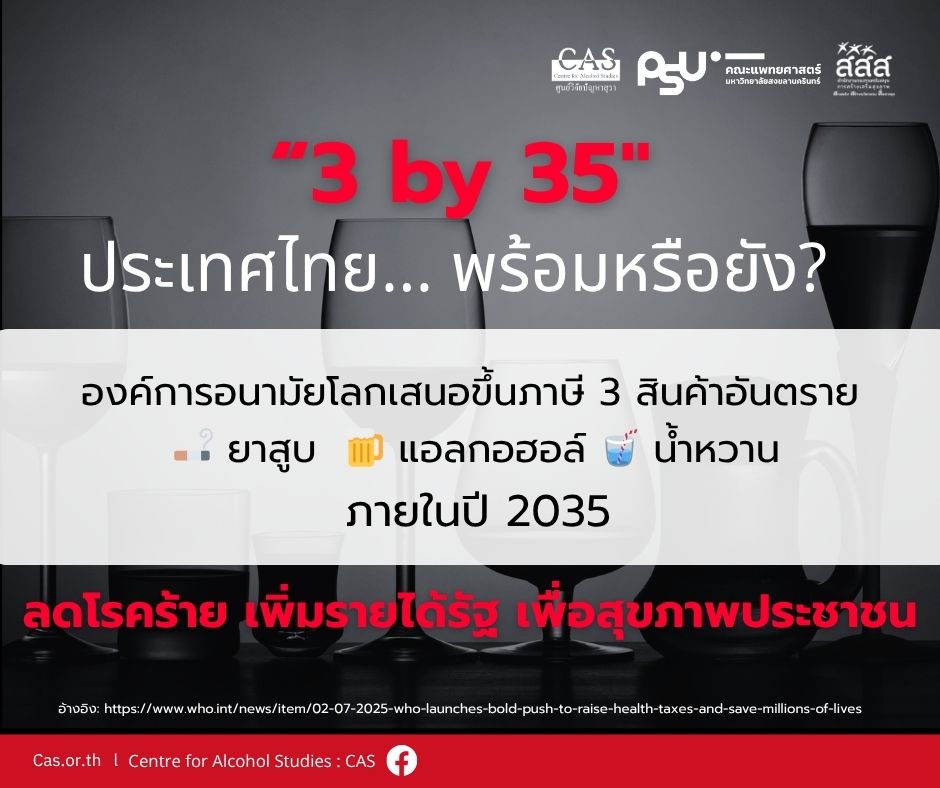
ล่าสุด! องค์การอนามัยโลก (WHO) ประกาศแผนเร่งด่วน “3 by 35” ขึ้นภาษี 3 สินค้าเสี่ยงภัยสุขภาพ ภายในปี 2035 เพื่อ “ช่วยชีวิตคนทั้งโลก”

3 เป้าหมายของ WHO คือ:

  1.  เพิ่มภาษี ยาสูบ
  2.  เพิ่มภาษี เครื่องดื่มแอลกอฮอล์
  3.  เพิ่มภาษี น้ำหวานและน้ำอัดลม


เพราะ 3 สิ่งนี้คือ “ฆาตกรเงียบ” ที่อยู่เบื้องหลังเบาหวาน มะเร็ง หัวใจ และอุบัติเหตุ

ประเทศไทยพร้อมหรือยัง?
วันนี้เรามีนักดื่มวัยรุ่นเพิ่มขึ้น
เด็กดื่มน้ำหวานทุกวัน
และบุหรี่ไฟฟ้าราคาถูกเกินไป

ถึงเวลาแล้วที่ไทยต้อง “เดินหน้าเก็บภาษีเพื่อสุขภาพ”
อย่างจริงจัง และ “นำรายได้คืนกลับสู่ระบบสุขภาพ”

มาร่วมส่งเสียงถึงนโยบายไทย
ให้ขยับตามข้อเสนอขององค์การอนามัยโลก
เพื่ออนาคตที่ปลอดเหล้า ปลอดบุหรี่ และปลอดโรค

อ้างอิง: https://www.who.int/.../02-07-2025-who-launches-bold-push...

ประเทศไทยในสายตา WHO: ต้นแบบการควบคุมปัญหาสุรา
https://cas.or.th/content?id=932

ประเทศไทยในสายตา WHO: ต้นแบบการควบคุมปัญหาสุรา

องค์การอนามัยโลก (WHO) ได้เผยแพร่รายงานปี 2025 ว่าด้วยกฎหมายและมาตรการควบคุมเครื่องดื่มแอลกอฮอล์ โดยยกประเทศไทยเป็นหนึ่งในตัวอย่างประเทศที่มีการดำเนินนโยบายเชิงรุกเพื่อควบคุมผลกระทบจากการบริโภคสุรา

ในรายงานดังกล่าว WHO ชี้ให้เห็นว่า ประเทศไทยมีมาตรการทางกฎหมายที่หลากหลายและมีความเข้มแข็ง เช่น การจำกัดเวลาและสถานที่จำหน่ายแอลกอฮอล์ ห้ามขายในสถานที่สาธารณะสำคัญ เช่น วัด โรงเรียน และสถานีบริการน้ำมัน รวมถึงการควบคุมการขายผ่านช่องทางที่ไม่เหมาะสม เช่น ตู้ขายอัตโนมัติและหาบเร่แผงลอย

นอกจากนี้ ระบบภาษีสรรพสามิตของไทยยังออกแบบให้ผสมผสานระหว่างปริมาณแอลกอฮอล์และราคาขาย เพื่อควบคุมการบริโภคอย่างมีประสิทธิภาพ ตัวอย่างเช่น เบียร์มีอัตราภาษีทั้งตามราคาขายปลีกและปริมาณแอลกอฮอล์บริสุทธิ์

การที่ WHO ยกตัวอย่างประเทศไทยในรายงานระดับโลก สะท้อนถึงความก้าวหน้าในการใช้ “กฎหมาย” เป็นเครื่องมือหลักในการลดอันตรายจากสุรา พร้อมยืนยันว่า การป้องกันเชิงระบบสามารถทำได้จริง หากมีเจตจำนงและการบังคับใช้ที่ชัดเจน

อ้างอิง: World Health Organization. Laws and regulations addressing the acceptability, availability and affordability of alcoholic beverages [Internet]. Geneva: World Health Organization; 2025 [cited 2025 May 21]. Available from: https://www.who.int/publications/i/item/9789240108301

ราคาของเครื่องดื่มแอลกอฮอล์กับมุมมองที่มากกว่าเศรษฐกิจ
https://cas.or.th/content?id=21

ราคาของเครื่องดื่มแอลกอฮอล์กับมุมมองที่มากกว่าเศรษฐกิจ

Sweetspot: จุดลงตัวระหว่างสุขภาพและเศรษฐกิจสำหรับสถานประกอบการที่จำหน่ายแอลกอฮอล์
https://cas.or.th/content?id=30

หลังการระบาดของโควิด-19 การจัดการการบริโภคแอลกอฮอล์กลายเป็นประเด็นที่ท้าทาย ส่วนหนึ่งเกิดจากปริมาณการขายเครื่องดื่มแอลกอฮอล์เพื่อการบริโภคนอกสถานที่ (off-trade) ที่เพิ่มขึ้น เช่น ร้านสะดวกซื้อ ซูเปอร์มาร์เก็ต หรือร้านขายสุรา รัฐบาลจึงต้องหาวิธีลดอันตรายที่เกิดจากการบริโภคแอลกอฮอล์ ในขณะเดียวกันก็ต้องคำนึงถึงการฟื้นตัวของสถานประกอบการที่ให้บริโภคเครื่องดื่มแอลกอฮอล์ในร้าน (on-trade) เช่น บาร์และร้านอาหาร

การเปลี่ยนแปลงดังกล่าวนำไปสู่งานวิจัยเพื่อค้นหาแนวทางที่เรียกว่า “sweetspot” หรือจุดสมดุลระหว่างสุขภาพและเศรษฐกิจ โดยมีเป้าหมายเพื่อลดอันตรายจากแอลกอฮอล์โดยไม่ส่งผลกระทบรุนแรงต่อธุรกิจสถานประกอบการ

แนวทางที่สองคือการควบคุมการขายเครื่องดื่มแอลกอฮอล์ออนไลน์ แม้ว่าปัจจุบันจะยังมีการศึกษาที่เกี่ยวข้องไม่มาก แต่ผู้เชี่ยวชาญเชื่อว่าการลดความสะดวกในการเข้าถึงเครื่องดื่มแอลกอฮอล์ผ่านบริการจัดส่ง เช่น การเพิ่มระยะเวลาการขนส่ง การจำกัดปริมาณการซื้อในแต่ละครั้ง และการใช้มาตรการห้ามส่งเสริมการขายหรือลดราคาสำหรับการซื้อในปริมาณมาก จะช่วยป้องกันการบริโภคที่เกินพอดี และลดจำนวนผู้ที่เปลี่ยนจากการดื่มในสถานประกอบการไปสู่การดื่มที่บ้าน ซึ่งอาจเพิ่มความเสี่ยงต่อสุขภาพและความรุนแรงในครอบครัว

นอกจากนี้ ผู้เชี่ยวชาญยังระบุว่ามาตรการดังกล่าวมีแนวโน้มที่จะช่วยดึงลูกค้ากลับมาใช้บริการในสถานที่ที่มีการควบคุมการดื่มแอลกอฮอล์อย่างเหมาะสม

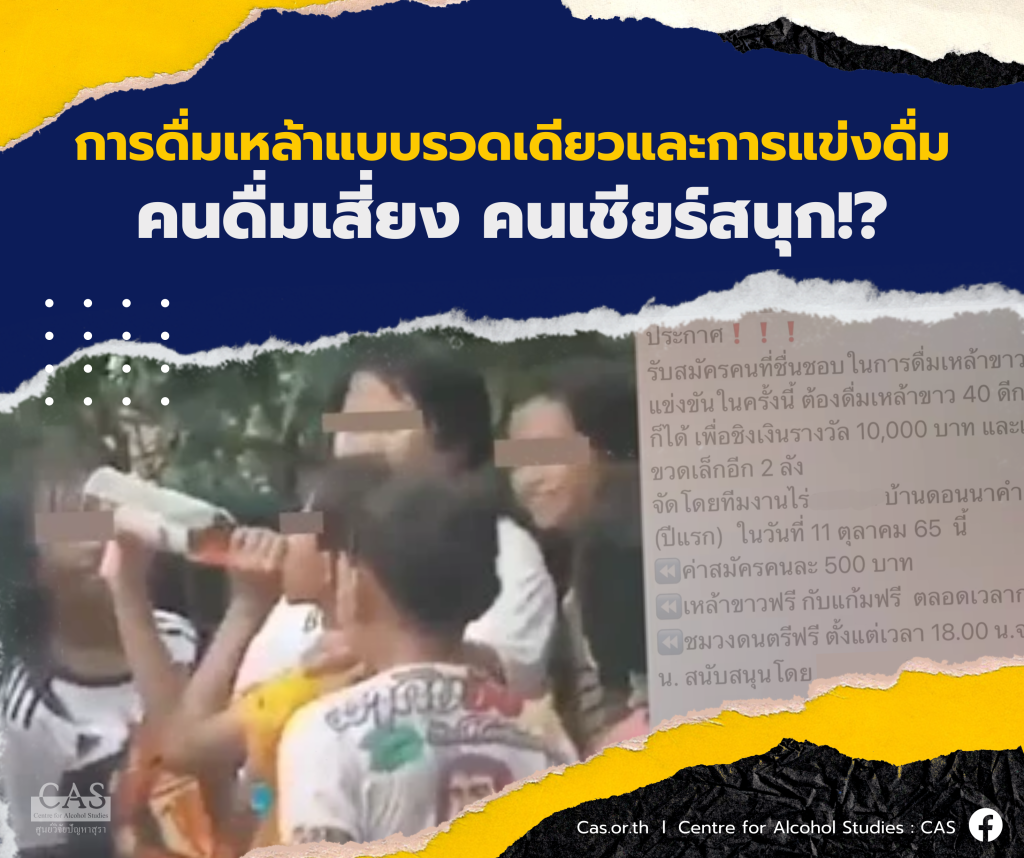
การดื่มเหล้าแบบรวดเดียวและการแข่งดื่ม คนดื่มเสี่ยง คนเชียร์สนุก?
https://cas.or.th/content?id=621

การดื่มเหล้าแบบรวดเดียวและการแข่งดื่ม คนดื่มเสี่ยง คนเชียร์สนุก⁉️

จากกระแสข่าวเด็กหญิงอายุ 13 ปี ถูกจ้างกระดกเหล้าเพียวๆ ในงานแห่นาค แลกกับเงิน 1 พันบาท น็อกเข้าไอซียู โดยญาติของน้องเล่าว่า เหตุการณ์เกิดจากกลุ่มชายวัยกลางคนหลายคนว่าจ้างและส่งเสียงเชียร์อย่างสนุกสนาน ให้เด็กหญิงวัย 13 ปีและเพื่อน ซึ่งเป็นเด็กชายวัย 13 ปีเช่นเดียวกัน ดื่มสุราเพียวๆ คนละครึ่งขวด หากดื่มหมดจะให้เงินค่าจ้าง 1,000 บาท จนเป็นเหตุให้เด็กหญิงเกิดอาการช็อก หมดสติ และถูกหามส่งโรงพยาบาลในเวลาต่อมา

อาการช็อกหมดสติที่เกิดขึ้นนั้น เกิดจากภาวะแอลกอฮอล์เป็นพิษ (alcohol intoxication) ต่อร่างกาย และปริมาณน้ำในร่างกายที่เพิ่มขึ้นมามากก็อาจส่งผลให้เกิดภาวะน้ำเป็นพิษ (water intoxication) ซึ่งส่งผลให้เกิดสมองบวมและระดับเกลือแร่ในเลือดเปลี่ยนแปลงอย่างรวดเร็ว เนื่องจากแอลกอฮอล์เป็นสารที่ออกฤทธิ์กดประสาทส่วนกลาง คล้ายยากดประสาท ซึ่งฤทธิ์นี้จะขึ้นโดยตรงกับปริมาณแอลกอฮอล์ที่ได้รับ ยกตัวอย่างเช่น การดื่มเหล้าหมดทีเดียว 1 ขวด จะทำให้แอลกอฮอล์ในกระแสเลือดเพิ่มสูงขึ้นได้ถึง 250 มิลลิกรัมเปอร์เซ็นต์ ในเวลาอันรวดเร็ว ทำให้เสี่ยงต่อการสำลัก อาเจียน หายใจไม่ออก หยุดหายใจ หมดสติ และอาจถึงขั้นเสียชีวิตจากการได้รับแอลกอฮอล์เกินขนาด ซึ่งโดยทั่วไป นักดื่มมักจะค่อยๆ ดื่ม จะเป็นการเปิดโอกาสให้ร่างกายได้ค่อยๆ ทำลาย และขับแอลกอฮอล์ออกจากกระแสเลือด ทำให้แอลกอฮอล์ไม่คั่งอยู่ในร่างกายของผู้ที่ดื่มมากนัก

แต่ในกรณีการดื่มแบบรวดเดียวในเวลาจำกัดนี้ อย่างกรณีของเด็กหญิงที่นอนอาการโคม่าอยู่นั้น จะมีลักษณะเหมือนเทแอลกอฮอล์พรวดเข้าไปในกระแสเลือดโดยไม่เว้นช่วงเวลาให้ร่างกายขับแอลกอฮอล์ออกมา กอปรกับน้องอายุเพียง 13 ปี นับเป็นเยาวชนที่องค์การอนามัยโลกจัดอยู่ในกลุ่มเปราะบางและแนะนำว่าไม่ควรดื่มเครื่องดื่มแอลกอฮอล์ แม้น้องจะดื่มเพียงครึ่งขวด แต่ส่งผลอันตรายจนทำให้น้องช็อกหมดสติ

จากพยานหลักฐาน พบว่า เหตุการณ์ในคลิปวีดีโอสอดคล้องกับคำบอกเล่าของพยาน โดยชายผู้ว่าจ้างเข้ามามอบตัวด้วยตนเอง และให้การภาคเสธ ยอมรับว่า อยู่ในขบวนแห่นาค จ่ายเงินให้เด็กหลังดื่มสุราจริง แต่ไม่ได้บังคับให้เด็กดื่มหมดขวด พนักงานสอบสวนแจ้งข้อหา บังคับขู่เข็ญ ชักจูง ส่งเสริม หรือยินยอมให้เด็กประพฤติตนไม่สมควร ว่าจ้างให้เด็กดื่มสุรา จนเป็นอันตรายต่อร่างกาย โทษจำคุกไม่เกิน 3 เดือน หรือ ปรับไม่เกิน 30,000 บาท หรือ ทั้งจำทั้งปรับ ตาม พ.ร.บ.คุ้มครองเด็ก พ.ศ. 2546 หมวด 2 มาตรา 26 (3) นอกจากนี้ พ.ร.บ. คุ้มครองเด็ก ครั้งแรก มีการห้ามขายเหล้าให้เด็กต่ำกว่า 18 ปี เพื่อมุ่งหวังที่จะรักษาผลประโยชน์ ปกป้อง สวัสดิภาพเด็ก และสร้างบรรทัดฐานในการคุ้มครองชีวิตของเด็ก

หากเป็นกรณีที่มีการเชิญชวนเข้าร่วมกิจกรรมแข่งกิน/ดื่มเบียร์หรือเหล้า และมีโปรโมชั่นจัดหนักจัดเต็มด้วยการโพสต์ผ่านทางโซเชียลมีเดียของร้านค้าหรือสถานประกอบการนั้น ถือว่าเข้าข่ายความผิด พ.ร.บ.ควบคุมเครื่องดื่มแอลกอฮอล์ พ.ศ. 2551 มาตรา 30 (3) ห้ามมิให้ผู้ใดขายเครื่องดื่มแอลกอฮอล์โดยวิธีการหรือในลักษณะการลดราคาเพื่อประโยชน์ในการส่งเสริมการขาย และ (4) ห้ามมิให้ผู้ใดขายเครื่องดื่มแอลกอฮอล์โดยวิธีการหรือในลักษณะการให้หรือเสนอให้สิทธิในการเข้าชมการแข่งขัน การแสดง การให้บริการ การชิงโชค การชิงรางวัล หรือสิทธิประโยชน์อื่นใดเป็นการตอบแทนแก่ผู้ซื้อเครื่องดื่มแอลกอฮอล์ หรือแก่ผู้นำหีบห่อหรือสลากหรือสิ่งอื่นใดเกี่ยวกับเครื่องดื่มแอลกอฮอล์มาแลกเปลี่ยนหรือแลกซื้อ ซึ่งนับเป็นการจูงใจสาธารณชนให้บริโภคเครื่องดื่มแอลกอฮอล์ และหากการเชิญชวนให้ดื่มนั้น ทำให้ลูกค้าได้รับอันตรายต่างๆ สามารถเอาผิดร้านค้าหรือสถานประกอบการในฐานะผู้ขายที่ควรต้องมีส่วนรับผิดชอบด้วยเช่นกัน เพราะผู้ขายอยู่ในข่ายของการก่อช่องภัยและอยู่ใกล้แก่เหตุจะเกิดความเสียหาย ซึ่งสามารถจะช่วยยับยั้งไม่ให้ปัญหาลุกลามไว้ได้แต่ต้น ข้อบังคับนี้มีเจตนาเพื่อให้ผู้เสียหายได้รับการชดเชยที่เป็นธรรม และเพื่อให้ผู้ขายมีการขายอย่างรับผิดชอบต่อสังคม ซึ่งโดยรวมแล้ว ก็เพื่อเป็นการรักษาสวัสดิภาพและความปลอดภัยในสังคมนั่นเอง

แหล่งที่มา:
https://www.pptvhd36.com/…/%E0%B8%AA%E0%B8%B1%E0…/225860
https://www.thairath.co.th/news/local/northeast/2792068
https://news.ch7.com/detail/733007

ศูนย์วิจัยปัญหาสุรา (ศวส.)

Centre for Alcohol Studies (CAS)

สาขาวิชาเวชศาสตร์ครอบครัวและเวชศาสตร์ป้องกัน อาคารศรีเวชวัฒน์ ชั้น 11 มหาวิทยาลัยสงขลานครินทร์ เลขที่ 15 ถนนกาญจนวนิช ตำบลคอหงส์ อำเภอหาดใหญ่ จังหวัดสงขลา 90110

083-5775533

https://www.facebook.com/cas.org.th

เข้าชมแล้ว 0 ครั้ง
Copyright © 2026 CAS All rights reserved.