คำค้นหา : ในประเทศ

คำค้นหา : ในประเทศ

คำนี้ค้นหามาแล้ว : 1928 ครั้ง
ปัจจัยเชิงพาณิชย์ที่กำหนดสุขภาพ: กรณีศึกษา อุตสาหกรรมเครื่องดื่มแอลกอฮอล์
https://cas.or.th/content?id=1147
Tags : -

ปัจจัยเชิงพาณิชย์ที่กำหนดสุขภาพ: กรณีศึกษา อุตสาหกรรมเครื่องดื่มแอลกอฮอล์
Commercial Determinants of Health: Alcohol Industry


ผู้เขียน: ศาสตราจารย์ ดร.นิทัศน์ ศิริโชติรัตน์
สถาบันส่งเสริมสุขภาพไทย มูลนิธิสาธารณสุขแห่งชาติ

องค์กรธุรกิจปกป้องผลประโยชน์และ ‘กำไร’ ด้วยกลยุทธ์ที่หลากหลาย

  • โน้มน้าว/ล้อบบี้ ผู้กำหนดนโยบาย
  • จัดตั้งองค์กรบังหน้า (front group)
  • การตลาด ‘ล่าเหยื่อ’
  • การให้ข้อมูลที่บิดเบือนเพื่อให้สังคมเข้าใจผิด

นิยามปัจจัยเชิงพาณิชย์ที่กำหนดสุขภาพ

ปัจจัยเชิงพาณิชย์ที่กำหนดสุขภาพ (Commercial Determinants of Health) หมายถึง ปัจจัยที่มีอิทธิพลทางลบต่อสุขภาพด้วยแรงจูงใจจาก “กำไร” ซึ่งหมายถึง พลังอำนาจเชิงธุรกิจที่มีอิทธิพลต่อการเมือง การเงิน เศรษฐกิจ สังคม และวัฒนธรรม ตลอดจนการค้าระหว่างประเทศ [1, 2] เหล่านี้เป็นปัจจัยคุกคามมหาศาล หากองค์กรธุรกิจนั้นผลิตสินค้าและผลิตภัณฑ์ที่ทำลายสุขภาพของผู้บริโภค

องค์กรธุรกิจปกป้องผลประโยชน์และ ‘กำไร’ ด้วยกลยุทธ์ที่หลากหลาย เช่น โน้มน้าว/ล้อบบี้ผู้กำหนดนโยบาย จัดตั้งองค์กรบังหน้า (front group) ใช้กลยุทธ์การตลาด ‘ล่าเหยื่อ’ เพื่อขับเคลื่อนอุปสงค์และอุปทานของสินค้าให้เพิ่มขึ้น [4]

กลยุทธ์ ‘ความรับผิดชอบต่อสังคม’ เป็นการสร้างภาพและรักษาภาพลักษณ์ที่ดีของอุตสาหกรรม ในขณะเดียวกัน เมื่อมีโอกาสอุตสาหกรรมจะใช้กลยุทธิ์นี้ในการ ‘เซาะกร่อน บ่อนทำลาย’ นโยบายสาธารณะเพื่อสุขภาพที่ ‘คุกคาม’ ผลประโยชน์เชิงพาณิชย์ [11]


กลยุทธ์อุตสาหกรรมเครื่องดื่มแอลกอฮอล์

อุตสาหกรรมเครื่องดื่มแอลกอฮอล์ เช่น บริษัทผู้ผลิต ใช้กลยุทธ์และวิธีการดังกล่าวข้างต้น ไม่แตกต่างกับกลยุทธ์ที่อุตสาหกรรมยาสูบใช้ [3] มีการให้ข้อมูลที่บิดเบือน เซาะกร่อนความจริง เพื่อให้สังคมเข้าใจผิดและบ่อนทำลายความน่าเชื่อถือทางวิชาการทางสาธารณสุข แม้ว่าข้อมูลเหล่านั้นดำเนินการโดยสถาบันวิจัยของมหาวิทยาลัยต่าง ๆ ทางด้านการสาธารณสุขและการแพทย์ชั้นนำก็ตาม

ที่ผ่านมา มีหลักฐานเชิงประจักษ์บ่งชี้ว่า อุตสาหกรรมแอลกอฮอล์ใช้วิธีการหลากหลายเพื่อบิดเบือนข้อเท็จจริงผลงานวิจัยเกี่ยวกับผลกระทบเชิงลบต่อสุขภาพของการดื่มแอลกอฮอล์ โดยปิดบัง ซ่อนเร้น บิดเบือน สร้างความสงสัยต่องานวิจัย และปฏิเสธข้อมูล

ข้อเท็จจริงทางสุขภาพที่ถูกอุตสาหกรรมบั่นทอน ได้แก่ ความเสี่ยงของการเกิดมะเร็งจากการดื่มเครื่องดื่มแอลกอฮอล์ [6]ความเสี่ยงของการดื่มของแม่ที่ตั้งครรภ์ต่อการเกิดกลุ่มความผิดปกติที่เกิดขึ้นกับทารกในครรภ์และอันตรายต่อทารก [7] ความสัมพันธ์ของการดื่มเครื่องดื่มแอลกอฮอล์ต่อการเกิดโรคระบบหลอดเลือดและหัวใจ [8, 9, 10]

ข้อมูลสถิติและการวิจัยทางวิทยาศาสตร์การแพทย์ บ่งชี้ชัดเจนว่า “เครื่องดื่มแอลกอฮอล์คือสารก่อมะเร็ง” แต่บริษัทเครื่องดื่มแอลกอฮอล์ข้ามชาติและรัฐบาลของประเทศที่เป็นผู้ส่งออกผลิตภัณฑ์เครื่องดื่มแอลกอฮอล์ ต่างพยายามปิดบัง อำพราง ซ่อนเร้น ไม่ให้สาธารณะและผู้บริโภคได้รับทราบถึงความสัมพันธ์ของการดื่มเครื่องดื่มแอลกอฮอล์และการเกิดโรคมะเร็ง [12, 13] รวมทั้ง การขัดขวางการออกมาตรการฉลากคำเตือนโรคมะเร็งบนบรรจุภัณฑ์เครื่องดื่มแอลกอฮอล์ ผ่านกลไกองค์การการค้าโลก (World Trade Organization) และระเบียบว่าด้วยอุปสรรคเชิงเทคนิคทางการค้า [14] นอกจากนี้ ยังมีการข่มขู่ว่าจะดำเนินคดีเพื่อขัดขวางงานวิจัยเกี่ยวกับประสิทธิผลของฉลากคำเตือนโรคมะเร็งบนบรรจุภัณฑ์เครื่องดื่มแอลกอฮอล์ของประเทศแคนาดา [15]

นอกจากนี้ อุตสาหกรรมเครื่องดื่มแอลกอฮอล์ยังพยายาม ‘สร้างภาพลักษณ์’ ด้วยกิจกรรมเพื่อสังคม อาทิ การบริจาคเงินเพื่อสาธารณประโยชน์ และสร้าง ‘วาทกรรม’ เพื่อโยนความรับผิดชอบไปยัง ปัจเจกบุคคล หรือโยนความผิดไปให้ผู้บริโภคว่าต้อง ‘ดื่มแบบรับผิดชอบ’ อีกด้วย [5]
 

กรณีศึกษาจากบทความวิชาการ วารสาร British Medical Journal (BMJ)

จากงานวิจัยการศึกษาอิทธิพลของอุตสาหกรรมแอลกอฮอล์ต่อนโยบายด้านสุขภาพ ที่ตีพิมพ์ในวารสาร British Medical Journal (BMJ) โดย Jim McCambridge และทีมวิจัยจาก London School of Hygiene and Tropical Medicine ที่เก็บข้อมูลโดยการสัมภาษณ์สมาชิกอาวุโสของอุตสาหกรรมเครื่องดื่มแอลกอฮอล์ พบว่า “อิทธิพลของอุตสาหกรรมเป็นไปอย่างแนบเนียนผ่านการล้อบบี้ และการสร้างสายสัมพันธ์ระยะยาวกับผู้กำหนดนโยบายคนสำคัญ” [16, 17]

อิทธิพลของอุตสาหกรรมเครื่องดื่มแอลกอฮอล์มีมหาศาล โดยผู้แทนจากอุตสาหกรรมเครื่องดื่มแอลกอฮอล์มักเข้าพบผู้บริหารในรัฐบาลหรือข้าราชการระดับสูงเป็นประจำ รวมถึงการร่วมประชุมกับรัฐมนตรี และที่ปรึกษาต่าง ๆ เป็นประจำ อาทิ กระทรวงการคลัง กระทรวงมหาดไทย สำนักนายกรัฐมนตรี กระทรวงสิ่งแวดล้อม กระทรวงการต่างประเทศ กระทรวงสาธารณสุข เป็นต้น

จากการศึกษา รายงานการประชุมพิจารณามาตรการราคาขายปลีกขั้นต่ำในประเทศสก็อตแลนด์ ในรายงานมีการชี้แจง หลักฐานเชิงประจักษ์จากกลุ่มแพทย์ผู้เชี่ยวชาญด้านโรคตับ ซึ่งมีน้ำหนักมากพอที่จะสนับสนุนการออกมาตรการราคาขายปลีกขั้นต่ำ แต่รองปลัดกระทรวงสาธารณสุข กลับสรุปว่า ความรับผิดชอบหลักในการลดปริมาณการดื่มเครื่องดื่มแอลกอฮอล์ อยู่ที่ตัวบุคคล” [16]

บทสรุป

พลังอำนาจทางธุรกิจของอุตสาหกรรมเครื่องดื่มแอลกอฮอล์มีอิทธิพลมหาศาล ทั้งด้านการเมือง การเงิน และการค้าระหว่างประเทศมีกรณีศึกษาอิทธิพลของอุตสาหกรรมเครื่องดื่มแอลกฮอล์ต่อการคัดค้านกฎหมายควบคุมเครื่องดื่มแอลกฮอล์ในหลายประเทศ เช่น การฟ้องร้องการออกกฎหมายราคาขายปลีกเครื่องดื่มแอลกอฮอล์ขั้นต่ำในสก็อตแลนด์ ในปี พ.ศ. 2555 ต่อศาลทั้งในสก็อตแลนด์ สหราชอาณาจักร และสหภาพยุโรป โดยอุตสาหกรรมเครื่องดื่มแอลกอฮอล์ นำโดยสมาคมสก็อตวิสกี้ ที่ทำให้มีการชะลอการออกฎหมายไปถึง 6 ปี

การปกป้องสุขภาพประชาชนจากปัจจัยเชิงพาณิชย์ที่กำหนดสุขภาพของอุตสาหกรรมเครื่องดื่มแอลกฮอล์ ต้องอาศัยความร่วมมือและบูรณาการระหว่างภาคประชาสังคม ภาควิชาการ และเครือข่ายระดับภูมิภาค/โลก จึงจะสามารถยืนหยัดเพื่อตอบโต้กับอิทธิพลเหล่านั้นได้ สถาบันวิชาการทางการแพทย์และการสาธารณสุข และภาคประชาสังคม ควรจะต้องสื่อสารเชิงรุกกับผู้กำหนดนโยบายทุกระดับ เกี่ยวกับปัจจัยเชิงพาณิชย์ที่กำหนดสุขภาพและผลกระทบต่อสุขภาพจากเครื่องดื่มแอลกอฮอล์ที่นำไปสู่อุปสรรคสำคัญสำหรับเป้าหมายของการพัฒนาอย่างยั่งยืน โดยเฉพาะสมาชิกสภาผู้แทนราษฎรและวุฒิสภาซึ่งมีอำนาจหน้าที่ในการพิจารณากฎหมายของประเทศ

เอกสารอ้างอิง:

  1. Kickbusch I, Allen L, Franz C, 2016. The Commercial Determinants of Health. Comment. Lancet Global Health 2016; 4 (12): e895-6. Available at: https://www.thelancet.com/action/showPdf?pii=S2214-109X%2816%2930217-0, https://doi.org/10.1016/S2214-109X(16)30217-0
  2. Maani N, Petticrew M, and Galea S, 2022. The Commercial Determinants of Health. Oxford University Press. ISBN-13: 978-0197578759
  3. Doyle A, 2025. Commercial determinants of health: the case of the alcohol industry. Drugnet Ireland, Issue 91, Spring 2025, pp.23-25. Available at: https://www.drugsandalcohol.ie/43352/
  4. Mialon M, 2020. An overview of the commercial determinants of health. Global Health 2020; 16: 74.
  5. Marten R, Amul GGH, Casswell S., 2020. Alcohol: global health’s blind spot. Lancet Glob Health 2020; 8: e329–30.
  6. Petticrew M, Maani N, Knai C, Weiderpass E, 2018. How alcohol industry organisations mislead the public about alcohol and cancer. Drug Alcohol Rev, 2018 Mar; 37(3): 293-303. doi: 10.1111/dar.12596. Epub 2017 Sep 7.
  7. Lim AWY, van Schalkwyk MCI, Maani N, Petticrew M, 2019.Pregnancy, fertility, breastfeeding, and alcohol consumption: an analysis of framing and completeness of information disseminated by alcohol industry-funded organizations. J Stud Alcohol Drugs, 2019 Sep; 80(5): 524-533. doi: 10.15288/jsad.2019.80.524.
  8. Peake L, van Schalkwyk MCI, Maani N, et al., 2021. Analysis of the accuracy and completeness of cardiovascular health information on alcohol industry-funded websites. Eur J Public Health, 2021 Dec 1; 31(6): 1197-1204. doi: 10.1093/eurpub/ckab135.
  9. Mitchell G, Lesch M, and McCambridge J, 2020. Alcohol industry involvement in the moderate alcohol and cardiovascular health trial. Am J Public Health, 2020 Apr; 110(4): 485-488. doi: 10.2105/AJPH.2019.305508. Epub 2020 Feb 20.
  10. Krittanawong C, Isath A, Rosenson RS, Khawaja M, Wang Z, Fogg SE, Virani SS, Qi L, Cao Y, Long MT, Tangney CC, Lavie CJ, 2022. Alcohol Consumption and Cardiovascular Health. Am J Med, 2022 Oct; 135(10): 1213-1230.e3. doi: 10.1016/j.amjmed.2022.04.021. Epub 2022 May 14.
  11. Marks JH 2019. The perils of partnership: industry influence, institutional integrity, and public health.Oxford: Oxford University Press.doi: 10.1093/oso/9780190907082.001.0001ISBN: 9780190907082; 9780190907112
  12. Madden M, McCambridge J, 2021. Alcohol marketing versus public health: David and Goliath? Global Health. 2021; 17(1): 45.
  13. Bates S, Holmes J, Gavens L, de Matos EG, Li J, Ward B, Hooper L, Dixon S, Buykx P, 2018. Awareness of alcohol as a risk factor for cancer is associated with public support for alcohol policies. BMC Public Health. 2018; 18(1): 688.
  14. O’Brien P, Stockwell T, Vallance K, Room R, 2021. WHO should not support alcohol Industry co-regulation of public health labelling.Addiction. 2021; 116(7): 1619-1621.
  15. Stockwell, T, Solomon R, O’Brien P, Vallance K, Hobin E, 2020. Cancer warning labels on alcohol containers: A consumer’s right to know, a government’s responsibility to inform, and industry’s power to thwart. J Stud Alcohol Drugs. 2020; 81(2): 284-292.
  16. Gornall J, 2014. Under the influence. BMJ 2014; 348: f7646 doi: https://doi.org/10.1136/bmj.f7646 (Published 08 January 2014)
  17. Hawkins B, Holden C, 2012. “Water dripping on Stone?” Industry lobbying and UK alcohol policy. Policy Press.


Commercial Determinants of Health: Alcohol Industry

Author: Professor Dr. Nithat Sirichotiratana 
Institute for Thai Health Promotion, National Health Foundation

Business Organizations Protect Their Interests and “Profits” Through Various Strategies

  • Influencing/lobbying policymakers
  • Establishing front groups
  • Predatory marketing
  • Providing distorted information to mislead the public

Definition of Commercial Determinants of Health

Commercial Determinants of Health (CDOH) refer to factors that negatively influence health, driven by the motivation to generate “profit.” These include the power of businesses to influence politics, finance, the economy, society, and culture, as well as international trade [1, 2]. These factors pose a significant threat when businesses produce goods and products that are harmful to consumers’ health.

Business organizations protect their interests and “profits” through various strategies, such as influencing or lobbying policymakers, establishing front groups, and employing “predatory” marketing strategies to drive demand for and supply of their products [4].

Corporate “social responsibility” strategies are used to create and maintain a positive image of the industry. At the same time, when opportunities arise, industries may use such strategies to “erode and undermine” public health policies that threaten their commercial interests [11].

Strategies of the Alcohol Industry

The alcohol industry, including manufacturers and producers, employs strategies and practices similar to those used by the tobacco industry [3]. These include providing misleading information, undermining scientific evidence, and eroding public understanding in ways that undermine the credibility of public health research, even when such research is conducted by leading university research institutions in the fields of public health and medicine.

There is substantial empirical evidence indicating that the alcohol industry has used various tactics to distort scientific evidence concerning the negative health effects of alcohol consumption. These tactics include concealing, suppressing, distorting, creating doubt about, and denying research findings.

Health-related facts that have been undermined by the industry include the risk of cancer associated with alcohol consumption [6], the risks of maternal alcohol consumption during pregnancy and its association with fetal abnormalities and harm to infants [7], and the relationship between alcohol consumption and cardiovascular disease [8, 9, 10].

Statistical data and medical scientific research clearly indicate that “alcohol is a carcinogen.” However, multinational alcohol companies and governments of countries that export alcoholic beverages have attempted to conceal, obscure, and withhold information from the public and consumers regarding the relationship between alcohol consumption and cancer [12, 13]. They have also opposed the introduction of cancer warning labels on alcoholic beverage packaging through mechanisms of the World Trade Organization (WTO) and the Agreement on Technical Barriers to Trade (TBT Agreement) [14]. In addition, there have been threats of legal action aimed at obstructing research on the effectiveness of cancer warning labels on alcoholic beverage packaging in Canada [15].

Furthermore, the alcohol industry seeks to build a positive public image through social activities, such as charitable donations and other philanthropic initiatives. It also constructs narratives that shift responsibility onto individuals, blaming consumers by promoting the notion that they should “drink responsibly” [5].

Case Study from an Academic Article Published in the British Medical Journal (BMJ)

A study examining the influence of the alcohol industry on health policy, published in the British Medical Journal (BMJ) by Jim McCambridge and a research team from the London School of Hygiene & Tropical Medicine, collected data through interviews with senior members of the alcohol industry. The study found that “industry influence operates subtly through lobbying and the development of long-term relationships with key policymakers” [16, 17].

The influence of the alcohol industry is substantial. Representatives of the alcohol industry frequently meet with senior government officials and high-ranking civil servants, as well as ministers and their advisers. Such interactions involve various ministries and government agencies, including the Ministry of Finance, Ministry of Interior, Office of the Prime Minister, Ministry of Environment, Ministry of Foreign Affairs, and Ministry of Public Health.

A review of the meeting records concerning the consideration of minimum retail pricing measures in Scotland found that the records included evidence presented by specialist physicians in liver disease. This evidence was sufficiently strong to support the introduction of minimum retail pricing. However, the Deputy Director-General of the Ministry of Public Health concluded that the primary responsibility for reducing alcohol consumption rested with individuals [16].

Conclusion

The business power of the alcohol industry has substantial influence over politics, finance, and international trade. There are numerous documented cases of the alcohol industry influencing and opposing alcohol control legislation in various countries. One example is the legal challenge to minimum unit pricing legislation for alcoholic beverages in Scotland in 2012, brought by the Scotch Whisky Association before courts in Scotland, the United Kingdom, and the European Union. The actions of the alcohol industry contributed to delaying the implementation of the legislation for as long as six years.

Protecting public health from the commercial determinants of health created by the alcohol industry requires collaboration and integration among civil society, academia, and regional and global networks in order to effectively counter such influence. Academic institutions in medicine and public health, together with civil society organizations, should proactively communicate with policymakers at all levels about the commercial determinants of health and the health impacts of alcohol. These factors represent significant barriers to achieving the Sustainable Development Goals (SDGs), particularly for members of the House of Representatives and the Senate, who have the authority and responsibility to consider and enact national legislation.

References:

  1. Kickbusch I, Allen L, Franz C, 2016. The Commercial Determinants of Health. Comment. Lancet Global Health 2016; 4 (12): e895-6. Available at: https://www.thelancet.com/action/showPdf?pii=S2214-109X%2816%2930217-0, https://doi.org/10.1016/S2214-109X(16)30217-0
  2. Maani N, Petticrew M, and Galea S, 2022. The Commercial Determinants of Health. Oxford University Press. ISBN-13: 978-0197578759
  3. Doyle A, 2025. Commercial determinants of health: the case of the alcohol industry. Drugnet Ireland, Issue 91, Spring 2025, pp.23-25. Available at: https://www.drugsandalcohol.ie/43352/
  4. Mialon M, 2020. An overview of the commercial determinants of health. Global Health 2020; 16: 74.
  5. Marten R, Amul GGH, Casswell S., 2020. Alcohol: global health’s blind spot. Lancet Glob Health 2020; 8: e329–30.
  6. Petticrew M, Maani N, Knai C, Weiderpass E, 2018. How alcohol industry organisations mislead the public about alcohol and cancer. Drug Alcohol Rev, 2018 Mar; 37(3): 293-303. doi: 10.1111/dar.12596. Epub 2017 Sep 7.
  7. Lim AWY, van Schalkwyk MCI, Maani N, Petticrew M, 2019.Pregnancy, fertility, breastfeeding, and alcohol consumption: an analysis of framing and completeness of information disseminated by alcohol industry-funded organizations. J Stud Alcohol Drugs, 2019 Sep; 80(5): 524-533. doi: 10.15288/jsad.2019.80.524.
  8. Peake L, van Schalkwyk MCI, Maani N, et al., 2021. Analysis of the accuracy and completeness of cardiovascular health information on alcohol industry-funded websites. Eur J Public Health, 2021 Dec 1; 31(6): 1197-1204. doi: 10.1093/eurpub/ckab135.
  9. Mitchell G, Lesch M, and McCambridge J, 2020. Alcohol industry involvement in the moderate alcohol and cardiovascular health trial. Am J Public Health, 2020 Apr; 110(4): 485-488. doi: 10.2105/AJPH.2019.305508. Epub 2020 Feb 20.
  10. Krittanawong C, Isath A, Rosenson RS, Khawaja M, Wang Z, Fogg SE, Virani SS, Qi L, Cao Y, Long MT, Tangney CC, Lavie CJ, 2022. Alcohol Consumption and Cardiovascular Health. Am J Med, 2022 Oct; 135(10): 1213-1230.e3. doi: 10.1016/j.amjmed.2022.04.021. Epub 2022 May 14.
  11. Marks JH 2019. The perils of partnership: industry influence, institutional integrity, and public health.Oxford: Oxford University Press.doi: 10.1093/oso/9780190907082.001.0001ISBN: 9780190907082; 9780190907112
  12. Madden M, McCambridge J, 2021. Alcohol marketing versus public health: David and Goliath? Global Health. 2021; 17(1): 45.
  13. Bates S, Holmes J, Gavens L, de Matos EG, Li J, Ward B, Hooper L, Dixon S, Buykx P, 2018. Awareness of alcohol as a risk factor for cancer is associated with public support for alcohol policies. BMC Public Health. 2018; 18(1): 688.
  14. O’Brien P, Stockwell T, Vallance K, Room R, 2021. WHO should not support alcohol Industry co-regulation of public health labelling.Addiction. 2021; 116(7): 1619-1621.
  15. Stockwell, T, Solomon R, O’Brien P, Vallance K, Hobin E, 2020. Cancer warning labels on alcohol containers: A consumer’s right to know, a government’s responsibility to inform, and industry’s power to thwart. J Stud Alcohol Drugs. 2020; 81(2): 284-292.
  16. Gornall J, 2014. Under the influence. BMJ 2014; 348: f7646 doi: https://doi.org/10.1136/bmj.f7646 (Published 08 January 2014)
  17. Hawkins B, Holden C, 2012. “Water dripping on Stone?” Industry lobbying and UK alcohol policy. Policy Press.
ผลการทบทวนวรรณกรรม เรื่อง นโยบายจำกัดระดับแอลกอฮอล์ในเลือดระดับต่ำ กลไก ผลกระทบ และการบังคับใช้ในต่างประเทศและประเทศไทย
https://cas.or.th/content?id=1146
Tags : -

ศูนย์วิจัยปัญหาสุรา (ศวส.) เผยผลการทบทวนวรรณกรรมเกี่ยวกับนโยบายจำกัดระดับแอลกอฮอล์ในเลือดระดับต่ำ พบหลักฐานจากต่างประเทศชี้ว่า การลดเกณฑ์ BAC สามารถสัมพันธ์กับการลดพฤติกรรมดื่มแล้วขับ อุบัติเหตุ และการบาดเจ็บ แต่ประสิทธิผลของนโยบายไม่ได้ขึ้นอยู่กับ “ตัวเลข BAC” เพียงอย่างเดียว หากขึ้นอยู่กับความเข้มแข็งของการบังคับใช้กฎหมาย เทคโนโลยี ระบบข้อมูล การฟื้นฟูผู้กระทำผิด และการสื่อสารสาธารณะที่ดำเนินการอย่างต่อเนื่อง

24 ประเทศใช้เกณฑ์ BAC ≤ 0.02 g/dL หรือ Zero Tolerance

ผลการทบทวนวรรณกรรมอย่างเป็นระบบครอบคลุมการศึกษา 39 เรื่อง จาก 5 ภูมิภาคทั่วโลก โดยพิจารณา 3 มิติสำคัญ ได้แก่ กลไกและการดำเนินนโยบาย BAC ระดับต่ำในต่างประเทศ ผลกระทบเชิงประจักษ์ของการลดเกณฑ์ BAC ต่ำกว่า 0.05 g/dL และ Zero Tolerance รวมถึงบริบทกฎหมายและระบบบังคับใช้ของประเทศไทย งานวิจัยส่วนใหญ่อยู่ในระดับความเสี่ยงปานกลางตามการประเมินด้วย ROBINS-I และไม่พบการศึกษาที่มีความเสี่ยงวิกฤต

การทบทวนพบว่า มี 24 ประเทศ ที่กำหนด BAC สำหรับผู้ขับขี่ทั่วไปที่ระดับไม่เกิน 0.02 g/dL หรือใช้แนวทาง Zero Tolerance โดยแบ่งเป็นประเทศที่ใช้เกณฑ์ BAC 0.02 g/dL จำนวน 10 ประเทศ เช่น นอร์เวย์ สวีเดน โปแลนด์ เอสโตเนีย โปรตุเกส และจีน และประเทศที่ใช้ Zero Tolerance หรือ BAC 0.00 g/dL จำนวน 14 ประเทศ สะท้อนแนวโน้มของนโยบายเชิงป้องกันที่เข้มงวดขึ้นเพื่อมุ่งลดการบาดเจ็บและการเสียชีวิตจากอุบัติเหตุทางถนน

หลักฐานต่างประเทศชี้ “ลด BAC” มีผล แต่บริบทการบังคับใช้สำคัญ

หลักฐานที่ทบทวนชี้ว่า การลดเกณฑ์ BAC จากระดับเดิมลงสู่ 0.03 หรือ 0.02 g/dL สามารถสัมพันธ์กับการลดพฤติกรรมดื่มแล้วขับ อุบัติเหตุ และการบาดเจ็บ ขณะที่ Zero Tolerance ให้ผลแตกต่างกันไปตามบริบท โดยความเข้มแข็งของระบบบังคับใช้ถือเป็นองค์ประกอบสำคัญของความสำเร็จ

ตัวอย่างเช่น ชิลี หลังลดเกณฑ์ BAC เหลือ 0.03 g/dL พบการบาดเจ็บลดลง 31–36% และอุบัติเหตุลดลง 32% ทันที ขณะที่ ไต้หวัน หลังลดเกณฑ์เหลือ 0.03 g/dL พบการเสียชีวิตและการบาดเจ็บลดลง 18% ในเวลากลางคืน ส่วน นอร์เวย์ ภายใต้เกณฑ์ BAC 0.02 g/dL พบสัดส่วนผู้ขับขี่ที่งดดื่มแอลกอฮอล์เด็ดขาดก่อนขับเพิ่มขึ้นจาก 82% เป็น 91% ซึ่งสะท้อนการเปลี่ยนแปลงบรรทัดฐานไปสู่แนวคิด “ดื่มแล้วไม่ขับ” และ จีน พบว่าสัดส่วนผู้เสียชีวิตที่เกี่ยวข้องกับแอลกอฮอล์ลดลง 7% ภายใต้เกณฑ์ BAC 0.02 g/dL

สำหรับ Zero Tolerance หรือ BAC 0.00 g/dL ผลลัพธ์ในประชากรทั่วไปมีความหลากหลายตามบริบทและความเข้มข้นของการบังคับใช้ ตัวอย่างเช่น บราซิล เมื่อใช้นโยบาย Zero Tolerance ควบคู่กับการบังคับใช้อย่างเข้มงวด พบว่าสามารถป้องกันการเข้ารักษาในโรงพยาบาลได้ถึง 440,599 ครั้ง ขณะที่ อุรุกวัย หลังใช้ BAC 0.00 g/dL พบอุบัติเหตุรุนแรงถึงชีวิตลดลง 21% ในช่วง 12 เดือนแรก

ไม่ใช่แค่ “ลดตัวเลข” แต่ต้องสร้างระบบบังคับใช้ให้พร้อม

การกำหนด BAC ระดับต่ำทำงานผ่านหลายกลไกร่วมกัน ทั้งการสร้างบรรทัดฐานใหม่เพื่อลด “พื้นที่สีเทา” ในการตัดสินใจและส่งสัญญาณว่า “ดื่มแล้วไม่ขับ” การเพิ่มความแน่นอนในการถูกตรวจจับผ่านการสุ่มตรวจลมหายใจหรือ Random Breath Testing (RBT) การใช้บทลงโทษแบบขั้นบันไดที่ได้สัดส่วนกับระดับ BAC และประวัติการกระทำผิด ตลอดจนการใช้เทคโนโลยี เช่น Alcohol Interlock ควบคู่กับโปรแกรมปรับเปลี่ยนพฤติกรรมและการฟื้นฟูผู้กระทำผิดซ้ำ

ดังนั้น การลดเกณฑ์เพียงอย่างเดียวจึงมีข้อจำกัด โดยเฉพาะต่อกลุ่มผู้ดื่มหนักและผู้กระทำผิดซ้ำ ซึ่งจำเป็นต้องมีมาตรการเสริมและการบังคับใช้อย่างจริงจัง เอกสารสรุปว่า ประสิทธิผลสูงสุดเกิดขึ้นเมื่อการกำหนด BAC ดำเนินควบคู่กับ การบังคับใช้กฎหมาย เทคโนโลยี การฟื้นฟู การสื่อสารสาธารณะ และระบบสนับสนุนอื่นอย่างเป็นระบบและต่อเนื่อง

ประเทศไทยยังมี “5 ช่องว่าง” ของระบบบังคับใช้

ปัจจุบันประเทศไทยกำหนดเกณฑ์ BAC แตกต่างกันตามกลุ่มผู้ขับขี่ โดยผู้ขับขี่ทั่วไปอยู่ที่ 0.05 g/dL ขณะที่กลุ่มเฉพาะ 4 กลุ่ม ได้แก่ ผู้มีอายุต่ำกว่า 20 ปี ผู้ใช้ใบอนุญาตขับขี่ชั่วคราว ผู้ใช้ใบอนุญาตผิดประเภท และผู้ไม่มีหรือถูกพักใช้ใบอนุญาต อยู่ที่ 0.02 g/dL ส่วนรถสาธารณะ/รถพาณิชย์กำหนดที่ 0.00 g/dL ตามข้อมูลที่รายงานในเอกสาร

อย่างไรก็ตาม การทบทวนพบช่องว่างเชิงระบบของการบังคับใช้กฎหมาย BAC ในประเทศไทย 5 ประการ ได้แก่ (1) การตรวจไม่ครอบคลุม โดยมักเข้มข้นในช่วงเทศกาล (2) ผลตรวจล่าช้าในคดีรุนแรง ซึ่งอาจทำให้ค่าที่ตรวจได้คลาดเคลื่อนจากระดับขณะขับขี่ (3) ฐานข้อมูลผู้กระทำผิดซ้ำไม่เชื่อมโยง (4) บทลงโทษไม่ผูกกับระดับ BAC ทำให้ผู้มีความเสี่ยงสูงอาจได้รับโทษใกล้เคียงกับผู้ที่เกินเกณฑ์เพียงเล็กน้อย และ (5) การสื่อสารไม่ต่อเนื่อง ซึ่งอาจทำให้ประชาชนมองว่าการบังคับใช้มุ่งจับผิดเพื่อค่าปรับมากกว่าการสร้างความปลอดภัย

จาก “การลดตัวเลข BAC” สู่ “การสร้างระบบที่พร้อม”

ผลการศึกษาจึงเสนอให้ประเทศไทยพิจารณาความพร้อมของระบบควบคู่ไปกับการตัดสินใจเรื่องเกณฑ์ BAC โดยมีทางเลือกเชิงนโยบายตั้งแต่การคงเกณฑ์ 0.05 g/dL แต่เพิ่มความเข้มงวดในการบังคับใช้ การลดเหลือ 0.02 g/dL ทันทีทุกกลุ่ม การปรับลดแบบเป็นระยะ (Phased-in) ไปจนถึงการควบคุมเข้มเฉพาะกลุ่มหรือพื้นที่เสี่ยง ทั้งนี้ เอกสารเตือนว่า หากระบบยังไม่มีความพร้อม การประกาศลดเกณฑ์ทันทีอาจเพิ่มภาระต่อระบบศาลและโรงพยาบาลมากกว่าการสร้างผลลัพธ์ด้านความปลอดภัย

ข้อเสนอเชิงนโยบายสู่การปฏิบัติประกอบด้วย การสุ่มตรวจตลอดปี (RBT) ให้เป็นมาตรการประจำวัน ไม่ใช่เฉพาะเทศกาล การจัดทำแนวปฏิบัติกลาง (SOP) และมาตรฐานเดียวในการตรวจ BAC ในกรณีอุบัติเหตุรุนแรง การกำหนดบทลงโทษแบบขั้นบันไดให้สอดคล้องกับปริมาณแอลกอฮอล์และประวัติคดี การพัฒนาฐานข้อมูลบูรณาการเชื่อมโยงตำรวจ–ศาล–ขนส่ง–คุมประพฤติ–สาธารณสุข การใช้มาตรการฟื้นฟูและบำบัดรักษาควบคู่กับการลงโทษสำหรับผู้กระทำผิดซ้ำ และการประเมินความพร้อมของระบบก่อนประกาศใช้เกณฑ์ 0.02 g/dL ทั่วประเทศ

ท้ายที่สุด เป้าหมายของนโยบายไม่ควรหยุดอยู่ที่การถกเถียงว่า “ตัวเลข BAC ควรเป็นเท่าไร” แต่ควรมุ่งไปสู่การสร้างระบบที่ทำให้มาตรการเกิดผลจริง ทั้งการตรวจจับที่ครอบคลุม การบังคับใช้ที่แน่นอนและเป็นธรรม ระบบข้อมูลที่เชื่อมโยง และการป้องกันการกระทำผิดซ้ำ เพื่อบรรลุเป้าหมายปลายทาง คือ “ลดอุบัติเหตุ การบาดเจ็บ และการเสียชีวิตจากการดื่มแล้วขับ”

อ้างอิง: พลเทพ วิจิตรคุณากร, อัจฉรา ประจงจีบ, และชฎาบุญ เจียรธนกฤติ. (2569). รายงานการศึกษาและทบทวนวรรณกรรมอย่างเป็นระบบ เรื่อง กลไกและผลกระทบการดำเนินนโยบายจำกัดปริมาณแอลกอฮอล์ในเลือดระดับต่ำในต่างประเทศ และสถานการณ์การบังคับใช้กฎหมายของประเทศไทย. ศูนย์วิจัยปัญหาสุรา มหาวิทยาลัยสงขลานครินทร์.

รายงานวิจัย การศึกษา ผลกระทบ และการเปลี่ยนแปลงหลังจากการเปลี่ยน กฎหมายเกี่ยวกับสุราพื้นบ้าน/ชุมชนต่อพลวัตการผลิต การจําหน่ายและการบริโภคสุราในประเทศไทย: กรณีศึกษาเชิงพื้นที่แบบพหุภูมิภาค
https://cas.or.th/content?id=1126
Tags : -

การศึกษา ผลกระทบและการเปลี่ยนแปลงหลังจากการเปลี่ยนกฎหมายเกี่ยวกับสุราพื้นบ้าน/ชุมชนต่อพลวัตการผลิต การจำหน่าย และการบริโภคสุราในประเทศไทย: กรณีศึกษาเชิงพื้นที่แบบพหุภูมิภาค

งานวิจัยนี้ศึกษาผลกระทบและการเปลี่ยนแปลงที่เกิดขึ้นภายหลังการปรับปรุงกฎหมายการผลิตสุราพื้นบ้าน/ชุมชน พ.ศ. 2565 โดยสำรวจสถานการณ์การผลิต การจำหน่าย และการบริโภคสุราในพื้นที่ 4 ภูมิภาคของประเทศไทย รวมถึงผลกระทบทางเศรษฐกิจ สังคม และการดำเนินนโยบายในระดับพื้นที่ ผลการศึกษาชี้ให้เห็นว่ากฎหมายใหม่ช่วยลดข้อจำกัดในการเข้าสู่ระบบของผู้ผลิตรายย่อยและเปิดโอกาสทางเศรษฐกิจแก่ชุมชนมากขึ้น แต่ยังคงมีความท้าทายด้านมาตรฐานการผลิต กระบวนการอนุญาต การบังคับใช้กฎหมาย และการควบคุมคุณภาพผลิตภัณฑ์สุรา งานวิจัยนี้นำเสนอข้อเสนอเชิงนโยบายเพื่อสร้างสมดุลระหว่างการส่งเสริมเศรษฐกิจฐานรากกับการคุ้มครองสุขภาพและความปลอดภัยของประชาชนอย่างยั่งยืน


A Study of the Impacts and Changes Following the Reform of Traditional/Community Liquor Laws on the Dynamics of Alcohol Production, Distribution, and Consumption in Thailand: A Multi-Regional Case Study

This research examines the impacts and changes following the reform of Thailand’s community liquor production regulations in 2022. The study investigates alcohol production, distribution, and consumption across four regions of Thailand, as well as the economic, social, and policy implications of the legal changes at the local level. Findings indicate that the revised law has reduced barriers for small-scale producers and created new economic opportunities for communities. However, challenges remain regarding production standards, licensing procedures, law enforcement, public understanding, and product quality control. The study provides policy recommendations aimed at balancing grassroots economic development with the protection of public health and consumer safety in a sustainable manner.

รายงานวิจัย การพัฒนาเครื่องมือช่วยในการถามปริมาณการดื่ม
https://cas.or.th/content?id=1118
Tags : -

รายงานวิจัย
การพัฒนาเครื่องมือช่วยในการถามปริมาณการดื่ม “THAI Drinking Survey Guide v.9”
(Development of the THAI Drinking Survey Guide v.9 for Alcohol Consumption Assessment)

รายงานวิจัยฉบับนี้มุ่งพัฒนาเครื่องมือช่วยในการประเมินและสอบถามปริมาณการดื่มเครื่องดื่มแอลกอฮอล์ของประชากรไทย โดยสำรวจข้อมูลประเภทเครื่องดื่ม ตรายี่ห้อ ปริมาตร และความเข้มข้นของแอลกอฮอล์ที่วางจำหน่ายในประเทศไทย เพื่อนำมาปรับปรุง “THAI Drinking Survey Guide v.9” ให้มีความทันสมัยและสอดคล้องกับรูปแบบผลิตภัณฑ์ในตลาดปัจจุบัน เพื่อเพิ่มความแม่นยำในการสำรวจพฤติกรรมการดื่มของคนไทย


Research Report
Development of the THAI Drinking Survey Guide v.9 for Alcohol Consumption Assessment

This research report focuses on developing and updating the THAI Drinking Survey Guide v.9, a tool designed to improve the assessment of alcohol consumption among Thai populations. The study surveyed alcoholic beverage types, brands, volumes, and alcohol content available in Thailand to create an up-to-date reference guide that enhances the accuracy and reliability of alcohol consumption surveys.

รายงานวิจัย การวิเคราะห์สารปนเปื้อนสุราพื้นบ้าน/ชุมชน ในประเทศไทย: กรณีศึกษาเชิงพื้นที่แบบพหุภูมิภาค
https://cas.or.th/content?id=1127
Tags : -

การวิเคราะห์สารปนเปื้อนสุราพื้นบ้าน/ชุมชนในประเทศไทย: กรณีศึกษาเชิงพื้นที่แบบพหุภูมิภาค

งานวิจัยนี้ศึกษาคุณภาพและความปลอดภัยของสุราพื้นบ้านและสุราชุมชนในประเทศไทย โดยตรวจวิเคราะห์สารสำคัญและสารปนเปื้อนในตัวอย่างสุราจาก 4 ภูมิภาค จำนวน 20 ตัวอย่าง ครอบคลุมสุรากลั่น เบียร์ ไวน์ และสาโท การศึกษามุ่งประเมินความสอดคล้องกับมาตรฐานคุณภาพของกรมสรรพสามิต รวมถึงการปนเปื้อนของสารที่อาจเป็นอันตรายต่อสุขภาพ เช่น เมทานอล แอลดีไฮด์ เอทิลคาร์บาเมต และโลหะหนัก ผลการศึกษาช่วยสะท้อนสถานการณ์คุณภาพผลิตภัณฑ์สุราชุมชนในปัจจุบัน และเสนอแนวทางพัฒนามาตรฐานการผลิตเพื่อยกระดับความปลอดภัยของผู้บริโภคและความยั่งยืนของอุตสาหกรรมสุราชุมชนไทย


Analysis of Contaminants in Traditional and Community Alcoholic Beverages in Thailand: A Multi-Regional Case Study

This study investigates the quality and safety of traditional and community-produced alcoholic beverages in Thailand through laboratory analysis of key compounds and contaminants. Twenty alcohol samples collected from four regions of the country, including distilled spirits, beer, wine, and rice wine, were examined and compared against standards established by the Excise Department. The research assessed the presence of potentially harmful substances such as methanol, aldehydes, ethyl carbamate, and heavy metals. The findings provide important evidence on the current quality and safety status of community-produced alcoholic beverages and offer recommendations for improving production standards, consumer safety, and the sustainable development of Thailand’s community alcohol industry.

รายงานวิจัย โครงการสํารวจผลกระทบจากการบริโภคเครื่องดื่มแอลกอฮอล์ต่อบุคคลรอบข้าง (ภัยเหล้ามือสอง) : กรณีศึกษาประชาชนอายุ 15 ปีขึ้นไป ใน 12 จังหวัดทั่วทุกภูมิภาคของประเทศ
https://cas.or.th/content?id=1125
Tags : -

โครงการสำรวจผลกระทบจากการบริโภคเครื่องดื่มแอลกอฮอล์ต่อบุคคลรอบข้าง (ภัยเหล้ามือสอง): กรณีศึกษาประชาชนอายุ 15 ปีขึ้นไปใน 12 จังหวัดทั่วทุกภูมิภาคของประเทศ

งานวิจัยนี้ศึกษาผลกระทบจากการดื่มเครื่องดื่มแอลกอฮอล์ที่เกิดขึ้นกับบุคคลรอบข้าง หรือ “ภัยเหล้ามือสอง” ในประชาชนไทยอายุ 15 ปีขึ้นไป จำนวน 3,927 คน จาก 12 จังหวัดทั่วประเทศ โดยสำรวจทั้งผลกระทบที่เกิดขึ้นในครอบครัว ชุมชน สถานที่ทำงาน และต่อเด็ก รวมถึงการได้รับผลกระทบจากผู้ดื่มหนักและคนแปลกหน้าที่ดื่มแอลกอฮอล์ ผลการศึกษาเป็นข้อมูลสำคัญที่สะท้อนภาระทางสังคมและสุขภาพจากการดื่มของผู้อื่น เพื่อนำไปสู่การพัฒนานโยบายและมาตรการควบคุมเครื่องดื่มแอลกอฮอล์ที่มีประสิทธิภาพยิ่งขึ้นในประเทศไทย


Survey of Alcohol’s Harm to Others (AHTO): A Study of People Aged 15 Years and Older in 12 Provinces Across Thailand

This study examined the impacts of alcohol consumption on people other than the drinkers themselves, commonly referred to as “Alcohol’s Harm to Others (AHTO)” or secondhand alcohol harm. The survey included 3,927 respondents aged 15 years and older from 12 provinces across Thailand. It explored the effects of others’ drinking on families, communities, workplaces, and children, as well as harms associated with heavy drinkers and intoxicated strangers. The findings provide important evidence on the social and health burdens caused by alcohol use and can support the development of more effective alcohol control policies and public health interventions in Thailand.

รายงานวิจัย การศึกษาแนวโน้ม กลยุทธ์และวาทกรรมในการสื่อสาร การตลาดออนไลน์ของเครื่องดื่มแอลกอฮอล์
https://cas.or.th/content?id=1122
Tags : -

การศึกษาแนวโน้ม กลยุทธ์ และวาทกรรมในการสื่อสารการตลาดออนไลน์ของเครื่องดื่มแอลกอฮอล์


งานวิจัยนี้ศึกษารูปแบบ แนวโน้ม กลยุทธ์ และวาทกรรมที่ใช้ในการสื่อสารการตลาดออนไลน์ของเครื่องดื่มแอลกอฮอล์ในประเทศไทย โดยวิเคราะห์ข้อมูลจากสื่อสังคมออนไลน์และแพลตฟอร์มดิจิทัลต่าง ๆ เพื่อทำความเข้าใจวิธีการสร้างการรับรู้แบรนด์ การใช้ผู้มีอิทธิพลทางออนไลน์ (Influencers) การสื่อสารเชิงสัญลักษณ์ และการใช้ภาษาเพื่อส่งเสริมการบริโภคเครื่องดื่มแอลกอฮอล์ ผลการศึกษาช่วยสะท้อนพลวัตของการตลาดดิจิทัลและสนับสนุนการพัฒนานโยบายและมาตรการกำกับดูแลการสื่อสารการตลาดเครื่องดื่มแอลกอฮอล์ในยุคดิจิทัล


A Study of Trends, Strategies, and Discourses of Alcohol Online Marketing Communication


This research investigates the trends, strategies, and discourses used in online marketing communication for alcoholic beverages in Thailand. The study analyzes content from social media and digital platforms to understand how alcohol brands build awareness, utilize influencers, employ symbolic communication, and use language to shape consumer perceptions and behaviors. The findings provide insights into the evolving dynamics of digital alcohol marketing and contribute to the development of effective policies and regulatory measures for alcohol marketing communication in the digital age.

รายงานวิจัย การทำความเข้าใจประสบการณ์การบริโภคเครื่องดื่มผสมแอลกอฮอล์ในผู้ใหญ่ตอนต้น ในประเทศไทยจากมุมมองจิตวิทยาการเมือง
https://cas.or.th/content?id=1105

งานวิจัยเรื่อง “การทำความเข้าใจประสบการณ์การบริโภคเครื่องดื่มแอลกอฮอล์ในผู้ใหญ่ตอนต้น ในประเทศไทยจากมุมมองจิตวิทยาการเมือง” ศึกษาประสบการณ์การดื่มของผู้ใหญ่ตอนต้นผ่านมุมมองด้านจิตวิทยาการเมือง เพื่อทำความเข้าใจความสัมพันธ์ระหว่างการดื่ม อำนาจของรัฐ นโยบายควบคุมเครื่องดื่มแอลกอฮอล์ และภาวะความอยู่ดีมีสุขของผู้ดื่ม ผลการศึกษาช่วยสะท้อนมิติทางสังคมและจิตวิทยาที่เกี่ยวข้องกับการดื่ม และสนับสนุนการพัฒนานโยบายและมาตรการควบคุมเครื่องดื่มแอลกอฮอล์ที่มีความละเอียดอ่อนและสอดคล้องกับบริบทของสังคมไทยมากยิ่งขึ้น


The study “Understanding Alcohol Consumption Experiences among Young Adults in Thailand from a psychopolitical perspective explores the drinking experiences of young adults through a psychopolitical perspective. It examines the relationships between alcohol consumption, state power, alcohol control policies, and the well-being of drinkers. The findings provide insights into the social and psychological dimensions of drinking and contribute to the development of more context-sensitive and effective alcohol control policies and interventions in Thailand.

รายงานวิจัย การใช้ระบบปัญญาประดิษฐ์ในการเฝ้าระวังรูปแบบแนวโน้มการตลาดเครื่องดื่มแอลกอฮอล์บนอินเทอร์เน็ต
https://cas.or.th/content?id=1101

งานวิจัยเรื่อง “การใช้ระบบปัญญาประดิษฐ์ในการเฝ้าระวังรูปแบบแนวโน้มการตลาดเครื่องดื่มแอลกอฮอล์บนอินเทอร์เน็ต” มุ่งพัฒนาระบบเฝ้าระวังการตลาดเครื่องดื่มแอลกอฮอล์บนสื่อออนไลน์และสื่อสังคมออนไลน์ โดยประยุกต์ใช้เทคโนโลยีปัญญาประดิษฐ์ (AI) เพื่อรวบรวม วิเคราะห์ และติดตามรูปแบบ กลยุทธ์ และแนวโน้มการโฆษณาและการสื่อสารการตลาดของอุตสาหกรรมเครื่องดื่มแอลกอฮอล์ ช่วยเพิ่มประสิทธิภาพการเฝ้าระวัง สนับสนุนการบังคับใช้กฎหมาย และเป็นฐานข้อมูลสำหรับการกำหนดนโยบายควบคุมเครื่องดื่มแอลกอฮอล์ในประเทศไทย


The study “Application of Artificial Intelligence for Monitoring Alcohol Marketing Patterns and Trends” aims to develop an AI-based surveillance system for monitoring alcohol marketing activities across online and social media platforms. The system is designed to collect, analyze, and track marketing strategies, advertising practices, and emerging trends used by the alcohol industry. The findings support more effective monitoring, strengthen regulatory enforcement, and provide evidence for alcohol control policy development in Thailand.

ข้อเท็จจริงและตัวเลขเครื่องดื่มแอลกอฮอล์ในประเทศไทย พ.ศ. 2565–2568: ภายใต้การเปลี่ยนแปลงนโยบายควบคุมเครื่องดื่มแอลกอฮอล์
https://cas.or.th/content?id=1099

ข้อเท็จจริงและตัวเลขเครื่องดื่มแอลกอฮอล์ในประเทศไทย พ.ศ. 2565–2568: ภายใต้การเปลี่ยนแปลงนโยบายควบคุมเครื่องดื่มแอลกอฮอล์ เป็นหนังสือที่รวบรวม วิเคราะห์ และนำเสนอข้อมูลสถานการณ์ล่าสุดเกี่ยวกับเครื่องดื่มแอลกอฮอล์ในประเทศไทย ในช่วงปี พ.ศ. 2565–2568 ซึ่งเป็นช่วงเวลาที่เกิดการเปลี่ยนแปลงสำคัญทั้งด้านนโยบาย กฎหมาย เศรษฐกิจ และสังคมที่เกี่ยวข้องกับเครื่องดื่มแอลกอฮอล์

บรรณาธิการ

  • ศ.ดร.พญ.สาวิตรี อัษณางค์กรชัย
  • รศ.ดร.นพ.พลเทพ วิจิตรคุณากร
  • ชฎาบุญ เจียรธนกฤติ

วัตถุประสงค์ของหนังสือ

หนังสือเล่มนี้จัดทำขึ้นเพื่อรวบรวม วิเคราะห์ และนำเสนอข้อมูลสถานการณ์เครื่องดื่มแอลกอฮอล์ของประเทศไทยในช่วงที่มีการเปลี่ยนแปลงเชิงนโยบายและบริบททางสังคมอย่างสำคัญ โดยครอบคลุมทั้งพฤติกรรมการบริโภค ผลกระทบด้านสุขภาพและเศรษฐกิจ การตลาดและวาทกรรมทางสังคม ตลอดจนการเปลี่ยนแปลงด้านกฎหมายและมาตรการควบคุมเครื่องดื่มแอลกอฮอล์ เพื่อเป็นแหล่งข้อมูลอ้างอิงสำหรับนักวิชาการ ผู้กำหนดนโยบาย หน่วยงานภาครัฐ ภาคเอกชน และภาคประชาสังคม รวมถึงสนับสนุนการกำหนดนโยบายและมาตรการที่มีประสิทธิภาพในการลดผลกระทบจากแอลกอฮอล์อย่างยั่งยืน

เนื้อหาภายในหนังสือ

หนังสือประกอบด้วย 6 บทหลัก ได้แก่

  1. พฤติกรรมการบริโภคเครื่องดื่มแอลกอฮอล์: สถานการณ์ปัจจุบันและแนวโน้มการเปลี่ยนแปลง
    • ปริมาณการบริโภคต่อหัว
    • ความชุกของนักดื่ม
    • พฤติกรรมการดื่มในวัยรุ่น
    • การบริโภคเครื่องดื่มแอลกอฮอล์นอกระบบภาษี
  2. ผลกระทบของการบริโภคเครื่องดื่มแอลกอฮอล์
    • ภาวะผิดปกติจากการดื่มสุรา
    • การเข้ารับการรักษาในโรงพยาบาล
    • ภาระโรคและการเสียชีวิต
    • ผลกระทบจากการดื่มของผู้อื่น (ภัยเหล้ามือสอง)
  3. อุตสาหกรรมและตลาดเครื่องดื่มแอลกอฮอล์: สถานการณ์ระดับโลกและในประเทศไทย
    • สถานการณ์ตลาดโลกและประเทศไทย
    • แนวโน้มอุตสาหกรรม
    • การตลาดออนไลน์
    • การปรับตัวของผู้ผลิตรายใหญ่และรายย่อย
  4. พลวัตของนโยบายแอลกอฮอล์ในประเทศไทย
    • ความเคลื่อนไหวด้านนโยบาย พ.ศ. 2565–2568
    • กฎหมายและระเบียบใหม่ที่เกี่ยวข้องกับการควบคุมเครื่องดื่มแอลกอฮอล์
  5. ผลของนโยบายควบคุมเครื่องดื่มแอลกอฮอล์ในประเทศไทย
    • ประสิทธิผลของมาตรการควบคุม
    • ผลกระทบทางเศรษฐกิจ สุขภาพ และสังคม
    • การเปลี่ยนแปลงโครงสร้างภาษี
    • การผ่อนปรนข้อจำกัดด้านการขายและการผลิตสุรา
  6. ความคิดเห็นและความรอบรู้ของประชาชนไทยต่อสถานการณ์และนโยบายเครื่องดื่มแอลกอฮอล์
    • ความคิดเห็นต่อนโยบายภาครัฐ
    • ความรู้ความเข้าใจเกี่ยวกับผลกระทบของแอลกอฮอล์
    • วาทกรรมทางสังคมเกี่ยวกับนโยบายแอลกอฮอล์


Facts and Figures on Alcohol in Thailand 2022–2025: Amidst the Evolution of Alcohol Control Policies provides a comprehensive overview of alcohol-related situations in Thailand during 2022–2025, a period marked by significant changes in alcohol policies, legislation, economic conditions, and social contexts. The book compiles and analyzes the latest evidence to support informed policy discussions and public health decision-making.

Editors

  • Prof. Dr. Sawitri Assanangkornchai
  • Assoc. Dr. Prof. Polathep Vichitkunakorn
  • Chadaboon Jiaratanakrit

Objectives

The book was developed to compile, analyze, and present up-to-date information on alcohol consumption, alcohol-related harms, market dynamics, social discourse, and policy developments in Thailand. It aims to serve as a key reference for researchers, policymakers, government agencies, civil society organizations, and other stakeholders working to prevent and reduce alcohol-related harm through evidence-based policies and interventions.

Contents

The publication is organized into six main chapters:

  1. Alcohol Consumption Patterns: Current Situation and Trends
    • Per capita alcohol consumption
    • Prevalence of alcohol use
    • Youth drinking behaviors
    • Unrecorded alcohol consumption
  2. Impacts of Alcohol Consumption
    • Alcohol use disorders
    • Hospital admissions
    • Alcohol-attributable diseases and deaths
    • Harm to others from drinking
  3. Alcohol Industry and Market Trends
    • Global and Thai alcohol markets
    • Industry developments
    • Online alcohol marketing
    • Adaptation strategies of major and small-scale producers
  4. Dynamics of Alcohol Policy in Thailand
    • Policy developments during 2022–2025
    • New alcohol-related laws and regulations
  5. Effects of Alcohol Control Policies
    • Policy effectiveness
    • Economic, health, and social impacts
    • Excise tax reforms
    • Regulatory changes related to alcohol sales and production
  6. Public Opinions and Alcohol Literacy in Thailand
    • Public attitudes toward alcohol policies
    • Knowledge and awareness of alcohol-related harms
    • Social discourse surrounding alcohol control policies

This book serves as an important evidence-based resource for understanding the evolving alcohol landscape in Thailand and the challenges of balancing economic interests with public health priorities.

Conference Proceedings การประชุมวิชาการสุราระดับภูมิภาค ภาคกลาง
https://cas.or.th/content?id=1098
Tags : -

เอกสาร Conference Proceedings การประชุมวิชาการสุราระดับภูมิภาค ภาคกลาง จัดทำขึ้นเพื่อรวบรวมสาระสำคัญจากการประชุมภายใต้หัวข้อ “สมดุลแห่งอนาคต: พระราชบัญญัติควบคุมเครื่องดื่มแอลกอฮอล์ต่อการท่องเที่ยวที่ปลอดภัยและการขับเคลื่อนเศรษฐกิจสุขภาพ” ซึ่งมุ่งสร้างพื้นที่แลกเปลี่ยนองค์ความรู้ ข้อมูลเชิงประจักษ์ และข้อเสนอเชิงนโยบายเกี่ยวกับการควบคุมเครื่องดื่มแอลกอฮอล์ ภายใต้บริบทการบังคับใช้พระราชบัญญัติควบคุมเครื่องดื่มแอลกอฮอล์ (ฉบับที่ 2) พ.ศ. 2568

สาระสำคัญของการประชุมสะท้อนแนวคิด “สมดุลแห่งอนาคต” ที่มุ่งสร้างความสมดุลระหว่างการคุ้มครองสุขภาพและความปลอดภัยของประชาชน กับการส่งเสริมเศรษฐกิจ การท่องเที่ยว และการพัฒนาชุมชนอย่างยั่งยืน โดยเน้นว่าการควบคุมเครื่องดื่มแอลกอฮอล์มิใช่การจำกัดโอกาสทางเศรษฐกิจ แต่เป็นการสร้างเงื่อนไขให้การเติบโตเกิดขึ้นบนพื้นฐานของความรับผิดชอบ ความปลอดภัย และคุณภาพชีวิตที่ดี

การประชุมได้เน้นบทบาทสำคัญของ คณะกรรมการควบคุมเครื่องดื่มแอลกอฮอล์ระดับจังหวัดและกรุงเทพมหานคร ซึ่งเป็นกลไกใหม่ภายใต้กฎหมายฉบับล่าสุดในการขับเคลื่อนนโยบายสู่การปฏิบัติในพื้นที่ โดยให้ความสำคัญกับการออกแบบมาตรการที่สอดคล้องกับบริบทเฉพาะของแต่ละพื้นที่ ทั้งเมืองท่องเที่ยว ย่านเศรษฐกิจกลางคืน พื้นที่อุตสาหกรรม และพื้นที่ใกล้สถานศึกษา

อีกประเด็นสำคัญคือการขับเคลื่อนนโยบายด้วยข้อมูลและหลักฐานเชิงประจักษ์ (Data-Driven Policy) ผ่านการนำเสนอกรณีศึกษาจากหลายจังหวัด ซึ่งแสดงให้เห็นว่าการใช้ข้อมูลสถานการณ์จริงสามารถนำไปสู่การพัฒนามาตรการ การบังคับใช้กฎหมาย และการสร้างความร่วมมือระหว่างภาครัฐ ภาคประชาสังคม และชุมชนได้อย่างเป็นรูปธรรม

นอกจากนี้ การประชุมยังให้ความสำคัญกับการป้องกันเด็ก เยาวชน และกลุ่มเปราะบางจากผลกระทบของเครื่องดื่มแอลกอฮอล์ โดยนำเสนอผลงานวิจัยและแนวปฏิบัติที่เป็นเลิศเกี่ยวกับการลดการเข้าถึงเครื่องดื่มแอลกอฮอล์ การป้องกันนักดื่มหน้าใหม่ การสร้างพื้นที่สร้างสรรค์ปลอดแอลกอฮอล์ และการใช้ทุนทางสังคมและวัฒนธรรมของชุมชนเป็นเครื่องมือในการลดปัจจัยเสี่ยง

โดยสรุป การประชุมครั้งนี้ได้เสนอทิศทางสำคัญของการควบคุมเครื่องดื่มแอลกอฮอล์ในประเทศไทยภายใต้กฎหมายฉบับใหม่ ผ่านการบูรณาการองค์ความรู้ทางวิชาการ ข้อมูลเชิงประจักษ์ และประสบการณ์จากการดำเนินงานในพื้นที่ เพื่อสนับสนุนการพัฒนานโยบายและมาตรการที่สามารถคุ้มครองสุขภาพประชาชน ลดผลกระทบทางสังคม เสริมสร้างความปลอดภัยของชุมชน และสนับสนุนการเติบโตของเศรษฐกิจสุขภาพและการท่องเที่ยวอย่างสมดุลและยั่งยืนในระยะยาว

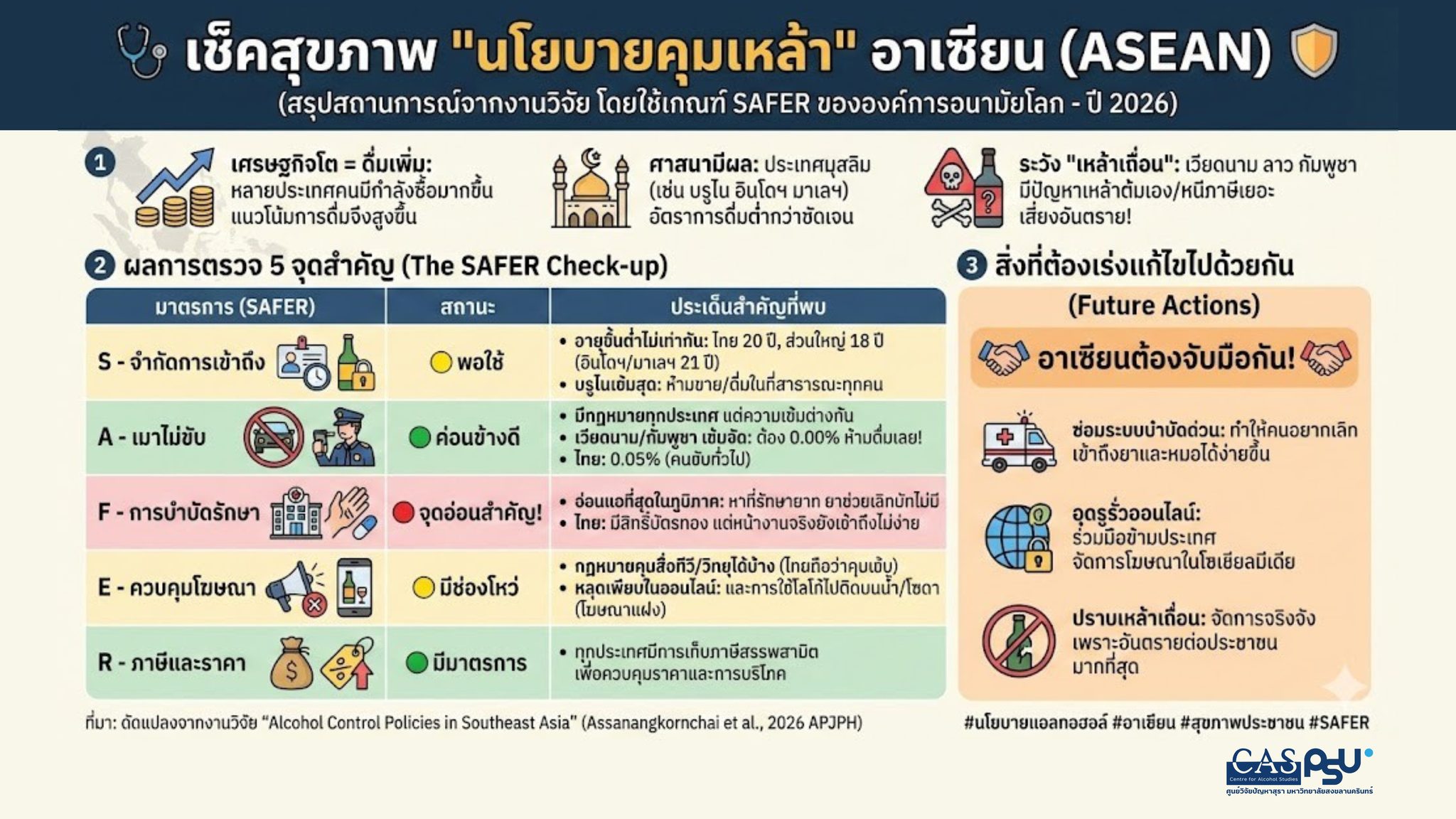
จับเข่าคุย: "ตรวจสุขภาพ" นโยบายคุมเหล้าอาเซียน ปี 2026 เราแข็งแรงแค่ไหน?
https://cas.or.th/content?id=1073
Tags : -

งานวิจัยล่าสุดจากศูนย์วิจัยปัญหาสุรา (ศวส.) จับเข่าคุย: "ตรวจสุขภาพ" นโยบายคุมเหล้าอาเซียน ปี 2026 เราแข็งแรงแค่ไหน?

ทีมวิจัยนำโดย ศ.ดร.พญ.สาวิตรี อัษณางค์กรชัย และคณะ ได้ทำการสำรวจนโยบายควบคุมเครื่องดื่มแอลกอฮอล์ใน 10 ประเทศอาเซียน โดยใช้เกณฑ์มาตรฐานโลก "SAFER" ขององค์การอนามัยโลก

ภาพรวม: เศรษฐกิจโต คนมีกำลังซื้อ ก็ดื่มกันมากขึ้น แต่สิ่งที่น่าห่วงคือ "เหล้านอกระบบ" (เหล้าเถื่อน/หนีภาษี) ในเพื่อนบ้านบางประเทศที่สูงน่าตกใจ

3 ประเด็นสำคัญที่ค้นพบ:

  1. กฎหมายมี แต่การบังคับใช้ต่างกัน: ทุกประเทศมีกฎหมายเรื่องอายุขั้นต่ำ (ส่วนใหญ่ 18 ปี, ไทย 20 ปี) และกฎหมายเมาไม่ขับ แต่ความเข้มข้นและการบังคับใช้ยังแตกต่างกันในแต่ละพื้นที่
  2. "ออนไลน์" คือช่องโหว่ใหญ่: มาตรการควบคุมโฆษณาในสื่อหลักทำได้ดีระดับหนึ่ง แต่ในแพลตฟอร์มออนไลน์และการตลาดข้ามพรมแดนยังเป็นความท้าทายใหญ่ที่ทุกประเทศเจอเหมือนกัน
  3. "ระบบบำบัด" คือจุดอ่อนที่สุดของภูมิภาค: นี่คือข้อค้นพบที่น่ากังวลที่สุด บริการช่วยเลิกบุหรี่และยาสำหรับผู้ติดสุรายังเข้าถึงยากและไม่เพียงพอในเกือบทุกประเทศ รวมถึงไทย

ทิศทางในอนาคต: งานวิจัยชี้ว่า ลำพังมาตรการในประเทศอาจไม่เพียงพอ จำเป็นต้องมีความร่วมมือระดับภูมิภาคอาเซียนเพื่อจัดการปัญหาโฆษณาข้ามชาติ และเร่งพัฒนาระบบบริการสุขภาพเพื่อรองรับผู้ต้องการเลิกดื่มอย่างจริงจัง

ผลการตรวจ SAFER Check-up:

  • จุดแข็ง: เรื่องกฎหมาย "เมาไม่ขับ" และ "ภาษี" ทุกประเทศมีมาตรการชัดเจน (บางประเทศเข้มกว่าไทยคือต้อง 0.00% เลยทีเดียว!)
  • จุดที่ต้องระวัง: "การควบคุมโฆษณา" แม้สื่อหลักจะคุมได้ แต่ในโลกออนไลน์และโฆษณาแฝงยังรั่วไหลเยอะมาก
  • จุดอ่อนสำคัญที่สุด: "ระบบบำบัดรักษา (F-Facilitate)" คือจุดที่อ่อนแอที่สุดในภูมิภาค คนอยากเลิกเหล้ายังเข้าถึงความช่วยเหลือและยาได้ยาก

บทสรุป: เรามีกฎหมายที่ดีหลายข้อ แต่การจะสู้กับปัญหานี้ได้จริง อาเซียนต้องจับมือกัน โดยเฉพาะการอุดรูรั่วในโลกออนไลน์ และที่เร่งด่วนคือการพัฒนาระบบช่วยเหลือผู้ที่ต้องการเลิกดื่มให้เข้าถึงง่ายขึ้นครับ

อ่านเพิ่มเติม: https://doi.org/10.1177/10105395251414918


ศูนย์วิจัยปัญหาสุรา (ศวส.)

Centre for Alcohol Studies (CAS)

สาขาวิชาเวชศาสตร์ครอบครัวและเวชศาสตร์ป้องกัน อาคารศรีเวชวัฒน์ ชั้น 11 มหาวิทยาลัยสงขลานครินทร์ เลขที่ 15 ถนนกาญจนวนิช ตำบลคอหงส์ อำเภอหาดใหญ่ จังหวัดสงขลา 90110

083-5775533

https://www.facebook.com/cas.org.th

เข้าชมแล้ว 0 ครั้ง
Copyright © 2026 CAS All rights reserved.